Pentagon Plans Historic Livestreamed Firing Squad Execution of Fort Hood Mass Killer, Sparking Legal and Human Rights Controversy

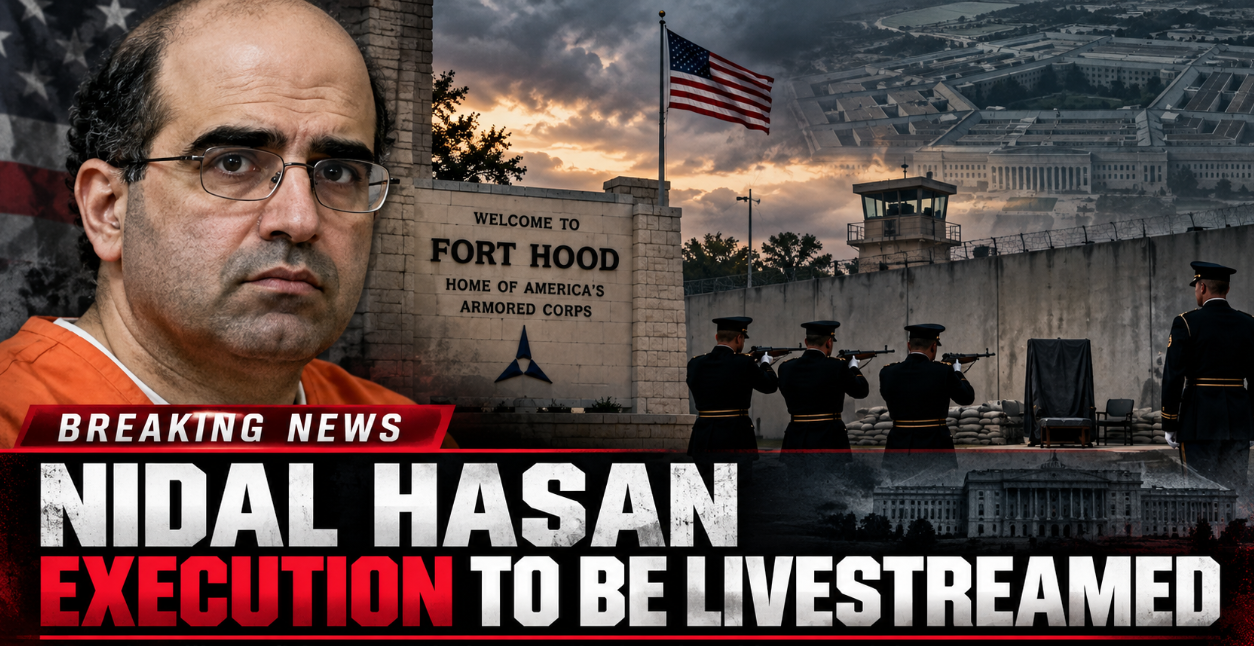
WASHINGTON, October 9, 2026 – The United States is preparing for an unprecedented military execution after Defense Secretary Pete Hegseth announced that the firing squad execution of former Army Major Nidal Malik Hasan, convicted of killing 13 people at Fort Hood, Texas, in 2009, would be broadcast live for public viewing.
The execution is scheduled for December 3 at 1 p.m. Central Time at Fort Hood, the same military installation where Hasan carried out one of the deadliest shootings in American military history. A Pentagon official confirmed the livestreaming plan, which would mark an extraordinary departure from the country’s longstanding practice of restricting access to executions.
President Donald Trump approved Hasan’s death sentence on October 2, following recommendations from military leadership. The Army formally announced the execution arrangements on October 7, ending years of military appellate review that included the Supreme Court’s refusal to hear Hasan’s case in March 2025.
Hegseth defended the decision to make the execution publicly accessible, arguing that Americans should witness the consequences of exceptionally serious crimes. He said Hasan would face a firing squad composed of soldiers and emphasized the administration’s determination to proceed with the punishment.
The announcement immediately triggered controversy among legal scholars, human rights advocates and political leaders. Critics argue that broadcasting a prisoner’s death risks transforming a solemn judicial punishment into a public spectacle, potentially violating human dignity and established standards governing executions.
The United Nations human rights office has raised concerns that livestreaming an execution could amount to a prohibited public execution under international human rights standards. Democratic Senator Chris Murphy also condemned the proposal, comparing the public display of state-sanctioned killing to practices associated with extremist organizations.
Families of the Fort Hood victims and survivors have expressed differing views. Former Army Sergeant Alonzo Lunsford, who survived seven gunshot wounds during the attack, supports Hasan’s execution but has questioned whether unrestricted public broadcasting is appropriate. He believes victims’ families and survivors should have an opportunity to witness the punishment without necessarily exposing the wider public, particularly children, to the graphic event.
Legal specialists have also questioned how the Pentagon intends to reconcile its broadcasting proposal with Army Regulation 190-55, which ordinarily limits attendance at military executions to authorized witnesses, including designated relatives and media representatives. The Pentagon has not yet provided complete details about the livestreaming platform, public access restrictions or safeguards preventing minors from viewing the execution.
If carried out, Hasan’s death would become the first US military execution since 1961, when Army Private John A. Bennett was executed by hanging. It would also be the first military execution by firing squad since 1945, when Private Eddie Slovik was executed for desertion during World War II.
The proposed public broadcast would be historically significant. The last widely recognized public execution in the United States occurred in Kentucky in 1936, when Rainey Bethea was hanged before thousands of spectators. No comparable execution has previously been livestreamed to the American public.
Although the Army says Hasan’s conviction and death sentence have completed military appellate review, legal experts caution that additional federal court challenges could still delay the scheduled execution.
The controversy comes amid renewed debate over capital punishment in the United States, particularly following the Trump administration’s reversal of the previous federal execution moratorium.
For supporters, the execution represents long-awaited justice for the victims of the Fort Hood massacre. For opponents, the decision to televise the killing raises troubling questions about the boundaries between justice, deterrence, government power and public spectacle.
As December 3 approaches, the case is emerging as a major test of how far the American government can go in making the ultimate criminal punishment visible to the world.