Middle East on Edge as Trump Signals More Strikes on Iran, Tehran Threatens U.S. Bases and Houthis Target Saudi Arabia


WASHINGTON / TEHRAN / RIYADH, October 22, 2026 — Tensions across the Middle East are intensifying as U.S. President Donald Trump signals the possibility of additional military strikes against Iran, Tehran threatens retaliation against American military installations, and Yemen’s Houthi movement claims a series of attacks on strategic targets in Saudi Arabia.
The latest developments have heightened concerns that the ongoing regional conflict could expand into a broader military confrontation, threatening international energy supplies, maritime trade and security across the Persian Gulf.
Speaking to reporters at the White House, President Trump suggested that Washington was prepared to take further military action against Iran following earlier American operations.
“We’ve knocked the hell out of them, and we may do it a little bit further,” Trump said, signaling that additional strikes remain an option.
Although the president stopped short of announcing a new military offensive, his remarks have renewed concerns about another round of direct U.S.-Iran confrontation.
Iran’s Islamic Revolutionary Guard Corps (IRGC) responded with a warning that American military bases throughout the Middle East could become targets if Washington continued what Tehran described as interference with maritime operations in the Strait of Hormuz.
Iranian officials have claimed that seven vessels were struck or damaged in incidents around the strategic waterway. However, American officials have disputed aspects of Iran’s account, and the full circumstances of the reported incidents remain independently unverified.
The Strait of Hormuz, through which a significant share of the world’s seaborne oil trade normally passes, has become a central flashpoint in the confrontation.
Despite the increasingly aggressive rhetoric, Iranian officials have maintained that Tehran does not seek an indefinite expansion of the conflict.
Major-General Mohsen Rezaei, secretary of Iran’s Supreme National Security Council, said the country’s objective was to bring the war to an end under conditions that would reduce the likelihood of another conflict.
His remarks suggest that Iran is attempting to combine military deterrence with demands for a more lasting security arrangement.
Meanwhile, the conflict has increasingly drawn Saudi Arabia into the regional confrontation.
Yemen’s Houthi movement claimed that its forces had targeted the Saudi Defence Ministry in Riyadh, Saudi Aramco energy facilities in Yanbu, and airports in Dammam and Abha during a series of operations over the previous 48 hours.
The claims could not all be independently verified, and the extent of the damage at the reported targets remains unclear.
The Saudi-led coalition separately reported intercepting and destroying two Houthi drones approaching southern Saudi Arabia.
The renewed attacks have raised concerns over the vulnerability of Saudi Arabia’s airports, energy infrastructure and other strategic facilities.
The economic implications are also becoming increasingly significant.
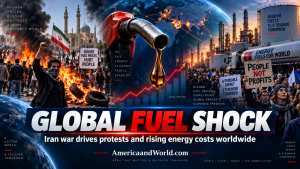
Security threats around the Strait of Hormuz and nearby shipping routes have placed additional pressure on global energy transportation, maritime insurance and commercial shipping operations.
President Trump has blamed Iran for disruptions affecting oil markets while asserting that American forces maintain control over the strategically important waterway. Tehran disputes Washington’s claims, leaving the military and commercial status of the region highly contested.
The issue also carries considerable political implications within the United States.
With the November 3 congressional midterm elections approaching, high fuel prices and uncertainty surrounding Middle Eastern oil supplies have become important domestic concerns for American households and policymakers.
At the diplomatic level, tensions have also emerged between Tehran and Paris.
Iranian Foreign Minister Abbas Araghchi criticized French President Emmanuel Macron over his recent statements concerning Iran’s nuclear activities, arguing that France’s current position appeared inconsistent with its previous support for the 2015 nuclear agreement.
The diplomatic disagreement comes as governments face growing pressure to prevent further regional escalation while addressing longstanding disputes over Iran’s nuclear program.
Elsewhere, the wider Middle Eastern crisis continues to generate international criticism over developments in the occupied West Bank.
U.S. Congresswoman Ilhan Omar called for the release of individuals detained by Israeli forces while assisting Palestinian farmers with the olive harvest. Among those detained was Democratic congressional candidate Brad Lander, who was subsequently released.
The overlapping crises underline the increasingly complex nature of the Middle East’s security situation, with military operations, diplomatic disagreements and humanitarian concerns unfolding simultaneously.
The possibility of renewed American strikes against Iran, combined with Tehran’s threats against U.S. military facilities and Houthi operations targeting Saudi Arabia, has intensified fears of a wider regional confrontation.
While diplomatic channels remain a potential avenue for de-escalation, continued military threats and attacks on strategic infrastructure could further complicate efforts to restore stability.
Any substantial escalation involving the United States and Iran could have consequences far beyond the Middle East, potentially affecting global oil prices, aviation, international shipping, financial markets and the broader world economy.
For now, the region remains caught between renewed military confrontation and efforts to prevent an already dangerous conflict from expanding further.