Five Dead After Amazon Prime Air Cargo Jet Overruns Runway at Miami International Airport

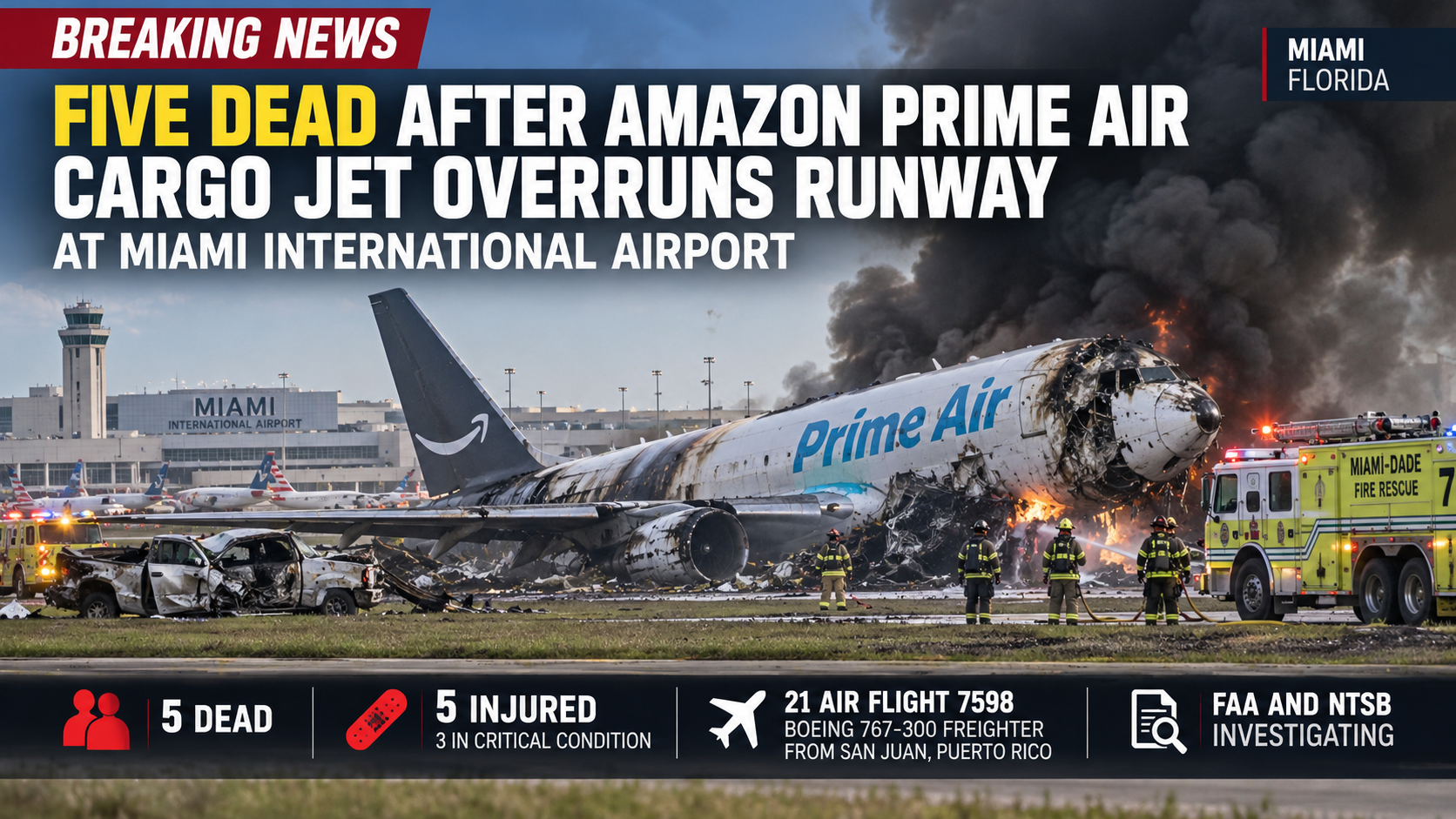
MIAMI, Florida — At least five people were killed and five others injured Sunday after a Boeing 767 cargo aircraft operating for Amazon Prime Air overran a runway while landing at Miami International Airport, struck vehicles on the ground and caught fire, triggering a massive emergency response at one of the busiest airports in the United States.
The Federal Aviation Administration said 21 Air Flight 7598, a Boeing 767-300 freighter, went beyond the end of the runway at approximately 2 p.m. local time on Sunday, September 6, 2026. The aircraft had arrived from Luis Muñoz Marín International Airport in San Juan, Puerto Rico.
Although the aircraft was carrying cargo for Amazon Prime Air, the flight was operated by 21 Air, a U.S. cargo carrier that provides aircraft and transportation services for Amazon’s air-freight network.
According to authorities, the aircraft continued beyond the runway boundary after landing and entered an area where it collided with several vehicles. Images from the scene showed extensive damage to the jet and fire scorching around sections of the aircraft.
The accident left at least five people dead and another five injured, with three of the injured reported to be in critical condition. Authorities had not immediately released the identities of those killed or provided a complete breakdown of whether the victims were aboard the aircraft or inside vehicles struck during the crash.
Emergency crews mounted a large-scale rescue operation within minutes of the accident.
More than 60 emergency units and approximately 200 personnel responded to the scene as firefighters worked to extinguish the blaze, rescue trapped victims and contain a fuel leak from the damaged aircraft.
The pilot and co-pilot were reportedly trapped inside the aircraft following the impact, while two additional people were trapped in vehicles on the ground. Specialized rescue teams worked to reach those caught in the wreckage as firefighters secured the surrounding area against the risk of another fire or explosion.
The accident caused significant disruption at Miami International Airport. Flight operations were restricted while emergency personnel worked near the runway and investigators began documenting the crash site.
By Sunday evening, operations had resumed on two of Miami International Airport’s four runways, although passengers continued to face delays and other disruptions resulting from the emergency response.
The cause of the runway overrun remained unknown Sunday night.
The Federal Aviation Administration has opened an investigation, while the National Transportation Safety Board is also investigating the fatal accident. NTSB Chair Jennifer Homendy was leading the agency’s response to the crash.
Investigators are expected to examine several possible factors, including the aircraft’s braking and landing systems, runway conditions, weather, crew actions, air traffic control communications and data recorded by the aircraft’s flight recorders.
Officials have cautioned that it is too early to determine what caused the Boeing 767 to continue beyond the runway after touchdown.
Amazon expressed its condolences following the crash and said it was cooperating with authorities. Aircraft operator 21 Air also said it was working with investigators as officials sought to establish the sequence of events that led to the deadly accident.
The crash is also expected to bring renewed scrutiny to the safety of the rapidly expanding air-cargo industry.
Amazon relies on a network of contracted aviation companies to operate much of its dedicated cargo fleet. While aircraft frequently carry Amazon Prime Air branding and freight, many are flown and maintained by partner airlines rather than directly by Amazon.
Sunday’s accident is not the first fatal crash involving a Boeing 767 operating within Amazon’s cargo network. In February 2019, Atlas Air Flight 3591, another Boeing 767 carrying Amazon cargo, crashed into Trinity Bay near Houston, Texas, killing all three people aboard.
However, investigators have not suggested any connection between the two accidents.
The Miami disaster is now likely to undergo months of technical investigation before authorities can determine precisely why Flight 7598 failed to stop on the runway.
A preliminary assessment may provide early evidence about the aircraft, runway and operating conditions, but the final determination of the cause will come only after investigators analyze flight-recorder information, cockpit communications, aircraft systems and physical evidence recovered from the scene.
For now, the tragedy has left five people dead, several others seriously injured and difficult questions about how a routine cargo arrival turned into one of the most serious accidents at Miami International Airport in recent years.