Nepal’s Bhote Koshi–Trishuli Flood Toll Reaches 389; 977 Still Missing as Fresh Flood Threat Persists

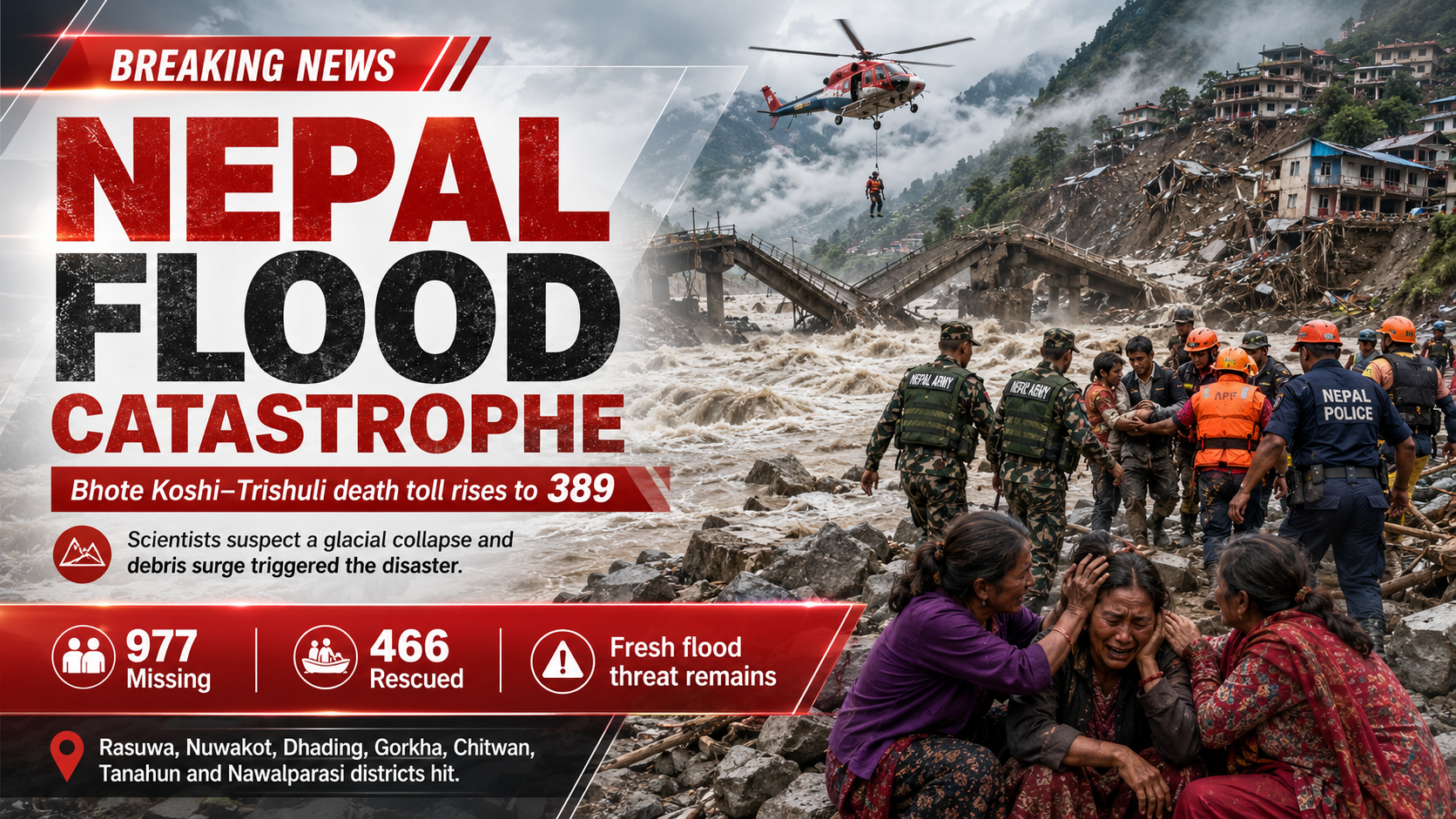
Hundreds of foreigners remain unaccounted for; massive ice-and-rock collapse believed to have triggered disaster, while debris-dammed lakes raise fears of another destructive surge
KATHMANDU, Aug. 28, 2026 — The death toll from the catastrophic flash flood that tore through Nepal’s Bhote Koshi–Trishuli river system has risen to 389, while a newly updated national disaster report says 977 people remain missing, underscoring the still-unfolding scale of one of Nepal’s worst natural disasters in recent history.
According to Nepal Police’s latest update, issued at 9 p.m. Thursday, recovery teams have retrieved bodies from eight districts stretching from the Himalayan border region deep into Nepal’s downstream river basin. The bodies recovered include 17 in Rasuwa, 28 in Nuwakot, 33 in Dhading, 32 in Gorkha, 137 in Chitwan, 28 in Tanahun, 87 in East Nawalparasi and 27 in West Nawalparasi.
The unusually high number of bodies recovered as far downstream as Chitwan and the Nawalparasi districts illustrates the extraordinary power of the flood, which carried victims and debris scores of kilometers from the initial disaster zone.
977 People Still Missing
The National Disaster Risk Reduction and Management Authority, or NDRRMA, said in its sixth situation report that 977 people remain unaccounted for.
Among the missing are 28 Nepal Police personnel, 45 Nepal Army personnel, 13 Armed Police Force personnel, 15 Customs Office employees and four Immigration Office staff. The missing-person list also includes 517 foreign nationals and 127 Nepalis living abroad who had returned to Nepal for visits, according to the latest consolidated disaster report.
The figure for missing foreigners has fluctuated considerably as embassies, tourism operators and Nepali authorities verify names and establish contact with survivors. An earlier Ministry of Foreign Affairs update issued at 8 p.m. Thursday had listed 596 people from 33 foreign countries as still missing, out of 627 foreigners initially reported in the affected area. The ministry said 31 had by then been located.
Because these databases are being updated at different times and through different agencies, officials have cautioned that nationality-specific and overall missing-person figures remain subject to reconciliation.
Hundreds Rescued as Massive Search Operation Continues
Nepal Police said 466 injured or affected people had been rescued in its latest operational update—289 from Rasuwa, 90 from Nuwakot, 84 brought to or rescued in Kathmandu and three from Dhading.
The Nepal Police alone has deployed 8,348 personnel for search, rescue, body recovery and relief operations, while the Nepal Army and Armed Police Force are also conducting extensive operations, including helicopter missions to communities isolated by destroyed roads and bridges.
There are differences between agency reporting categories. NDRRMA’s later consolidated status report separately lists 73 people as injured, while the police operational report refers to 466 injured or affected people rescued. Authorities are continuing to reconcile casualty, rescue and evacuation records as information arrives from remote disaster zones.
Search teams are working along riverbanks, mud-covered settlements and debris fields from Rasuwagadhi and the upper Bhote Koshi corridor through Nuwakot, Dhading and the lower Trishuli–Narayani river system.
Roads, Bridges and Communities Devastated
The flood has destroyed or damaged critical infrastructure on an enormous scale.
Earlier NDRRMA reporting cited by Nepal’s public broadcaster said 35 motorable bridges, 45 suspension bridges and around 40 kilometers of roads had been damaged. Separately, the Ministry of Infrastructure Development reported that approximately 40 kilometers of road in Rasuwa had been completely destroyed and that 41 bridges had been completely damaged.
The Betrawati–Mailung–Syafrubesi–Rasuwagadhi road corridor has suffered particularly severe destruction. About 10 kilometers of the Galchhi–Trishuli road was also reported closed, while approximately 13 kilometers of the Prithvi Highway was covered by mud and debris. Heavy equipment has been deployed to reopen vital transport links.
Homes, schools, security posts, vehicles, hydropower facilities, electricity networks and other public infrastructure have also been swept away or buried.
The government has appealed for support for survivors and says its immediate priorities are search and rescue, medical treatment, emergency shelter, evacuation of vulnerable communities and restoration of transportation and communications.
What Triggered the Disaster?
Scientific understanding of the disaster has also evolved rapidly.
The U.S. Geological Survey says the catastrophic debris flow and flood on Wednesday morning was likely triggered by a glacial collapse in Langtang National Park near the Nepal-China border. According to the USGS, the resulting debris flow and flooding traveled nearly 100 kilometers, affecting populated areas along the Bhote Koshi and Trishuli river systems and damaging critical infrastructure.
Preliminary scientific assessments indicate that a massive ice-and-rock avalanche entered the upper river system, sending enormous volumes of glacier ice, rock, mud and debris downhill.
Evidence being examined by scientists suggests that the avalanche may have temporarily blocked the Lhende Khola, a tributary feeding the Bhote Koshi system. Water accumulating behind the debris barrier may then have broken through, unleashing the destructive flood downstream.
A seismic signal associated with the event was initially interpreted as an earthquake. Subsequent analysis, however, indicated that the signal was produced by the enormous glacier and debris collapse itself rather than by a conventional tectonic earthquake. Reports citing the revised scientific analysis have described the collapse as generating a seismic signal equivalent to approximately magnitude 5.2.
Scientists caution that detailed field investigation and satellite analysis will still be needed before the complete sequence of events can be established with certainty.
Danger Not Over: New Lakes Raise Fresh Flood Fears
Perhaps most concerning is that authorities say the danger has not yet passed.
The enormous movement of ice, rock and sediment has created new blockages and temporary lakes in the Himalayan river system. Nepal and China have warned of the possibility of additional flooding if one or more of these natural debris dams collapses suddenly.
Residents, travelers and rescue workers in vulnerable downstream areas have therefore been urged to remain away from riverbanks and follow evacuation and safety instructions.
Scientists say such cascading disasters—where a glacier or ice-rock avalanche triggers a landslide, blocks a river, creates a temporary lake and then generates an outburst flood—are a growing concern across the Himalayan region.
The wider Hindu Kush Himalaya is warming rapidly, contributing to glacier retreat, permafrost degradation and instability on high mountain slopes. Scientists stress, however, that the precise role of climate change in this individual collapse will require further investigation rather than being assumed from the disaster alone.
Death Toll Could Rise Further
With 977 people still listed as missing, vast areas covered in mud and debris and some communities still difficult to access, authorities fear that the confirmed death toll could continue to rise.
The disaster began on the morning of August 26, when an enormous surge of water, rock, ice and mud descended from the high Himalayan border region and entered the Bhote Koshi system in Rasuwa. It then raced downstream through the Trishuli and Narayani river networks, spreading destruction through Nuwakot, Dhading, Gorkha, Chitwan, Tanahun and the Nawalparasi districts.
Nepal’s Ministry of Foreign Affairs has established an emergency mechanism to coordinate information on foreign nationals affected by the disaster, while international assistance and relief efforts are beginning to mobilize.
For thousands of families, however, the immediate crisis remains deeply personal: relatives are continuing to search hospitals, identification centers and devastated riverbanks for loved ones who have not returned.
With hundreds confirmed dead, nearly a thousand people still missing, entire communities devastated and the threat of another flood not yet eliminated, the Bhote Koshi–Trishuli catastrophe has emerged as one of the gravest natural disasters Nepal has faced in recent decades.