Nepal Recommends Ambassadors to 13 Countries, Including India, China, US and UK

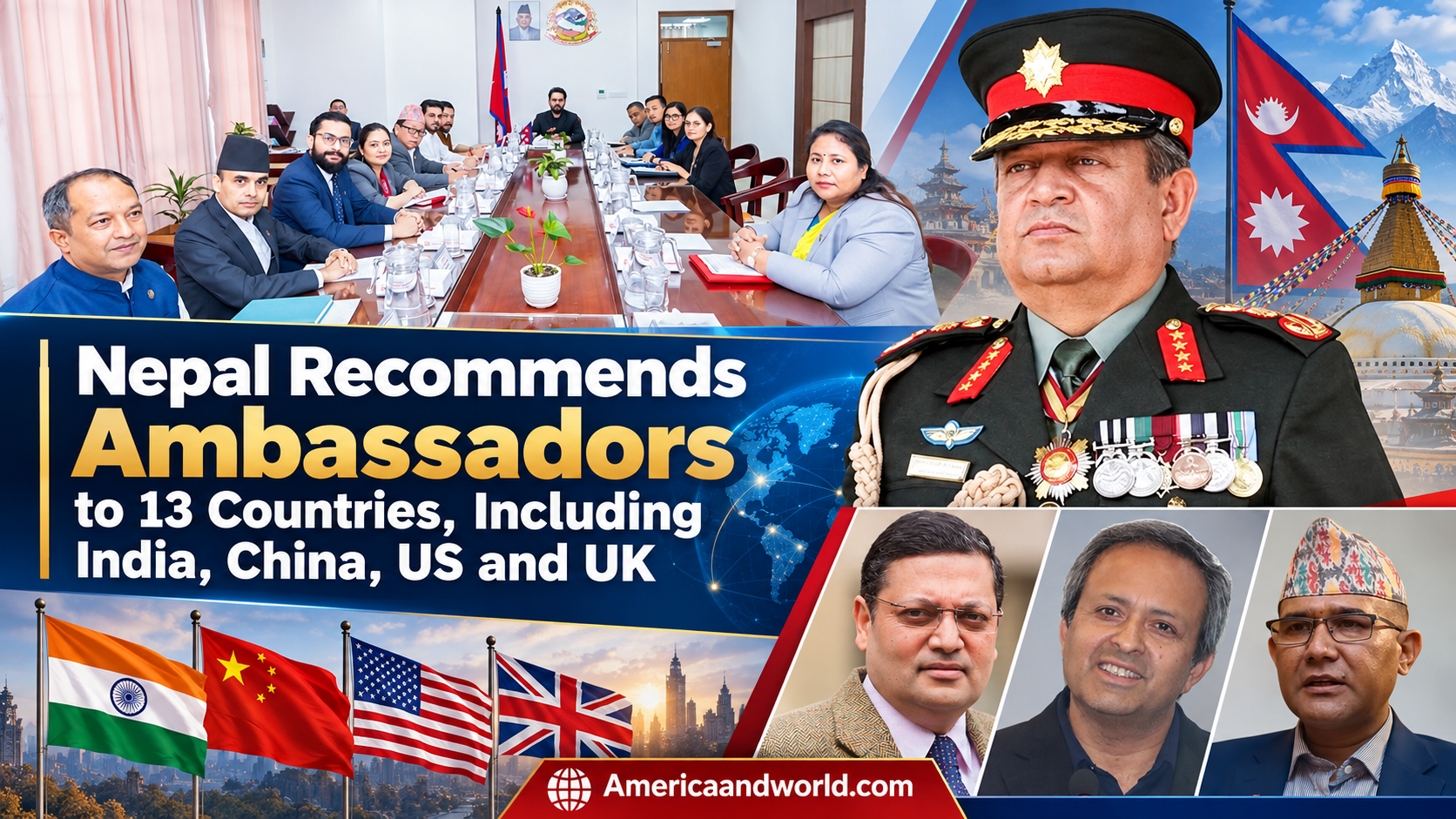
Former Army Chief Gaurav Shumsher Rana nominated for London, security expert Chiran Jung Thapa tapped for Washington
KATHMANDU, Sept. 18, 2026 — Nepal’s government has recommended ambassadors to 13 countries, including India, China, the United States and the United Kingdom, moving to fill some of the country’s most important diplomatic posts after months of vacancies.
The Council of Ministers, chaired by Prime Minister Balendra Shah, approved the nominations at a meeting on Friday. Foreign Minister Shisir Khanal confirmed the recommendations, which must still pass Nepal’s constitutionally required parliamentary hearing process before the nominees can proceed toward formal appointment.
Under the Cabinet decision, Dr. Nischal Nath Pandey has been recommended as Nepal’s ambassador to India, Dr. Kalyan Raj Sharma to China and security expert Chiran Jung Thapa to the United States. Former Chief of Army Staff Gen. Gaurav Shumsher Jung Bahadur Rana has been nominated for the United Kingdom.
The other nominees are Jigyan Kumar Thapa for Japan, Suresh Kumar Karna for Israel, Prapti Sherchan for Spain, Sharu Joshi for Germany, Dr. Padmakshi Rana for Oman, Chudamani Kharel for Malaysia, Prof. Dr. Sangam Shrestha for South Korea, Dr. Manchal Jha for Sri Lanka and Giri Bahadur Sunar for Saudi Arabia.
The recommendations bring academics, security specialists, former senior military leadership and professionals from other fields into some of Nepal’s most consequential diplomatic assignments.
Key nominees bring diverse backgrounds
Pandey, nominated for India, is the director of the Kathmandu-based Centre for South Asian Studies and has worked extensively on Nepal’s foreign policy, regional cooperation and South Asian affairs. He has previously served as executive director of Nepal’s Institute of Foreign Affairs and has participated in government-level foreign policy initiatives.
Sharma, the nominee for China, is known for his academic and professional engagement with China and has studied at Shanghai’s Fudan University. His nomination comes at a time when Kathmandu continues to manage close economic, political and infrastructure relations with both of its giant neighbors, India and China.
For Washington, the government has selected Chiran Jung Thapa, a security and strategic affairs specialist whose work has focused on national security, intelligence, counterterrorism, crisis management and civil-military relations. Thapa holds a master’s degree in international affairs from Columbia University with a concentration in international security policy and has served as a consultant to Nepal’s National Security Council. He has also lectured at the Nepali Army Command and Staff College and the Armed Police Force Staff College.
His nomination comes as Nepal-US relations increasingly encompass development cooperation, trade and investment, security cooperation, migration and diaspora affairs as well as broader Indo-Pacific and multilateral issues.
For Britain, the government has turned to former Army Chief Gaurav Shumsher Rana, who led the Nepali Army from 2012 to 2015 after a military career spanning nearly four decades. During his tenure, Nepal was completing the post-conflict integration of former Maoist combatants into the national army, while the military also played a major role in rescue and relief operations following the devastating April 2015 earthquake.
Rana also holds the honorary rank of General of the Indian Army, conferred on him by then Indian President Pranab Mukherjee in January 2013 under the longstanding tradition of the two countries honoring each other’s army chiefs.
Another prominent academic among the nominees is Prof. Dr. Sangam Shrestha, proposed for South Korea. Shrestha is a professor of water engineering and management at the Asian Institute of Technology in Thailand and has served as dean of its School of Engineering and Technology. His research has focused on water resources, groundwater, climate change adaptation and environmental management.
Unusually large response to open application process
The nominations followed an unusually broad selection exercise launched by Nepal’s Ministry of Foreign Affairs.
On May 28, 2026, the ministry publicly invited qualified Nepali citizens to apply or be recommended for ambassadorial positions. The application deadline was 5 p.m. on June 5. The official terms required applicants to be at least 35 years old and possess relevant professional experience and demonstrated leadership skills.
The process attracted more than 4,400 applications. After duplicate and incomplete submissions were removed, approximately 2,700 candidates remained, and the Foreign Ministry subsequently narrowed the field to a few hundred for further consideration.
The open-call process marked a departure from the traditional practice in which non-career ambassadorial positions were largely determined through political negotiations and recommendations. Nepal has historically used a combination of career Foreign Ministry diplomats and outsiders selected under the so-called political quota for ambassadorial appointments.
Friday’s nominations do not resolve all of Nepal’s ambassadorial vacancies. The government still needs to make additional appointments, including from among senior career diplomats in the Ministry of Foreign Affairs. As of Friday, officials said 22 diplomatic missions were without ambassadors or required new appointments, reflecting both earlier recalls and the expiration of several ambassadors’ four-year terms.
Sixteen missions—including those in Australia, China, Germany, India, Israel, Japan, South Korea, Malaysia, Oman, Qatar, Russia, Saudi Arabia, Sri Lanka, the United Kingdom, the United States and Spain—had been operating without ambassadors. The terms of ambassadors serving in Austria, Egypt, Bahrain, Bangladesh and Myanmar had also expired, although some were asked to remain temporarily until further decisions were made.
What happens next?
The Cabinet recommendation does not mean the nominees have yet become ambassadors.
Under Article 292 of Nepal’s Constitution, ambassadorial nominees must undergo a parliamentary hearing before the joint Parliamentary Hearing Committee of the Federal Parliament. The committee reviews nominees before the appointment process moves forward.
After the hearing process is completed, Nepal will seek agrément—formal diplomatic consent—from each receiving government. Once a host country grants agrément, the nominee can proceed toward formal appointment by Nepal’s President and subsequently present credentials in the receiving country.
The timing is also significant because Nepal’s senior diplomatic leadership is preparing for the 81st session of the United Nations General Assembly in New York. Foreign Minister Khanal is scheduled to travel to New York on September 20, while Prime Minister Shah will lead Nepal’s delegation during the high-level segment and address the General Assembly on September 24.
The government’s September 18 decision therefore begins, rather than completes, the process of restoring ambassador-level leadership to several of Nepal’s most important overseas missions. The speed of parliamentary hearings, host-country agrément and the government’s remaining career-diplomat nominations will determine when Nepal’s wider diplomatic vacancies are ultimately filled.