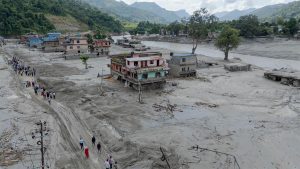
What began on Wednesday morning as a sudden and destructive flood in the Bhotekoshi area of Rasuwa has, within hours, become far more than a local disaster. The devastation that spread from Rasuwa through Nuwakot, Dhading, and downstream riverbelt communities is not a crisis that can be measured only in district boundaries, casualty figures, or damaged infrastructure. It is a national tragedy. It is a moment of grief, emergency, and profound moral testing for the entire country.
According to the latest police update made public at 11:05 p.m., 157 bodies had been recovered across seven districts, 41 injured people were receiving treatment in hospitals, and 28 police personnel remained out of contact. Those figures may still change as rescue and search operations continue. In disasters of this scale, official numbers often evolve hour by hour, and the final human cost may prove even more painful than what is currently known.
Behind every statistic is a family shattered, a home destroyed, a future interrupted.
Markets that were active only hours earlier have been swallowed by mud and water. Homes that sheltered generations have vanished. Roads, bridges, police posts, banks, government offices, hydropower infrastructure, and other public and private property have been swept away. Many families are still desperately searching for relatives. Some have lost their homes; others have lost their livelihoods; many may have lost both. Rescue personnel themselves are among the missing. And because roads, electricity, communications, and internet services remain disrupted in some places, the full extent of the destruction is still not completely visible.
In moments like this, one truth must guide the nation: the first and highest priority is to save human life.
The government’s performance will not be judged by the number of meetings it holds, statements it releases, or promises it makes. It will be judged by outcomes: how many people are rescued in time, how many injured receive urgent treatment, how many displaced families are given shelter, food, clean water, and security, and how effectively the search for the missing is conducted.
The government has mobilized the Nepal Army, Nepal Police, and Armed Police Force. Helicopters from the army and private sector have been used in rescue efforts. Medical teams have been deployed, and major hospitals in Kathmandu have reportedly been placed on standby for emergency care. Additional funds have also been released to local disaster management mechanisms in the affected districts. These are necessary and welcome steps.
The Cabinet has also announced decisions including free treatment for the injured, shelter, food and accommodation for those who have lost homes, reopening blocked roads, restoring drinking water, electricity and telecommunications, providing financial assistance to the families of the deceased in accordance with the law, and mobilizing resources for reconstruction of damaged public infrastructure. The decision to declare affected local areas disaster crisis zones for a limited period is also appropriate.
These commitments matter. But Nepal’s past experience offers a hard lesson that must not be ignored: announcements are not enough; implementation is everything.
Too often in previous disasters, relief has been promised but not delivered on time. Compensation has been delayed for months. Reconstruction files have gathered dust in offices. Those with influence have gained access before those in greatest need. Relief goods have been mismanaged, politicized, or trapped in bureaucracy. Disaster has too frequently been turned into spectacle, paperwork, and political messaging rather than swift action and public service.
This time, that must not happen.
Every rupee allocated for relief and reconstruction must be transparently accounted for. Every item of assistance—whether from government sources, private donors, national institutions, or international partners—must be tracked publicly. Citizens deserve to know what has arrived, where it has gone, who has received it, and what gaps remain.
That need for transparency is especially urgent now that support is expected not only from within Nepal but also from abroad. The Prime Minister’s Office has appealed for contributions to official disaster and relief funds. India, China, the United States, and the World Bank have all reportedly expressed willingness to support Nepal’s rescue, relief, and reconstruction efforts. Such support is valuable and should be welcomed.
But international assistance must be organized around clear, evidence-based needs, not vague appeals or symbolic diplomacy.
Nepal must rapidly produce a scientific assessment of what is required: How many helicopters are needed? How many trained search-and-rescue specialists? What volume of medicines, food supplies, temporary shelters, heavy equipment, bridge materials, communications support, and engineering teams are urgently necessary? External support should be directed by a transparent and prioritized list of needs, not by guesswork or political preference.
At the same time, this disaster raises another serious national question: how prepared is Nepal for high-risk events in its Himalayan and cross-border river systems?
Official accounts state that an unusually large flood entered the Bhotekoshi around 8:40 a.m. Earlier reports also noted seismic activity in the Tibet region shortly before the flooding. Initial satellite-based analysis has suggested the possibility that a mass of ice, rock, or land may have collapsed into the river system upstream, creating a destructive surge of water, mud, and debris. However, the actual cause of the flood has not yet been scientifically confirmed.
This distinction matters.
In times of fear and confusion, rumors travel faster than facts. It is irresponsible to promote any single explanation as final before scientific verification is complete. Responsible public communication requires discipline. The cause must be investigated carefully, transparently, and independently, because understanding what happened is not merely a matter of curiosity—it is essential for saving lives in the future.
And that future cannot be managed with old assumptions.
Nepal can no longer treat disaster management as a seasonal emergency response issue—something that becomes urgent only after monsoon damage is already underway. The nature of risk is changing. Rising temperatures in the Himalayas, glacial change, unstable geology, poorly planned road construction, expanding settlements near riverbanks, and the growing spread of hydropower and transport infrastructure in fragile terrain are all reshaping the disaster landscape.
For rivers flowing across borders, Nepal needs far stronger systems for real-time transboundary early warning, satellite monitoring, river sensors, automatic alert mechanisms, local siren systems, mobile emergency warnings, hazard mapping, and regular community-level evacuation drills. These are not luxuries. They are not optional development extras. They are matters of national safety and strategic preparedness.
One difficult but necessary question must now be asked: if warnings about unusual upstream river conditions, glacial instability, a major landslide, or temporary river blockage had reached vulnerable communities even minutes or hours earlier, how many lives might have been saved?
That question is painful. But it must be faced honestly—not to assign blind blame in the middle of a crisis, but to ensure that negligence, institutional delay, and policy weakness do not continue unchecked.
This is also a time when political leaders must rise above petty division.
The suffering unfolding in Rasuwa and beyond is too grave to be turned into partisan opportunity. Any attempt to use this disaster for political point-scoring, propaganda, or self-promotion would be an insult to the dead and a betrayal of the living. The duty of the moment is larger than party lines. From the Prime Minister to ward chairs, from ministers to civil servants, from security personnel to doctors, from business leaders to the Nepali diaspora, and from journalists to ordinary citizens, the responsibility is shared: save lives, support victims, and help Nepal stand again.
A special appeal must also go to Nepalis living abroad.
At this moment, the homeland needs more than sympathy. It needs solidarity expressed through action. Those who are able to help financially should contribute through official government-designated funds, recognized relief organizations, or trustworthy local mechanisms. People must remain cautious of unverified personal accounts or opaque fundraising campaigns launched in the name of emotion but lacking accountability.
And help does not mean money alone. Medicine, technical expertise, rescue equipment, communications support, shelter materials, logistics coordination, and international advocacy can all make a real difference if channeled properly.
Citizens within Nepal also have a crucial role to play.
Do not crowd rescue sites unnecessarily. Do not travel to dangerous riverbanks merely to capture photographs or videos. Follow instructions from security agencies. Be prepared to donate blood if necessary. Share verified information with relevant authorities. Support local coordination where possible.
Most importantly, do not spread unverified death tolls, old videos, false rescue requests, or fear-inducing misinformation on social media. During a disaster, false information can become a second disaster.
The media, too, carries a particularly heavy responsibility.
Turning grief into sensational content is not journalism. Broadcasting the identity of the dead before official confirmation, declaring missing persons dead without verification, or presenting speculative causes as established fact does not serve the public interest. Media organizations must ask hard questions, hold authorities accountable, expose failures, and demand transparency. But they must do so without inflaming panic or obstructing rescue efforts.
Compassion and responsibility must guide reporting.
Today, we offer our deepest tribute to all Nepali and foreign nationals who have lost their lives. We extend heartfelt condolences to the bereaved families. We pray for the swift recovery of the injured. We hope that those still unaccounted for will be found alive. And we express profound respect to the Nepal Army, Nepal Police, Armed Police Force, health workers, local representatives, volunteers, journalists, and ordinary citizens who are risking everything to respond in this difficult hour.
But condolence alone is not enough.
Today, we must rescue. Tomorrow, we must deliver relief. After that, we must rebuild lives. And when we rebuild, we must do so more wisely than before. Nepal cannot afford to reconstruct the same vulnerabilities in the same dangerous ways, only to watch them collapse again in the next flood.
This disaster has swept away homes, roads, bridges, businesses, and public infrastructure. It has uprooted families and erased years of labor within minutes.
But one thing must not be washed away:
our humanity, our national unity, and our determination to protect one another.
This is not Rasuwa’s sorrow alone. It is not only the pain of Nuwakot, Dhading, Chitwan, Gorkha, Tanahun, or Nawalparasi. It is the pain of Nepal.
And so the call before us is simple and urgent:
Wherever we are, whatever we can do, let us act.
Let us help save lives.
Let us stand beside grieving families.
Let us strengthen the morale of rescuers.
Let us demand accountability from the state.
Let us keep relief transparent and just.
And let us treat this disaster not as a political event, but as a human emergency.
Nepal is in pain today. Nepal is mourning. And if Nepal is to rise again, all of us must rise together.