Supreme Court Blocks Trump Administration’s Mail-Ballot Restrictions as 2026 Midterm Voting Gets Underway

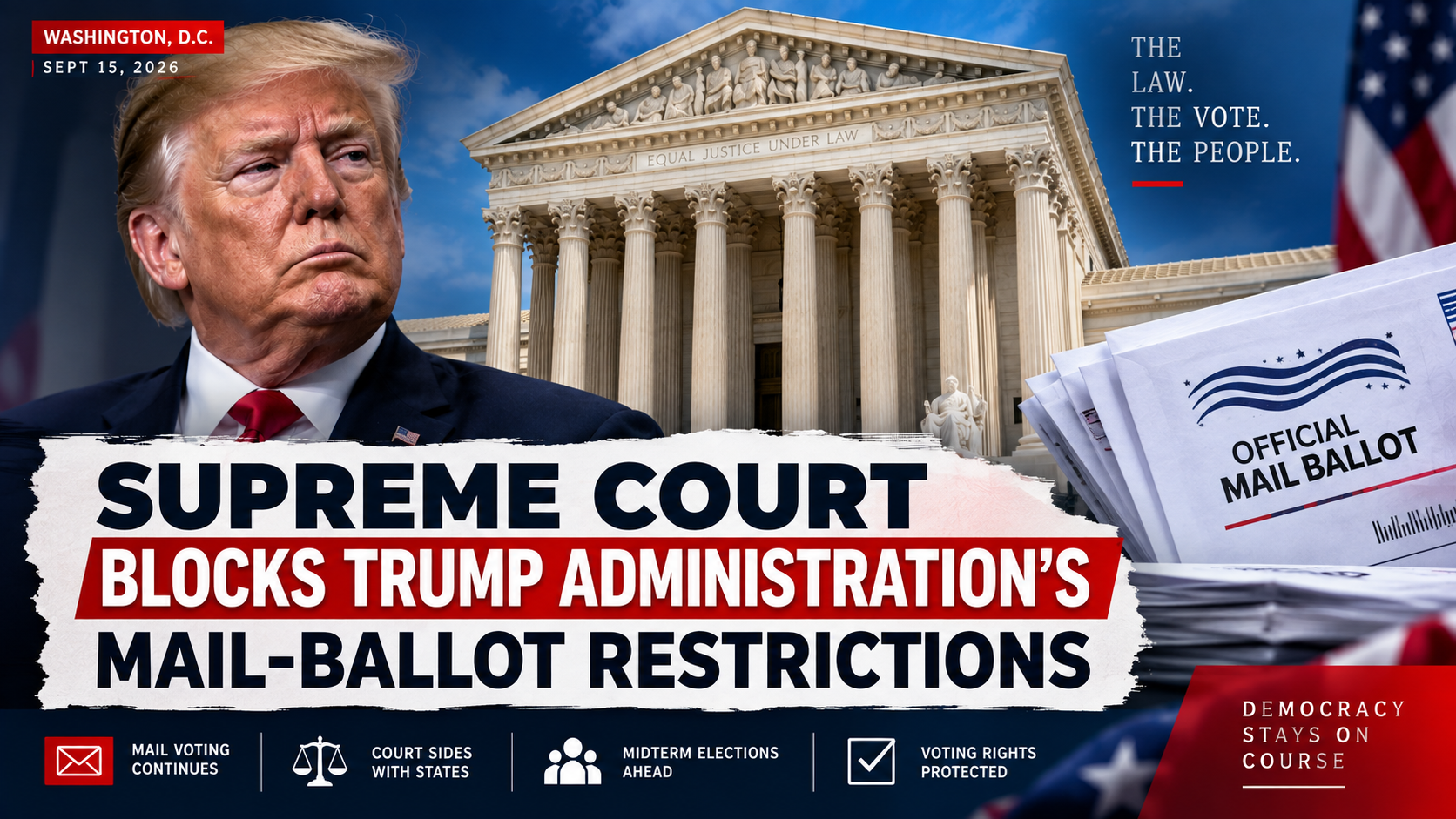
WASHINGTON, Sept. 15, 2026 — The U.S. Supreme Court has rejected the Trump administration’s emergency attempt to activate sweeping new Postal Service requirements for mail ballots ahead of the November 3 midterm elections, preserving existing vote-by-mail procedures at a moment when ballots are already being distributed in several states and election officials nationwide are entering the final phase of preparations.
The decision, issued Monday, September 14, leaves in place a nationwide preliminary injunction preventing the U.S. Postal Service from enforcing a new federal rule that would have required states to redesign ballot-mail envelopes, obtain Postal Service approval for those designs, use specialized voter-specific barcodes and transmit voter information through a new federal portal.
The Supreme Court’s action represents a major legal setback for President Donald Trump’s effort to tighten federal controls over mail voting before elections that will determine control of Congress. But the ruling is not a final judgment on every aspect of the administration’s policy. The underlying litigation continues, leaving unresolved the broader question of how much authority the Postal Service may ultimately exercise over election mail.
The dispute stems from an executive order Trump issued on March 31 directing the Postal Service to develop new procedures governing absentee and mail ballots used in federal elections. The administration said the initiative was intended to strengthen election integrity, prevent violations of federal law and increase public confidence in election results.
The Postal Service subsequently adopted a final rule in late August. According to the Supreme Court’s own description of the regulation, federal ballot mail would have to be sent in envelopes containing three specific features: an official election-mail logo, compatibility with high-speed Postal Service scanning equipment and a specialized barcode unique to each voter.
States would also have been required to design their ballot envelopes according to the federal specifications and submit those designs to the Postal Service for review. In addition, basic information about each voter receiving a ballot would have to be uploaded to a newly created Postal Service portal.
The consequences for noncompliance were potentially significant. The rule provided that mailings failing to satisfy the federal requirements would not be accepted by the Postal Service and would instead be returned to the state, which could attempt to correct the errors and resubmit them.
That provision became one of the central issues in the legal battle because states were already deep into election preparations when the final rule was issued.
Election officials and organizations challenging the regulation argued that an entirely new federal verification and ballot-processing system could not realistically be established nationwide only weeks before voting. They warned that administrative mistakes involving envelope designs, barcodes, voter records or the federal portal could delay or prevent otherwise eligible voters from receiving their ballots.
Those concerns became increasingly urgent as the litigation moved through the courts. Alabama, North Carolina and Wisconsin had already begun mailing ballots while other states were preparing to follow. States that rely heavily on voting by mail faced particularly significant logistical concerns because their existing election infrastructure was designed around large-scale ballot distribution rather than a sudden shift toward in-person voting.
The legal challenges produced injunctions in more than one federal court.
U.S. District Judge Indira Talwani in Massachusetts issued a nationwide preliminary injunction stopping the Postal Service rule from taking effect. A federal appeals court subsequently declined to lift that injunction, concluding that the administration had not made a sufficiently strong showing that the lower court was wrong to find the final rule likely unlawful.
Then, just before the Supreme Court acted, U.S. District Judge Carl Nichols in Washington issued a separate preliminary injunction against the rule.
Nichols concluded that the plaintiffs had demonstrated an increased risk that otherwise valid absentee or mail ballots might not ultimately be counted if the regulation took effect immediately. He also emphasized the public interest in preventing such an outcome.
The administration nevertheless urged the Supreme Court to intervene, arguing that the federal government’s authority over the Postal Service allowed it to establish rules governing the handling of ballot mail and that states could comply with the requirements.
On Monday, the Supreme Court refused.
The Court denied the government’s emergency application to stay the Massachusetts injunction, meaning the administration cannot enforce the challenged rule while the injunction remains in effect.
The majority said the government was unlikely to succeed on the merits and that the other considerations governing emergency relief did not justify suspending the lower court’s order.
Justice Brett Kavanaugh agreed that the regulation should not take effect for the 2026 midterm elections, although his position suggested that the administration’s broader argument about Postal Service authority could receive a different reception if the underlying legal dispute eventually returns to the Court under different circumstances.
Justices Samuel Alito and Clarence Thomas dissented.
Alito argued that the Postal Service possesses broad statutory authority to regulate the mail and concluded that the government was likely to succeed on the merits of its appeal. His dissent also challenged aspects of the plaintiffs’ legal standing and the nationwide scope of the injunction.
The disagreement among the justices illustrates an important distinction in Monday’s ruling: the Supreme Court has not issued a final decision permanently declaring that the Postal Service can never impose additional requirements on election mail.
Instead, the Court has refused to allow this particular system to take effect now, under the present legal and factual circumstances, while the underlying lawsuits proceed.
For the 2026 midterms, however, the practical consequences are immediate.
States can continue distributing mail ballots using procedures that have been in place rather than attempting an eleventh-hour transition to the new federal system. The Postal Service cannot, under the existing injunction, refuse ballot mail simply because a state has not complied with the challenged new envelope, barcode, portal and approval requirements.
That stability matters because voting by mail has become a major component of American elections. The Associated Press reports that mail ballots have accounted for nearly one-third of votes cast in recent elections.
The timing also magnified the dispute.
The November 3 midterm elections will determine control of the U.S. House of Representatives and Senate and will shape the balance of political power in Washington during the remaining two years of Trump’s current presidential term. Changing one of the country’s major voting systems less than two months before Election Day therefore raised both practical and legal concerns.
A whistleblower report cited in reporting on the case also raised concerns about the technical readiness of the proposed Postal Service system. According to AP, the report warned that problems with the not-yet-operational portal and barcode verification could result in large batches of ballots failing to move through the system correctly.
Those allegations added to election administrators’ argument that even if federal authorities ultimately possessed some legal power to impose additional requirements, introducing them immediately before a national election created an unacceptable risk of disruption.
The administration, by contrast, has maintained that stronger controls are necessary to protect election integrity and that the Postal Service has authority to establish standards for material moving through the federal mail system.
That disagreement raises a deeper constitutional and statutory question extending beyond the 2026 election: who has authority to determine the mechanics of ballot distribution when state-run elections depend on a federally operated postal system?
The Constitution gives states substantial responsibility for administering elections, while Congress possesses constitutional authority concerning federal elections and the postal system. The administration has sought to rely on federal postal authority to justify the new requirements. Challengers argue that postal authority cannot be transformed into executive control over fundamental aspects of state election administration.
A Washington federal court examining the final rule concluded that no statute gave the Postal Service authority to impose key portions of the system and found that the challengers were likely to succeed on their claim that USPS had acted beyond its legal authority.
The controversy also has a complicated procedural history.
Earlier litigation challenged Trump’s executive order before the Postal Service had finalized the actual regulation. The Supreme Court previously intervened in that earlier stage on procedural grounds without deciding whether the eventual Postal Service rule itself would be lawful.
Once USPS formally issued the final rule, states and other challengers returned to court. That distinction is important because the present litigation concerns an actual regulation with specific operational consequences rather than merely a presidential directive about what the Postal Service should consider doing.
The First Circuit Court of Appeals on September 10 refused to let the administration implement the final rule while the litigation proceeded. The three-judge panel concluded that the government had not made a strong showing that the district court erred in determining that the final rule was likely unlawful.
Days later, the Supreme Court reached essentially the same immediate outcome by declining to suspend the injunction.
The political debate surrounding mail voting remains intense. Trump has repeatedly criticized voting by mail and has argued that stronger safeguards are necessary to protect public confidence in elections. His administration presented the Postal Service regulation as an election-integrity measure rather than an effort to prevent lawful voting.
Opponents, including states, election officials and voting-rights organizations, argue that the system would impose federal requirements without adequate statutory authority and could interfere with eligible voters’ access to ballots.
The Supreme Court’s emergency decision does not settle that political debate, nor does it decide every constitutional question surrounding mail voting.
What it does settle, barring another significant legal development before Election Day, is the immediate operational question facing election administrators.
The challenged Postal Service requirements cannot presently be enforced.
That means states preparing for November 3 do not have to suddenly redesign millions of ballot envelopes, obtain federal approval for those designs, enroll voters in the new Postal Service portal or comply with the disputed voter-specific barcode system as a condition for their ballot mail to be accepted.
The case therefore carries significance far beyond a routine procedural court order. It removes a major source of uncertainty from election administration at precisely the moment when voting is beginning.
It also demonstrates that the larger legal fight is far from finished.
Justice Kavanaugh’s position leaves open the possibility that at least some federal regulation of ballot mail could eventually survive judicial review. Alito and Thomas would already have allowed the government to proceed. Meanwhile, lower courts have expressed substantial doubts that Congress actually authorized USPS to exercise the election-related powers contained in the final rule.
For voters, however, the immediate effect is considerably simpler.
As of September 15, the existing injunction remains in force, the Trump administration’s new Postal Service mail-ballot system cannot be implemented under the current court orders, and states may continue their established vote-by-mail operations as the United States moves toward the November 3, 2026 midterm elections.
The ultimate legality of the administration’s policy remains for future litigation to resolve. But for this election, the Supreme Court has declined to permit a major restructuring of mail-ballot procedures after voting had effectively begun.