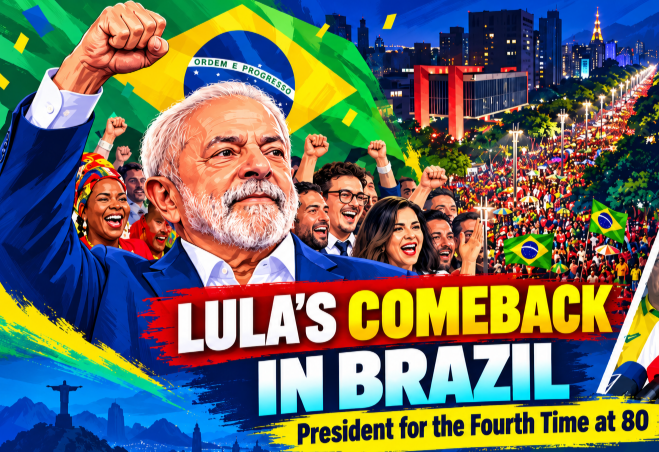
Historic Political Comeback in Brazil: Lula Wins Fourth Presidential Term at 80

* Flávio Bolsonaro Loses Runoff Despite First-Round Lead, Rejects Election Results and Calls for Vote to Be Annulled
* Lula’s Victory Reshapes South American Politics as Brazil Faces Deepening Political Divisions and Uncertainty
BRASILIA, Brazil, October 26, 2026: Brazil has witnessed a historic political comeback as 80-year-old President Luiz Inácio Lula da Silva secured an unprecedented fourth presidential term, defeating his conservative challenger, Senator Flávio Bolsonaro, in a closely contested runoff election. The dramatic result marks a significant moment in the political history of South America’s largest country, demonstrating that even a first-round electoral lead cannot guarantee ultimate victory.
According to the reported election results, Lula received 51.79 percent of valid votes in Sunday’s runoff, held on October 25, while Bolsonaro secured 48.21 percent. Lula obtained approximately 64.26 million votes compared with Bolsonaro’s 59.83 million, winning by more than 4.43 million votes. The outcome represents the first time in Brazil’s modern democratic presidential history that a candidate who finished second in the opening round reversed the result to win the presidency.
The election took an unexpected turn after the first round on October 4, when Bolsonaro led with 47.03 percent of the vote against Lula’s 45.16 percent. However, an intensified campaign, broader voter mobilization and efforts to attract supporters of eliminated candidates helped Lula reverse the political equation within three weeks.
Following the announcement of the results, thousands of Lula supporters celebrated in São Paulo and other major Brazilian cities, waving national flags and chanting slogans. Lula portrayed his victory as a renewed mandate to defend democratic institutions, strengthen social protections and work toward national unity after an increasingly divisive election campaign.
The 80-year-old veteran politician, whose career began in the labor union movement, previously governed Brazil from 2003 to 2010. He returned to power in January 2023 after defeating former President Jair Bolsonaro in the 2022 election. His latest victory makes him the first Brazilian leader to win four presidential elections.
However, the political celebrations were overshadowed by controversy when defeated candidate Flávio Bolsonaro refused to concede. Bolsonaro, the son of former President Jair Bolsonaro, challenged the legitimacy of the result and called for the election to be annulled, citing concerns over a decision to extend voting hours at some polling locations.
Brazilian authorities had authorized extended voting after heavy rainfall and transportation difficulties disrupted access to polling stations. Election officials defended the arrangements as necessary to protect voting rights. No independently verified evidence has emerged demonstrating that the extension altered the overall result or involved electoral fraud.
The controversy has renewed concerns about political polarization in Brazil, particularly given the history of the Bolsonaro family’s confrontation with the country’s electoral and judicial institutions. Former President Jair Bolsonaro was sentenced to more than 27 years in prison following his conviction over an attempted coup connected to his defeat in the 2022 presidential election.
Political observers point to support among lower-income voters, women, northeastern Brazilian communities and beneficiaries of social assistance programs as important factors in Lula’s electoral coalition. His campaign emphasized poverty reduction, workers’ rights, public healthcare, education and economic opportunities while seeking to reassure voters concerned about democratic stability.
The result also carries substantial implications beyond Brazil’s borders. Several Latin American countries have recently experienced electoral shifts toward conservative leadership, making Lula’s victory a notable departure from that regional pattern. His reelection preserves an important left-wing presence in Latin America and could influence regional diplomacy, environmental policies and economic cooperation.
The election also has implications for Brazil’s relationship with the United States. Flávio Bolsonaro is politically aligned with the movement associated with US President Donald Trump, while Lula has pursued a more independent international strategy, maintaining relations with Washington while strengthening Brazil’s partnerships with China, the BRICS grouping and other emerging economies.
Despite their political differences, Brazil and the United States remain important economic partners. Trade, investment, tariffs, critical minerals and regional security are expected to remain major subjects of bilateral negotiations.
Lula’s fourth term, scheduled to begin in January 2027, will nevertheless present considerable challenges. A conservative-leaning Congress, fiscal pressures, public debt, inflation concerns, crime, unemployment and persistent economic inequality could complicate his administration’s agenda. The substantial number of votes secured by Bolsonaro also reflects the continuing strength of conservative political forces across Brazil.
The outcome demonstrates both the resilience and the divisions of Brazil’s democratic system. While Lula has achieved a remarkable political milestone at the age of 80, his rival’s refusal to accept the results raises questions about the political atmosphere following the election and the legal challenges that may emerge.
At a time when youth-driven political movements and demands for generational change are gaining attention across different parts of the world, Brazil has chosen an experienced 80-year-old leader to guide the nation for another four years.
Ultimately, the historic election is not merely a victory for Lula or a defeat for Bolsonaro. It represents another defining chapter in Brazil’s continuing debate over democracy, economic opportunity, political identity and the country’s future direction.
With the votes counted and the winner declared, attention now shifts from the election campaign to the difficult task of governing a deeply divided nation.