America and Canada at the Tariff Crossroads: Why North America Cannot Afford This Trade War

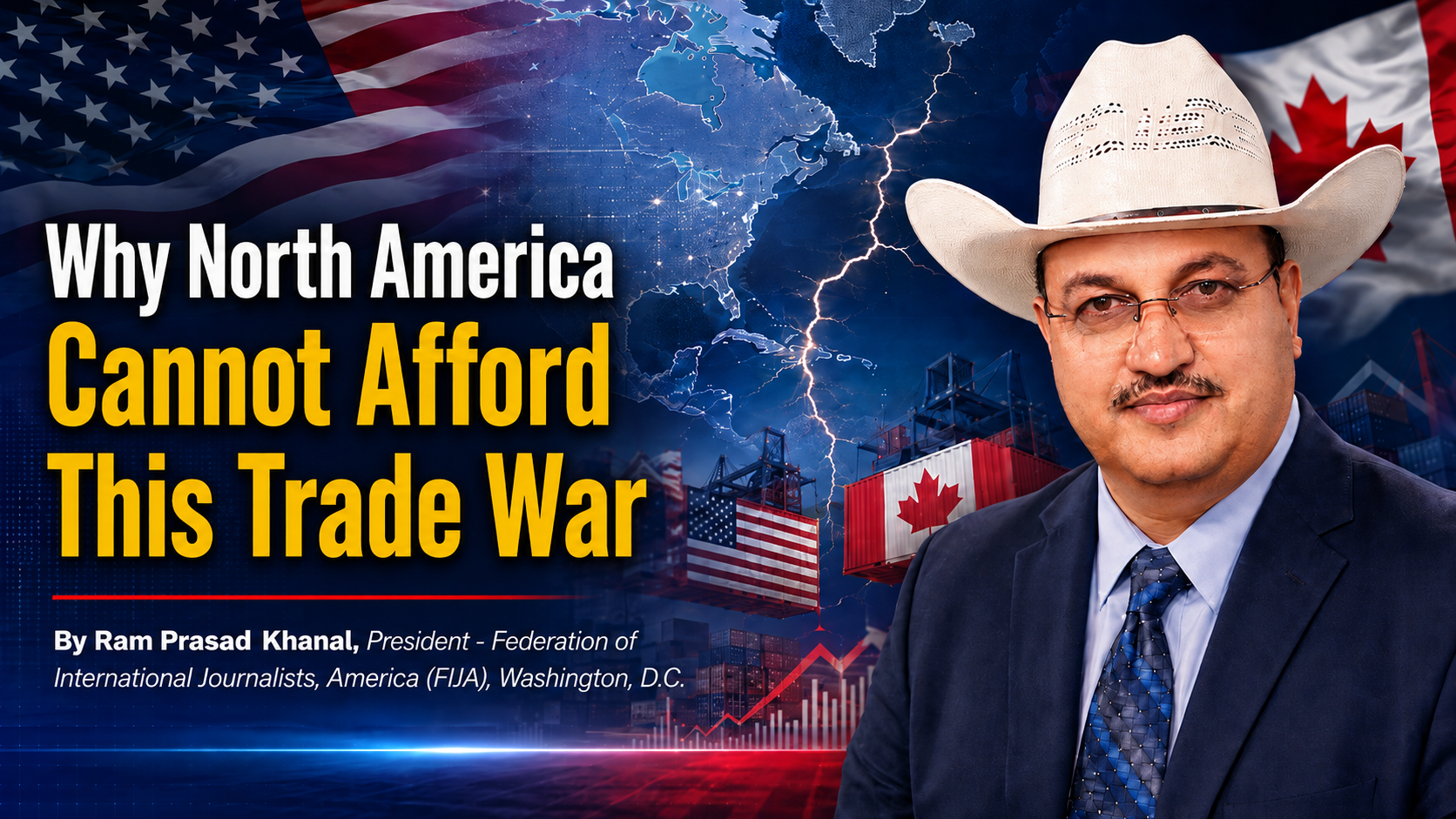
From the Auto Pact and NAFTA to USMCA, the United States and Canada spent generations building one of the world’s deepest economic partnerships. Escalating tariffs now threaten jobs, investment, consumers, supply chains—and a relationship far more valuable than either side can afford to lose.
By Ram Prasad Khanal
President, Federation of International Journalist, America (FIJA), Washington, D.C.
September 2, 2026 /The United States and Canada share much more than the world’s longest international border. They share factories, energy networks, highways, railways, defense responsibilities, families, tourism, investment, agriculture, technology, and supply chains that have been constructed over generations.
Yet today, two of the closest friends and trading partners in the democratic world are caught in an increasingly dangerous trade confrontation.
What began as disagreements over trade balances, border security, fentanyl, steel, aluminum, automobiles, dairy and market access has developed into a wider political and economic dispute. Tariffs have been answered with tariffs. Negotiations have broken down. Political rhetoric has hardened. Businesses are delaying decisions. Consumers are becoming caught in the middle.
And, perhaps most seriously, confidence in one of the most successful bilateral relationships in modern history is being damaged.
This is precisely the moment when Washington and Ottawa need statesmanship rather than escalation.
The Current Crisis
The latest escalation followed the collapse of intensive U.S.–Canada negotiations on August 21, 2026.
Canadian Prime Minister Mark Carney said his government could not accept American demands that Canada believed would undermine important Canadian industries, economic independence and national sovereignty. The United States, meanwhile, argued that Canada had rejected an attractive agreement and continued to maintain unfair or discriminatory policies affecting American exporters.
President Donald Trump’s administration has invoked Section 338 of the Tariff Act of 1930 to impose additional duties on selected Canadian products. The White House has specifically accused Canada of discriminatory treatment involving sectors including automobiles and dairy. Presidential proclamations have authorized additional duties of as much as 50 percent on designated Canadian products.
After negotiations failed, Canada announced that it would respond dollar for dollar to U.S. measures.
According to the Canadian government, the latest American action applies 50 percent tariffs to approximately C$27.6 billion worth of Canadian goods. Ottawa has announced counter-tariffs covering the same value of American imports beginning September 8, 2026.
Canadian retaliation will include tariffs of 15, 25 and 50 percent on various products, concentrating on sectors including steel and aluminum, dairy, agricultural equipment, appliances, pulp and paper, plastics and electronics. Existing Canadian measures affecting American automobiles also remain in place.
The automobile dispute is especially alarming. Automakers are also preparing for the possibility of much broader 50 percent U.S. tariffs affecting Canadian-built vehicles, trucks and auto parts beginning January 1, 2027. Because North American automobile manufacturing is extraordinarily integrated, such measures could affect Canadian plants as well as American factories, suppliers, dealerships and consumers.
Prime Minister Carney said on September 1 that Washington needed to “start being serious” before meaningful negotiations could resume. He nevertheless continued to leave open the possibility of a mutually beneficial agreement.
The door, therefore, is damaged—but it is not yet closed.
How Did Two Close Allies Get Here?
This confrontation did not begin overnight.
After President Trump returned to office in January 2025, his administration intensified its use of tariffs as an instrument of economic and foreign policy. The administration linked some of its early pressure on Canada and Mexico to border security and fentanyl trafficking while simultaneously raising concerns about trade deficits and industrial production.
Canada retaliated against several American measures.
During 2025, however, both governments also made attempts at de-escalation. Canada eventually removed many of its retaliatory tariffs effective September 1, 2025, after most Canadian goods complying with USMCA/CUSMA rules continued to receive tariff-free treatment in the United States.
Ottawa nevertheless maintained retaliatory measures on steel, aluminum and automobiles because American sectoral tariffs in those areas continued.
The conflict then moved into the critical 2026 review of the United States-Mexico-Canada Agreement—USMCA, known as CUSMA in Canada.
On July 1, representatives of the United States, Canada and Mexico conducted the six-year joint review required by the agreement.
The Trump administration declined to extend the agreement automatically for another 16-year term and instead sought further negotiations and modifications, particularly concerning automobiles, rules of origin, manufacturing, economic security and trade imbalances.
This does not mean USMCA has already expired.
The agreement remains legally in force through 2036, but the failure to agree on an extension means annual reviews can continue, creating uncertainty for companies deciding where to build factories and make long-term investments.
That uncertainty may itself become economically costly.
Businesses can adapt to tariffs. They can adapt to regulations. What businesses find much harder to manage is not knowing what the rules will be five or ten years from now.
A Relationship Built Over Generations
The current confrontation is particularly unfortunate because North American economic integration has taken decades to construct.
The 1965 Canada-U.S. Automotive Products Agreement, commonly known as the Auto Pact, helped integrate automobile production across the border.
The Canada-U.S. Free Trade Agreement, signed in 1988 and implemented in 1989, dramatically expanded bilateral economic integration.
It was followed in 1994 by the **North American Free Trade Agreement—NAFTA—**linking Canada, the United States and Mexico into a continental trading system.
President Trump criticized NAFTA during his first administration and negotiated its replacement.
The result was USMCA, which entered into force in July 2020 after approval by all three countries.
Ironically, therefore, the trade structure now under enormous pressure is largely the agreement negotiated and championed by President Trump himself during his first administration.
The two countries have experienced tariff disputes before.
In 2018, the first Trump administration imposed Section 232 tariffs on Canadian steel and aluminum on national-security grounds. Canada responded with reciprocal measures covering approximately C$16.6 billion in American products.
But eventually diplomacy prevailed.
On May 17, 2019, Washington and Ottawa reached an understanding. The United States eliminated its steel and aluminum tariffs and Canada removed its retaliation. The countries also established mechanisms to monitor trade and prevent transshipment and unfairly subsidized metals from entering their markets.
That experience offers a lesson for 2026:
Serious disputes between the United States and Canada can be resolved when political leaders choose negotiation over permanent confrontation.
Nearly $900 Billion Is at Stake
The scale of this relationship is extraordinary.
According to the Office of the United States Trade Representative, total U.S. trade in goods and services with Canada reached an estimated $872.3 billion in 2025.
American goods exports to Canada totaled approximately $333.6 billion, while U.S. goods imports from Canada reached approximately $381.9 billion.
The United States therefore recorded a goods deficit of about $48.3 billion with Canada.
But goods tell only part of the story.
The United States exported approximately $92.3 billion in services to Canada and imported about $64.5 billion, creating a U.S. services surplus of approximately $27.7 billion.
Combining those figures substantially reduces the overall imbalance.
This distinction matters.
President Trump is correct that the United States has historically run a goods deficit with Canada. A government has every right to examine whether trade arrangements are working fairly for its workers and industries.
But a bilateral economic relationship should not be evaluated simply by looking at one number.
Trade deficits are influenced by energy imports, currencies, investment, consumer demand, industrial specialization and macroeconomic conditions.
Moreover, American companies earn enormous revenues selling goods and services to Canadians.
Canada remains one of the most important export customers that American farmers, manufacturers, technology companies and service providers have anywhere in the world.
During the first six months of 2026 alone, U.S. Census Bureau data show American goods exports to Canada of approximately $175.8 billion, against imports of approximately $200.2 billion.
These are not two economies operating independently.
They are deeply interconnected.
Canada Has More to Lose—But America Will Not Escape the Damage
Because Canada is much smaller economically and more dependent on the U.S. market, a prolonged trade war would almost certainly inflict proportionately greater damage on Canada.
Statistics Canada reported that 71.7 percent of Canadian merchandise exports went to the United States in 2025, although that was down substantially from 75.9 percent in 2024.
Similarly, the U.S. share of Canadian merchandise imports fell from 62.3 percent in 2024 to 58.8 percent in 2025.
At the same time, Canadian trade with countries outside the United States increased significantly, demonstrating Ottawa’s effort to diversify its economy.
That diversification is understandable.
But geography cannot be diversified.
The United States will always be Canada’s immediate neighbor and natural economic partner.
No European or Asian market can reproduce the economic advantage of transporting products by truck across a nearby border.
And the same geography that makes Canada dependent on America also provides enormous advantages to American companies.
The Auto Industry Could Become the Biggest Casualty
Nowhere is integration clearer than in automobiles.
A vehicle described as “Canadian” or “American” may contain parts manufactured on both sides of the border. Components can cross the border several times during the manufacturing process before the finished vehicle reaches a dealership.
That means a tariff applied at the border may not simply punish a foreign competitor.
It can increase costs inside the tariff-imposing country itself.
Canadian-built vehicles represented approximately 6 percent of U.S. automobile sales in 2025, according to reporting on the current dispute. Major companies including General Motors, Ford, Stellantis, Toyota and Honda operate within highly integrated North American production networks.
Canada’s automobile sector supports hundreds of thousands of jobs directly and indirectly. Toyota and Honda alone account for a large share of Canadian vehicle production, while American manufacturers maintain major Canadian operations.
A 50 percent tariff would therefore create an enormous incentive to reorganize production.
But moving an automobile assembly plant is not like changing supermarkets.
Factories represent billions of dollars in investment. Supplier networks take years to develop. Skilled workforces cannot simply be recreated overnight.
If companies begin concluding that North American trading rules are unreliable, investment may move not merely from Canada to the United States, but potentially away from the continent altogether.
That would weaken both countries.
Steel and Aluminum: Protection Versus Cost
The Trump administration argues that tariffs can protect American industrial capacity, encourage domestic production and prevent unfair foreign competition.
There is legitimacy in the broader goal of maintaining strategic steel and aluminum capacity. No major country should be indifferent to losing industries critical to defense, infrastructure and manufacturing.
But tariffs inevitably create winners and losers.
American steel or aluminum producers may benefit from protection against imported competition.
American companies that consume steel and aluminum—including manufacturers of automobiles, machinery, appliances, construction equipment and countless other products—may face higher input costs.
Canadian retaliatory tariffs then create another group of casualties: American exporters trying to sell into Canada.
The result can become a cycle in which both governments claim victory for protecting one industry while businesses and consumers elsewhere quietly absorb higher costs.
Energy Makes Separation Even More Difficult
The United States and Canada also possess one of the world’s most integrated energy relationships.
U.S. Energy Information Administration data show that bilateral energy trade was worth approximately $137 billion in 2025.
The United States imported approximately $111 billion in energy products from Canada while exporting roughly $26 billion to Canada.
Most importantly, Canada remained the largest source of U.S. crude-oil imports, supplying an average of approximately 3.9 million barrels per day in 2025. Crude oil represented 69 percent of the value of bilateral energy trade.
This illustrates why turning economic interdependence into a political weapon can become dangerous.
Canada needs the enormous American energy market.
But American refineries also rely heavily on Canadian crude.
The countries additionally trade natural gas and electricity through integrated cross-border infrastructure.
Energy security should therefore be an area of continental cooperation—not economic warfare.
American Farmers and Businesses Also Face Retaliation
Canadian counter-tariffs are deliberately designed to create political and economic pressure inside the United States.
Dairy, agricultural machinery, steel, appliances, electronics and other American products are being targeted.
The economic logic of retaliation is straightforward: make tariffs costly enough for American constituencies that Washington feels pressure to negotiate.
But Canadian retaliation comes with its own price.
Canadian companies importing American equipment may pay more. Canadian consumers may face higher prices. Manufacturers may have difficulty finding immediate substitutes.
That demonstrates the central problem with trade wars:
Retaliatory tariffs hurt the country imposing them as well as the country being targeted.
Tourism and Public Sentiment Are Becoming Economic Issues
The damage is no longer limited to merchandise.
Political tensions have affected how Canadians view the United States, and that has begun influencing consumer and travel behavior.
Statistics Canada reported that Canadians made 23.1 million trips to the United States in 2025, a decline of 23.5 percent from 2024.
Canadian spending during U.S. visits fell to approximately C$18.8 billion, down 15.1 percent.
That affects hotels, restaurants, airlines, rental-car agencies, entertainment businesses and retailers, particularly in American border states and popular Canadian tourism destinations such as Florida, Arizona, California, Nevada and New York.
More recent reporting indicates that Canadian consumers are also reducing purchases of some American products while Canadian businesses look for domestic or international suppliers.
If these habits become permanent, the long-term damage could exceed the immediate value of the tariffs themselves.
A lost customer is difficult to recover.
A lost sense of trust is even harder.
Canada’s Economy Has Shown Resilience—but the Risk Is Growing
Canada has not collapsed under the trade pressure.
The Canadian economy expanded at an annualized rate of approximately 3.3 percent in the second quarter of 2026, demonstrating resilience.
Nevertheless, the Bank of Canada warned on September 2 that escalating tariffs and trade uncertainty could damage future growth and contribute to inflationary pressure. The central bank maintained its policy interest rate at 2.25 percent while acknowledging increased risks from the trade conflict.
This is an important distinction.
A country can survive tariffs without tariffs being harmless.
The larger concern is what happens if temporary uncertainty becomes permanent.
Companies can postpone factories.
Investors can redirect capital.
Supply contracts can be rewritten.
Customers can discover alternative suppliers.
Once supply chains move, they may never return.
Washington’s Concerns Should Not Simply Be Dismissed
A durable solution also requires Canada to acknowledge that the United States has legitimate economic concerns.
Washington wants greater access for American agricultural and dairy products.
It wants stronger North American rules of origin.
It wants to prevent Chinese or other non-North-American goods from receiving indirect preferential access through Canada or Mexico.
It wants more manufacturing investment inside the United States.
And it wants trade agreements to provide tangible benefits to American workers rather than simply increasing aggregate trade.
During the USMCA review process, American negotiators have emphasized manufacturing, agriculture, automobiles, steel, aluminum, economic security and preventing third-country “free-riding.”
Those issues are negotiable.
Canada similarly has legitimate concerns.
It cannot reasonably be expected to surrender control over its economic, cultural or regulatory policy simply to avoid tariffs.
It must protect workers and industries from measures it considers discriminatory.
And any lasting trade agreement must provide predictability rather than requiring businesses to renegotiate their economic future every few months.
The solution therefore cannot be unconditional surrender by either side.
It must be a compromise.
The Political Rhetoric Must Cool Down
Trade disagreements between democracies are normal.
Personal humiliation, threats, ridicule and language questioning the sovereignty or dignity of a neighboring country are not useful negotiating tools.
They create political conditions in which compromise begins to look like weakness.
Canada is an independent sovereign nation.
The United States is entitled to defend American interests aggressively—but respecting Canadian sovereignty does not weaken America.
Likewise, Canadian political leaders should resist turning legitimate disagreement with a particular American administration into generalized anti-Americanism.
Governments change.
Presidents change.
Prime ministers change.
Geography does not.
Americans and Canadians will still be neighbors long after today’s politicians have left office.
Responsible leaders should act accordingly.
What Both Countries Should Do Now
The United States and Canada need to return to the negotiating table quickly, but simply reopening talks will not be enough.
They need a structured path toward settlement.
First, both countries should establish an immediate tariff standstill, agreeing not to introduce additional measures while negotiations continue.
Second, Washington and Ottawa should separate solvable sectoral disputes from broader political grievances.
Steel and aluminum should have their own negotiating track.
Automobiles and rules of origin should have another.
Agriculture and dairy should be addressed separately.
Energy security should be protected from unnecessary escalation.
Third, both governments should establish a joint economic-impact commission involving government officials, manufacturers, farmers, labor representatives, energy companies and small businesses.
Politicians should know precisely who is paying the cost of every tariff.
Fourth, Canada, the United States and Mexico should restore confidence in USMCA by establishing a realistic path toward long-term renewal.
Companies cannot make twenty-year investments based on twelve-month political calculations.
Fifth, Washington and Ottawa should create a permanent high-level economic-security dialogue addressing Chinese overcapacity, unfair subsidies, transshipment, critical minerals, energy, artificial intelligence, defense manufacturing and resilient North American supply chains.
These are areas where the United States and Canada have far more reason to work together than to fight each other.
The Larger Strategic Question
The world is becoming more dangerous.
China is competing with the United States economically and technologically.
Russia continues challenging the Western security order.
Wars and geopolitical tensions are disrupting energy markets and shipping routes.
Artificial intelligence is transforming industries.
Countries are competing for critical minerals, semiconductors and advanced manufacturing.
Supply-chain security has become a national-security issue.
In such an environment, should the United States and Canada really spend their economic and political capital weakening each other?
Or should North America become the world’s strongest integrated democratic economic bloc?
The answer should be obvious.
The United States has capital, technology, entrepreneurship, enormous consumer markets and military power.
Canada possesses energy, critical minerals, agricultural resources, advanced industries, skilled workers and geographic depth.
Mexico contributes industrial capacity, labor, manufacturing scale and access to Latin America.
Together, the three countries possess nearly everything necessary to build one of the world’s most secure and competitive economic regions.
Breaking that system apart would be an extraordinary strategic mistake.
Nobody Truly Wins a U.S.–Canada Trade War
President Trump is right about one fundamental principle: every government has an obligation to protect its own workers and pursue fair trade.
Prime Minister Carney is equally right that Canada must defend its independence, industries and national interests.
But protecting national interests and maintaining a strong bilateral partnership are not contradictory objectives.
They should be pursued together.
America does not become stronger simply because Canada becomes poorer.
Canada does not become stronger simply because American farmers or manufacturers lose customers.
A General Motors worker in Michigan, an auto-parts worker in Ontario, a farmer in Wisconsin, an aluminum worker in Quebec, an energy producer in Alberta and a retailer in New York are connected through an economic system that politics cannot easily separate.
Tariffs may create negotiating leverage.
They may sometimes protect strategic sectors.
But when tariffs become permanent weapons between deeply integrated allies, their costs eventually travel through supply chains until they reach ordinary families.
The American and Canadian governments therefore need to stop measuring success by how much pain they can impose on the other side.
They should measure success by how much prosperity they can create together.
More than $872 billion in annual goods and services trade, millions of jobs, enormous cross-border investments and generations of friendship deserve more than a cycle of retaliation.
History shows that Washington and Ottawa have disagreed before and found solutions.
They can do it again.
President Donald Trump and Prime Minister Mark Carney should authorize their negotiating teams to return to serious discussions, reduce provocative rhetoric, freeze further escalation and pursue a comprehensive settlement that protects legitimate American and Canadian interests.
Neither country needs to surrender.
Both countries need to negotiate.
Because when America and Canada cooperate, both become stronger.
When they turn their economic strength against each other, workers, businesses and families on both sides of the border ultimately pay the price.
The negotiating table—not the tariff wall—is where this dispute must end.