Harry and Meghan ‘Surprised’ by King Charles’s Royal Status Letter as UK Security Review Looms

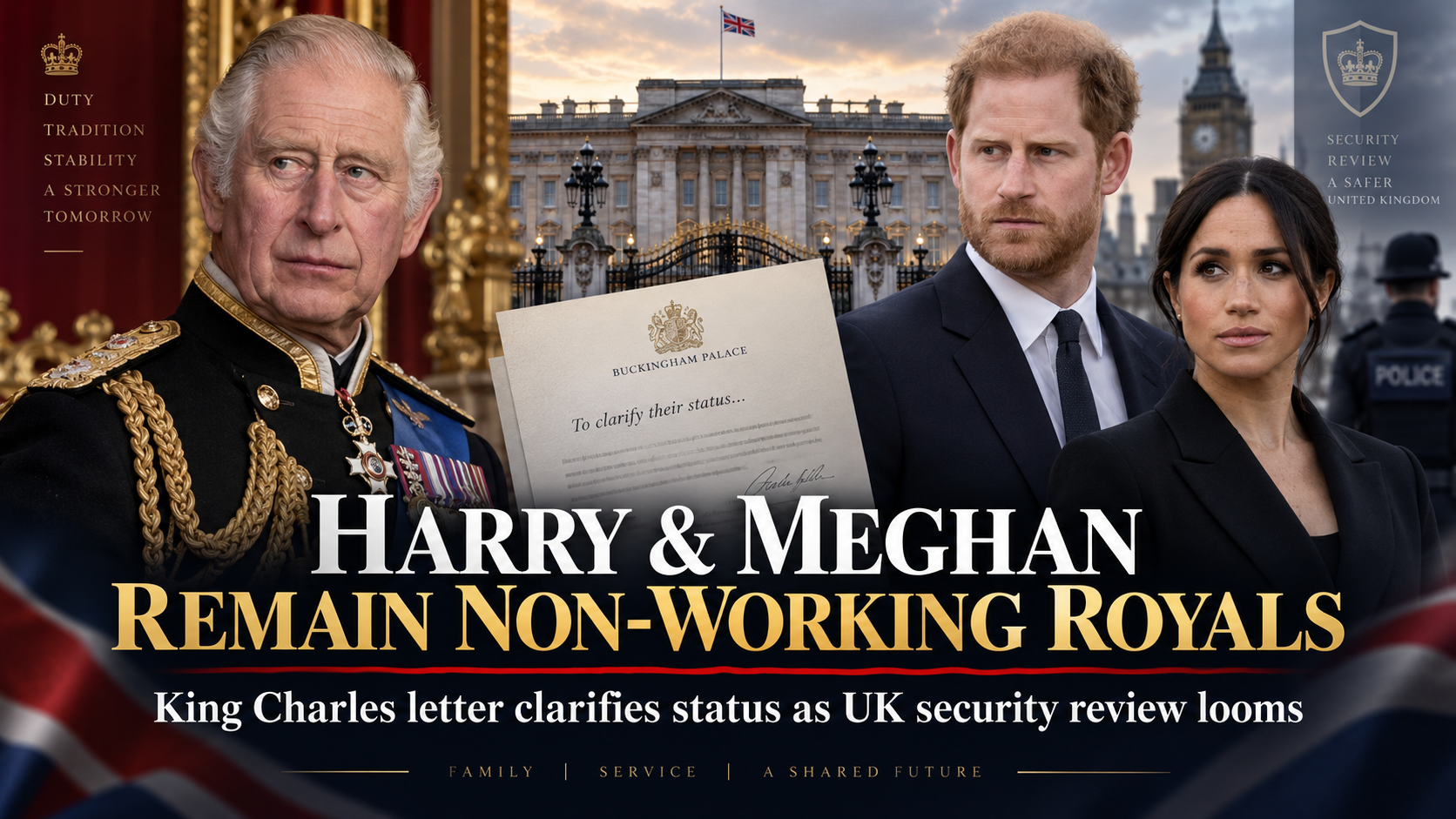
LONDON / Prince Harry and Meghan, the Duke and Duchess of Sussex, have expressed surprise over the way Buckingham Palace handled a formal letter issued on behalf of King Charles III reaffirming that the couple remain non-working members of the Royal Family, just weeks after they returned to live in Britain following six years in the United States.
A spokesperson for the Sussexes said the couple were “a little surprised” that they had not been given more advance notice before the letter was circulated publicly. Palace sources, however, maintain that Harry and Meghan’s representatives were informed before the document was released.
The disagreement appears to center less on the substance of the letter than on its timing. Reports indicate that the Sussexes received the communication only a little more than an hour before it was made available to the media, leaving their team limited opportunity to review or respond to it.
The episode has revived scrutiny of relations between the Sussexes and Buckingham Palace at a particularly sensitive moment. Harry, Meghan and their children, Prince Archie and Princess Lilibet, returned to Britain in late August after spending roughly six years primarily based in California. Their return represented a significant change after years of public disputes involving the Royal Family, the British press and Harry’s security arrangements.
The letter, issued by the Lord Chamberlain on King Charles’s behalf, was distributed to Prince Harry’s office as well as senior government officials, military authorities and Lord-Lieutenants, who serve as the monarch’s representatives around the country.
Its central message was unequivocal: the Sussexes’ return to Britain does not amount to a return to official royal life.
Harry and Meghan continue to hold the titles Duke and Duchess of Sussex, but they are not working royals and do not carry out engagements on behalf of the sovereign. Their charitable, commercial and public activities are therefore undertaken in a private capacity rather than as representatives of the Crown.
The clarification also preserves the arrangement governing their use of royal styles. Under the settlement reached after their withdrawal from official duties in 2020, Harry and Meghan no longer use the styles His Royal Highness and Her Royal Highness in their public working lives. Buckingham Palace stated at the time that the couple would no longer formally represent Queen Elizabeth II and would not receive public funds for carrying out royal duties.
That framework emerged from the January 2020 negotiations commonly associated with the Sandringham summit, when Queen Elizabeth and senior members of the Royal Family considered Harry and Meghan’s request to step away from their frontline roles.
The Queen initially said the Royal Family respected the couple’s desire for a more independent life, while acknowledging that the family would have preferred them to remain full-time working royals. The final arrangement effectively rejected a permanent “half-in, half-out” system under which the Sussexes could independently pursue commercial opportunities while simultaneously performing official duties for the monarch.
King Charles’s latest intervention therefore does not create a new constitutional position for Harry and Meghan. Instead, it formally restates boundaries that have existed for more than six years — boundaries that have become more relevant now that the Sussex family is once again living in Britain.
Palace officials appear particularly concerned that government departments, military organizations, local officials and others involved in organizing public appearances understand the distinction between a Sussex charitable or private appearance and an official royal engagement.
That distinction could become increasingly important as Harry and Meghan resume a more visible public schedule in Britain.
Prince Harry is expected to remain heavily involved with organizations including the Invictus Games Foundation, which he founded after being inspired by the U.S. Warrior Games. Birmingham will host the next Invictus Games from July 10 to 17, 2027, bringing the international sporting event for wounded, injured and sick service personnel and veterans back to Britain for the first time since the inaugural London Games in 2014.
The more immediate and potentially contentious question, however, concerns security.
RAVEC, the committee responsible for assessing protective security arrangements for members of the Royal Family and other prominent public figures, is expected to review what level of taxpayer-funded protection should apply to the Sussexes now that they are again based in Britain.
The issue has been one of the most serious points of dispute between Prince Harry and the British government since he stopped being a working royal.
After Harry and Meghan stepped away from royal duties in 2020, RAVEC decided that Harry would no longer automatically receive the same publicly funded police protection previously available to him. Instead, his protection while in Britain would be assessed according to the circumstances.
Harry launched a lengthy legal challenge against the decision, arguing that the arrangements were inadequate and made it difficult for him to bring his family safely to the UK.
In May 2025, however, the Court of Appeal rejected his challenge. The court acknowledged that Harry felt he had been treated unfairly but concluded that his concerns did not establish a legal error in RAVEC’s decision-making process. The official judicial summary confirmed that RAVEC had changed his security arrangements after he ceased performing official royal duties.
His permanent or extended return to Britain could now alter the circumstances considered by security officials, although it does not automatically guarantee the restoration of full-time taxpayer-funded police protection.
The Home Office follows a longstanding policy of refusing to discuss individual protective-security arrangements publicly, arguing that disclosure could undermine their effectiveness and potentially endanger those involved.
Buckingham Palace’s new letter similarly avoids determining the security question itself, directing operational security matters to the relevant police and government authorities rather than presenting them as a decision for the King.
The timing of the letter has nevertheless created another moment of tension.
From the Palace’s perspective, formally reminding institutions that the Sussexes remain private individuals may prevent confusion now that Harry and Meghan are physically back in Britain and likely to appear at high-profile charitable and public events.
From the Sussexes’ perspective, however, the limited warning before the letter became public appears to have raised concerns about communication between their office and Buckingham Palace.
Reuters reported that the couple’s surprise related particularly to how little time they were given before the announcement, while royal sources maintained that Harry’s representatives had been informed in advance.
The renewed debate highlights the unusual position Harry and Meghan continue to occupy.
They remain prominent members of King Charles’s family and retain their Duke and Duchess of Sussex titles, yet they operate outside the institution of the working monarchy. Their charitable projects, media ventures and other professional activities are their own, and their presence at an event should not be interpreted as an appearance on behalf of the King.
For Buckingham Palace, the latest letter appears designed to eliminate any ambiguity about that distinction.
For Harry and Meghan, however, their return to Britain opens a new chapter in which questions surrounding royal protocol, security, public appearances and their relationship with the wider Royal Family are likely to remain under intense scrutiny.
For now, one point has been made unmistakably clear: moving back to Britain has changed where the Sussexes live, but it has not changed their official position within the monarchy.