
Trump Faces Growing Scrutiny Over $5,000 Midterm Pledge, Media Ban, Disaster-Aid Remark and Other Controversies

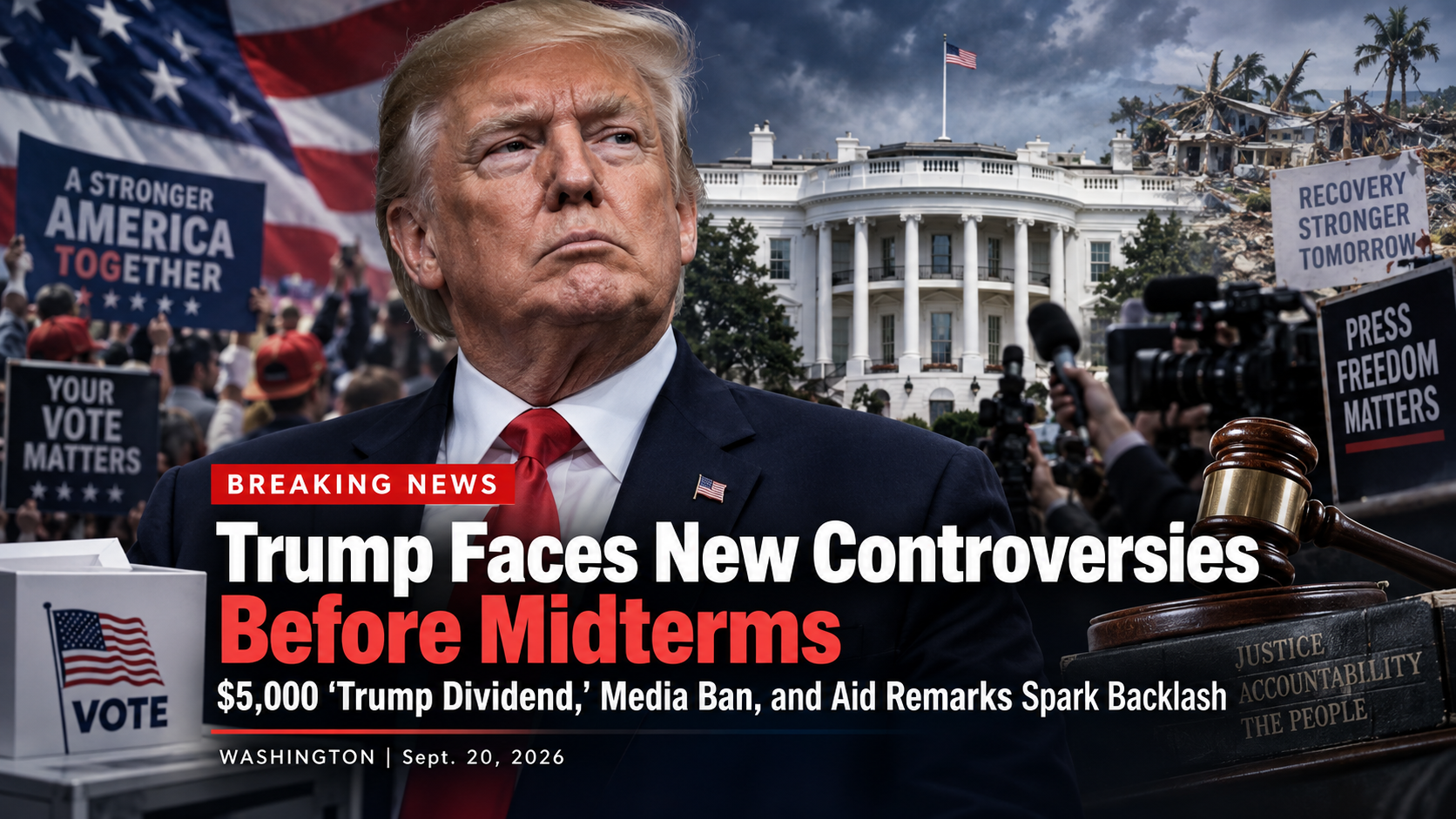
WASHINGTON, Sept. 20, 2026 / With the November 3 midterm elections approaching, President Donald Trump has generated a new series of political and legal controversies involving campaign promises, disaster assistance, the media, the 2024 assassination attempt against him and the Kennedy Center, while national polls continue to show significant voter concerns about aspects of his leadership and decision-making.
One of the most closely watched developments is Trump’s promise to provide a $5,000 “Trump dividend” to every American adult if Republicans retain control of both chambers of Congress. Trump announced the proposal at a Republican gathering in Dallas on September 9. The plan would require congressional action, and many Republican candidates have stopped short of embracing it. House Speaker Mike Johnson has also acknowledged that Congress would have to approve such a payment. A Reuters/Ipsos poll conducted September 11–14 found that 63% of Americans disapproved of the proposal, including 40% of Republicans.
Trump created another controversy at a September 16 campaign rally in Gastonia, North Carolina, while campaigning for Republican Senate nominee Michael Whatley. Discussing additional Hurricane Helene recovery money, Trump said, “If Michael loses, I’m not sending it,” before immediately adding, “No, I’m only kidding. You’re getting it.” The president was referring to billions of dollars in federal disaster and infrastructure assistance for North Carolina.
Two days later, Trump announced that CNN, MS NOW and Politico were being barred from the White House, accusing the organizations of producing “fake news.” The decision moved beyond rhetoric on September 19 when journalists from the three organizations were denied entry and some had their White House credentials confiscated or deactivated. The news organizations have challenged the action on First Amendment grounds and said they intend to continue covering the administration.
Trump has also revived controversy surrounding the July 2024 assassination attempt against him in Butler, Pennsylvania. He recently alleged on social media that the shooting was a “Democrat Plot.” Investigators, however, have publicly presented no evidence of a Democratic Party or broader political conspiracy involving gunman Thomas Matthew Crooks. Reuters reported this week that investigators continue examining new information about Crooks but still have found no evidence establishing such a conspiracy.
His statements surrounding the 25th anniversary of the September 11 attacks have received renewed scrutiny as well. Trump repeated claims about his presence and activities near Ground Zero following the attacks, including an account of firefighters carrying him away because another building appeared in danger of collapsing. The Washington Post reported that video confirms Trump was in the neighborhood near Ground Zero on September 13, 2001, but said the White House had not produced records corroborating his claims about sending workers into the recovery operation.
Meanwhile, Trump has sharply criticized Supreme Court justices — including some he appointed — after the court declined to allow his administration’s proposed restrictions on mail-in ballots to take effect before the midterms. He has also remained embroiled in a dispute over adding his name to the Kennedy Center. A federal judge ruled that such a change cannot be made without congressional authorization, after which the center’s Trump-aligned board voted to close much of the institution for extensive renovations. Trump later suggested he could block the renovation project if courts continued preventing the addition of his name.
The disputes come as several national surveys show skepticism among substantial portions of the public about Trump’s approach to presidential decision-making. An April 24–28 Washington Post-ABC News-Ipsos poll found that nearly 67% of Americans said Trump did not carefully consider important decisions. An April Reuters/Ipsos survey found only 26% described him as “even-tempered.” And a Fox News poll conducted September 11–14 found 71% of registered voters believed the Trump administration lacked a clear strategy for ending the Iran war.
The most recent Reuters/Ipsos survey, conducted September 11–14 among 1,143 U.S. adults, put Trump’s overall job approval at 35%, up slightly from 33% in an earlier survey. The poll had a margin of sampling error of about three percentage points.
Taken together, the developments ensure that Trump himself remains a central figure in the closing weeks of the 2026 campaign. Republicans are seeking to preserve their congressional majorities, while Democrats are focusing heavily on the administration’s economic, foreign-policy and governing record. How voters ultimately weigh those issues will be determined at the polls on November 3.