Iran Sends War-Ending Terms to Washington as Houthi Attacks on Saudi Arabia Raise Regional Stakes

TEHRAN/RIYADH, Sept. 19, 2026 / Iran says it has formally conveyed conditions for ending its conflict with the United States to Washington through Qatari mediators, even as a sharp escalation between Yemen’s Houthis and Saudi Arabia threatens to open an increasingly dangerous new front in the wider Middle East war.
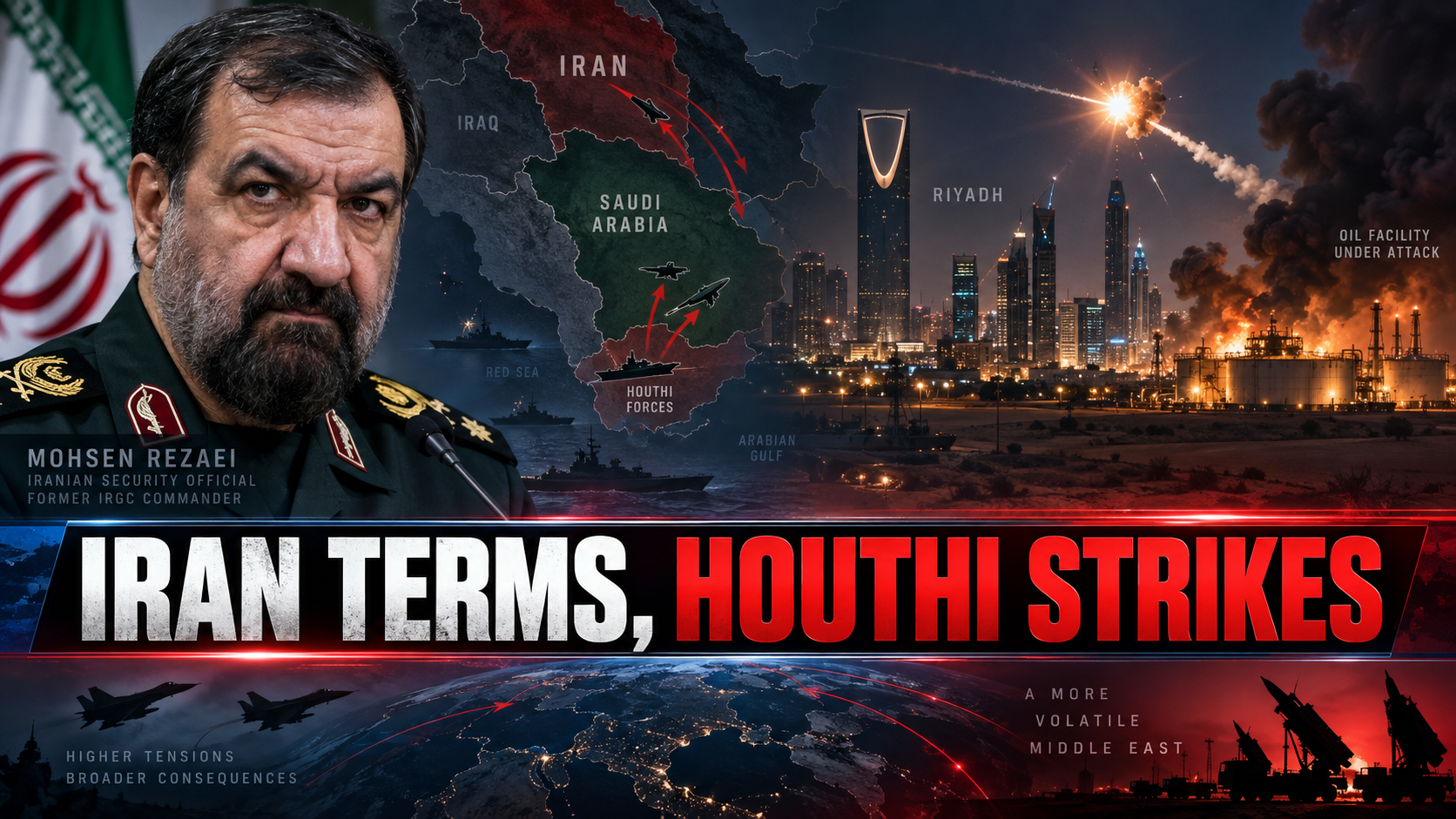
Mohsen Rezaei, secretary of Iran’s Supreme National Security Council, told Al Jazeera that Tehran remains in contact with Qatar and is awaiting a response from U.S. President Donald Trump. Rezaei said Iran’s conditions include ending the war “on all fronts,” releasing frozen Iranian funds and ending what Tehran describes as a U.S. naval blockade.
Rezaei, who took over as secretary of Iran’s powerful security council roughly a month ago, presented a dual message: Iran is prepared to pursue diplomacy but is also preparing for further military confrontation if negotiations fail. He said Qatar and Pakistan remain involved in efforts to restore negotiations between Tehran and Washington.
The diplomatic opening comes as fighting involving the Iran-aligned Houthi movement in Yemen has intensified dramatically.
The Houthis said Saturday that they launched ballistic and cruise missiles and drones against what they described as “sensitive” targets in Riyadh and against Saudi Aramco facilities in Yanbu, a major oil-exporting city on Saudi Arabia’s Red Sea coast. The group said the attacks were retaliation for strikes on Yemen.
Saudi-led coalition forces said air defences intercepted and destroyed a ballistic missile heading toward Riyadh and thwarted additional attacks targeting Bisha, Taif, Farasan and Yanbu. Saudi authorities reported no casualties or damage from the intercepted Riyadh missile.
Reuters footage showed a large column of black smoke rising near Riyadh’s King Khalid International Airport after explosions were heard, with flames visible near what appeared to be fuel-storage facilities. The precise cause of the fire was not immediately independently established.
Saturday’s attack claim appeared to mark the Houthis’ first reported strike against Riyadh since the latest Saudi-Houthi escalation began in July. The confrontation has increasingly drawn Saudi cities, energy facilities and Red Sea shipping into the broader regional conflict.
Saudi Arabia has warned that it reserves the right to take measures to defend civilians and critical infrastructure. However, reports that Riyadh and its partners are preparing an imminent, enormous land-sea-air assault should be treated as analysis rather than an officially announced military plan.
Nawaf Obaid, a senior research fellow at King’s College London, told Al Jazeera that he believes a coalition is forming around Saudi Arabia and predicted that any eventual response could be “sequenced” and involve land, sea and air forces. His assessment has not been fully confirmed by the governments he suggested could participate.
There are, however, signs of increased regional security coordination. Turkish Foreign Minister Hakan Fidan said Saturday that Ankara is prepared to help Saudi Arabia meet military or technical requirements under the recently signed Mecca Joint Defence Agreement involving Turkey, Saudi Arabia and Pakistan. The agreement treats an armed attack against one member as an attack against all three.
Fidan stopped short of announcing Turkish combat participation. Pakistan has likewise said there have been no discussions so far about an immediate Pakistani military response under the pact.
The United States, meanwhile, issued a regional security warning urging Americans in the Middle East to exercise heightened vigilance because of the escalating Houthi attacks. Washington also advised Americans outside the region to seriously reconsider travel through parts of the Middle East.
The United Nations Security Council has condemned continuing Houthi attacks on Saudi Arabia, including strikes affecting civilian and energy infrastructure, while also expressing concern about the group’s military escalation inside Yemen.
The renewed fighting is producing a rapidly worsening humanitarian crisis. The UN migration agency said at least 112,000 people had been displaced inside Yemen within two weeks, while nearly 3,000 people had fled across the Gulf of Aden to Djibouti as fighting intensified along Yemen’s western coast.
The strategic implications extend far beyond Yemen and Saudi Arabia. Houthi advances along Yemen’s Red Sea coast have increased concerns about security around the Bab el-Mandeb Strait, one of the world’s most important maritime passages, while disruptions around the Strait of Hormuz have already complicated Gulf energy exports and international shipping.
Against that backdrop, Rezaei said Tehran itself wants the Saudi-Houthi war brought to an end and believes a settlement is possible. His broader proposal to Washington suggests that Iran is attempting to connect several regional battlefronts to a single diplomatic settlement.
But there is still no public indication that Washington has accepted Tehran’s conditions, and Rezaei simultaneously warned that Iran is preparing for another major confrontation should diplomacy fail.
The result is an increasingly precarious situation: diplomatic channels involving Qatar and Pakistan remain active, while missile attacks, air strikes and military preparations continue across the region at the same time. Whether those parallel tracks lead toward negotiations or a wider confrontation remains unresolved.