Trump Unveils New Tariffs on 14 Major Trading Partners, Reigniting Global Trade Tensions

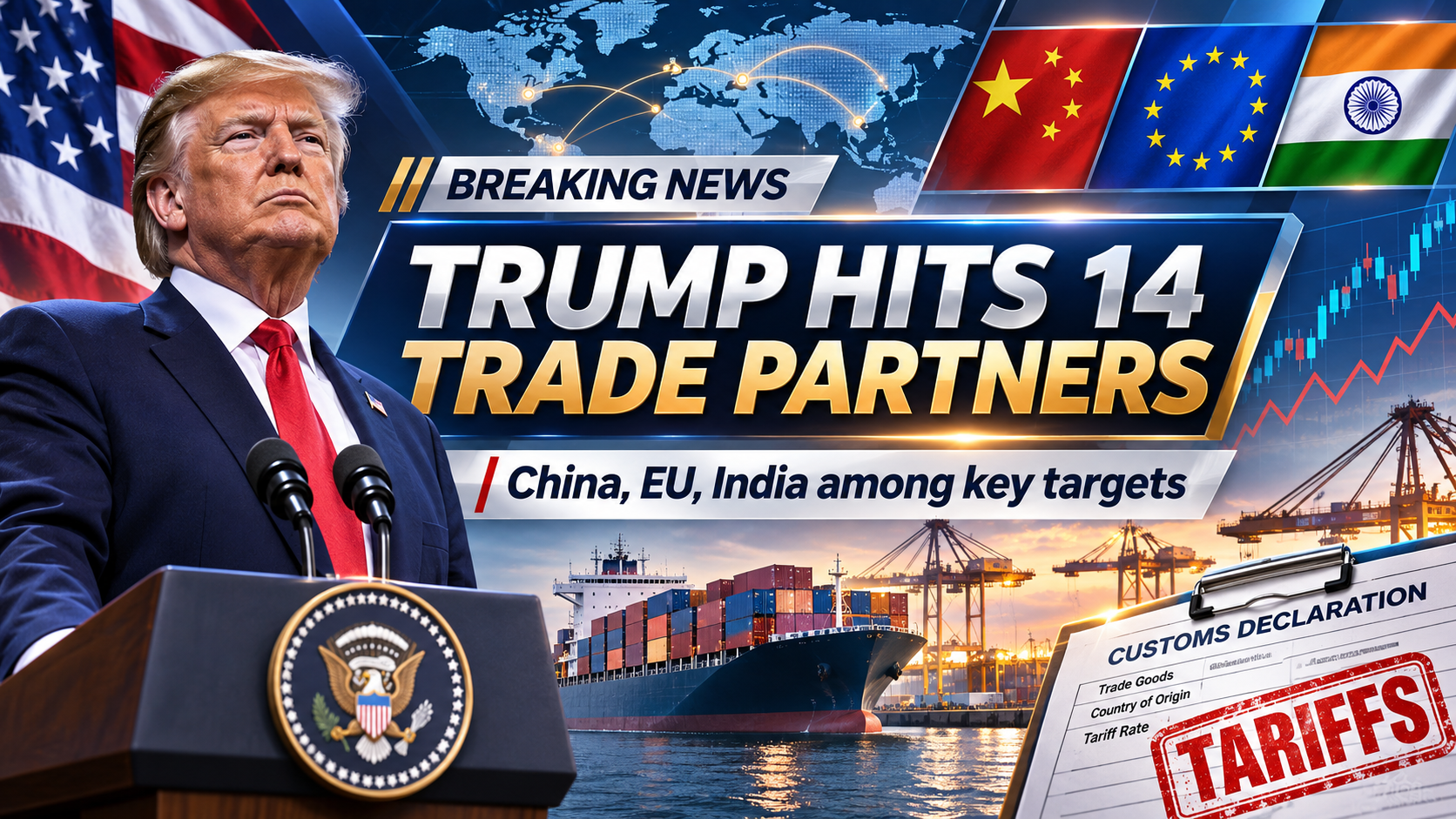
Washington, D.C., November 25, 2026: The administration of U.S. President Donald Trump announced a sweeping new round of proposed tariffs on 14 major trading partners on Wednesday, intensifying global economic tensions and triggering uncertainty across international financial markets.
The announcement follows an eight-month investigation by the Office of the United States Trade Representative (USTR), which concluded that industrial policies, government subsidies, excessive manufacturing capacity and other allegedly unfair trade practices in several economies have disadvantaged American manufacturers, workers and businesses.
The latest tariff initiative comes after the U.S. Supreme Court struck down Trump’s sweeping global tariffs in February 2026. The administration is now pursuing its protectionist trade agenda under Section 301 of the Trade Act of 1974, which authorizes action against foreign trade practices deemed unfair or discriminatory toward American commerce.
U.S. Trade Representative Jamieson Greer defended the administration’s decision, arguing that decades of market-distorting industrial policies have weakened American manufacturing, reduced employment opportunities and increased dependence on foreign supply chains. The administration maintains that the proposed measures are intended to restore fair competition and encourage domestic manufacturing.
The proposed tariff rates, subject to existing trade agreements, negotiations and product-specific exemptions, are as follows:
- Vietnam: Up to 35%, potentially reduced to 20% under a trade agreement.
- India: Up to 25%, potentially reduced to 17% under a trade agreement.
- China: Up to 20% under the existing trade arrangement.
- Singapore: Up to 20%, potentially reduced to 10% through negotiations.
- Bangladesh, Cambodia, Indonesia, Malaysia and Thailand: Up to 18%.
- European Union, Japan, South Korea, Switzerland and Taiwan: Up to 15%.
These rates do not necessarily represent uniform additional duties on every imported product, as existing tariffs, negotiated limits and exemptions will influence the final charges.
China remains a central target of Washington’s trade policy. The proposed duties would come alongside tariffs imposed during Trump’s first presidential term. However, approximately $30 billion worth of Chinese imports being considered for preferential tariff treatment under a bilateral trade mechanism would be exempt from the latest measures.
Mexico and Norway, which were also included in the original investigation, have been excluded from Wednesday’s announcement because investigations remain ongoing. Nepal is not among the economies targeted by this particular round of tariffs.
In a separate development, the administration proposed a 10% tariff on finished commercial aircraft manufactured by Brazilian aerospace company Embraer, along with higher duties on Brazilian sugar imports exceeding established quotas. The aircraft proposal could have implications for American regional airlines that extensively operate Embraer jets.
The announcement has drawn criticism from several international governments. China rejected Washington’s allegations of industrial overcapacity, accusing the United States of politicizing international trade. Beijing urged Washington to maintain stable bilateral economic relations and honor existing agreements.
The European Union also rejected the administration’s findings, arguing that European industries are themselves vulnerable to global industrial overcapacity. Switzerland expressed opposition to the allegations, while Norway welcomed its exclusion from the proposed measures.
Legal experts have questioned whether the administration’s expanded reliance on Section 301 could undermine Congress’s constitutional authority over taxation and international trade. The initiative could face further legal and political scrutiny, particularly following Republican losses in the November midterm elections.
Financial markets reacted sharply to the announcement. The technology-heavy Nasdaq Composite plunged more than 4% during early trading before recovering significantly to close 0.6% lower. The S&P 500 declined 0.25%, while the Dow Jones Industrial Average reversed earlier losses and finished approximately 0.3% higher.
Gold prices dropped more than 3%, reaching their lowest level in over a year, as investors assessed both the tariff announcement and fresh U.S. inflation data. Government bond yields also declined in the United States and Europe, reflecting growing concerns about economic uncertainty.
Economists warn that although tariffs could benefit certain American manufacturers by reducing foreign competition, they could also increase production costs for businesses dependent on imported materials, raise consumer prices, disrupt global supply chains and complicate the Federal Reserve’s monetary policy decisions.
The announcement comes ahead of the December G20 meetings, where international trade disputes are expected to become a major subject of discussion among world leaders.
The proposed tariffs have not yet taken effect. The USTR has set January 5, 2027, as the deadline for written public comments, with public hearings scheduled to begin on January 25, 2027.
While the Trump administration describes its latest initiative as a necessary step toward rebuilding American manufacturing and correcting global trade imbalances, critics fear that renewed protectionism could escalate international trade disputes, intensify inflationary pressures and create greater economic and financial instability in 2027.
The coming weeks of diplomatic negotiations and public consultations will be crucial in determining whether the latest tariff proposals lead to new trade agreements or another prolonged global trade confrontation.