Once a Nepali, Always a Nepali: Do Not Separate Us From Our Homeland

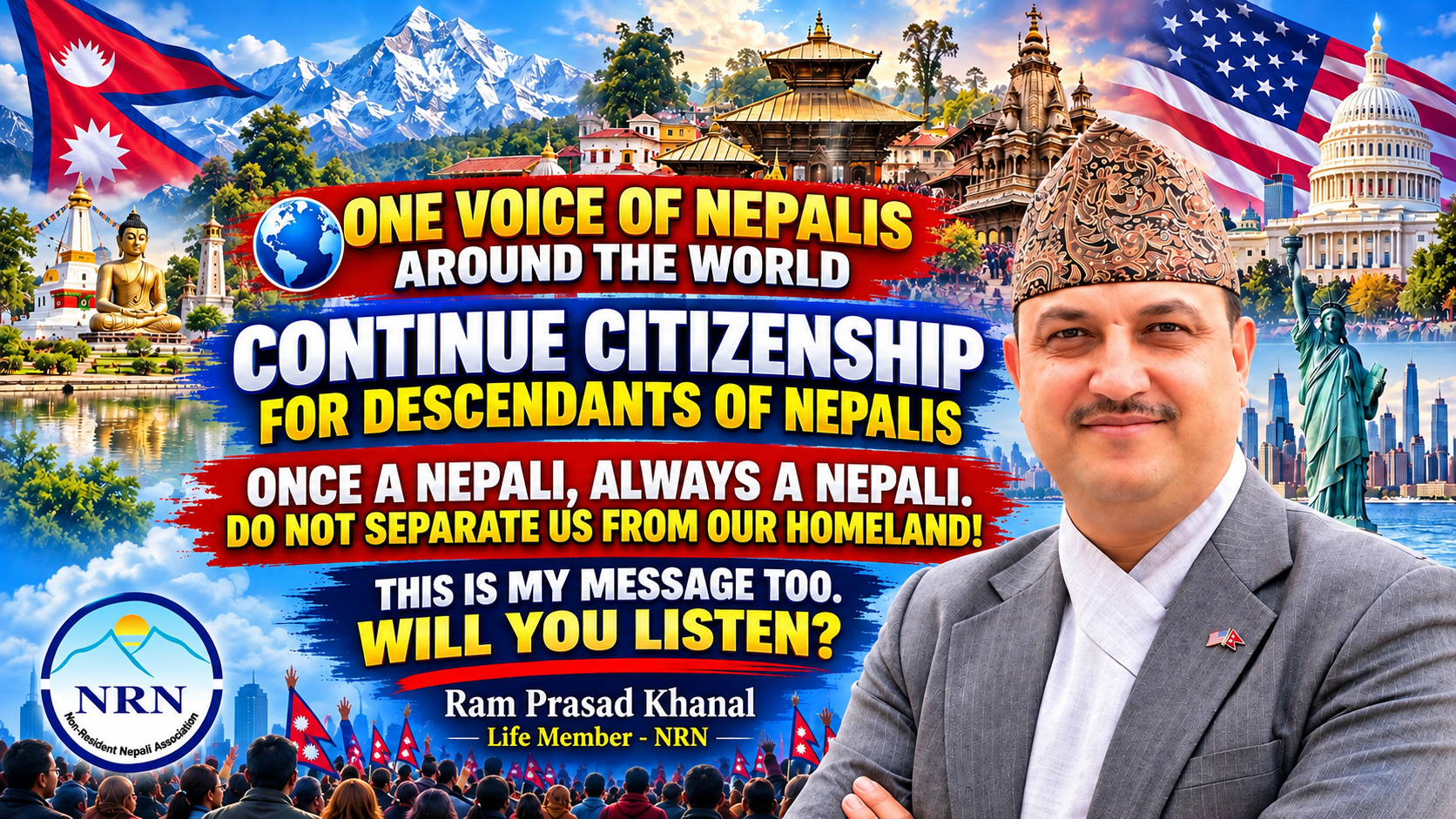
* One Voice of Nepalis Worldwide: Continue Citizenship for People of Nepali Descent
-
Nepali Diaspora Calls on the Government to Honor Its Citizenship Promises
– By Ram Prasad Khanal
Millions of Nepalis living across different parts of the world are asking the same fundamental question today: Why is our bond with Nepal, the country where we were born, raised, and where our ancestors shed their blood, sweat, and tears, being weakened?
Acquiring foreign citizenship may be the result of necessity, employment, security, family circumstances, professional obligations, or the realities of life abroad. But a change of citizenship does not erase a person’s history, ancestry, emotions, love for the motherland, or connection to the country of birth. A passport may change. The country of residence may change. But one’s ancestral homeland, roots, heritage, and identity do not simply disappear.
That is why the message from Nepalis around the world is clear: Ensure the continuity of citizenship for people of Nepali descent. Once a Nepali, always a Nepali. Do not separate us from our own homeland.
This is not the demand of one individual, one organization, or one political group. It is a question of identity, belonging, continuity, and the right of the Nepali diaspora to remain connected with Nepal for generations to come.
Nepal’s Constitution provides for Non-Resident Nepali citizenship with certain economic, social, and cultural rights. Yet in practice, issues related to citizenship, property, family rights, administrative procedures, and relations with the state remain complicated, unclear, and inconsistent. Granting rights on paper while making them difficult to exercise in practice is not a genuine solution.
More importantly, before recent elections, various political parties addressed the concerns of Non-Resident Nepalis and expressed support for the principle of “Once a Nepali, always a Nepali.” They spoke about continuity of citizenship, property rights, investment security, and strengthening the relationship between Nepal and Nepalis living abroad.
That is why the government and political leadership must now be asked a direct question: What happened to the promises you made during the election? Have you forgotten them?
Nepal has repeatedly witnessed a political culture in which one thing is promised while seeking votes and something entirely different is said after reaching power. Previous governments repeatedly offered assurances to Non-Resident Nepalis. Committees were formed. Declarations were made. Speeches were delivered. Yet when the time came for concrete decisions and full implementation, the issue was delayed, diluted, or pushed aside.
Much was expected from newer political forces. They promised a different kind of politics, pledged to honor commitments made to the public, and spoke of redefining Nepal’s relationship with its global diaspora. If those same forces now begin retreating from their commitments, changing their language, or avoiding the issue, it is only natural that serious questions will be raised.
The government must understand one thing very clearly. Non-Resident Nepalis are not merely people who send money back to Nepal. They are Nepal’s sons and daughters. Their parents are in Nepal. Their brothers and sisters are in Nepal. Their ancestral homes are in Nepal. Their land and property are in Nepal. Their traditions are rooted in Nepal. Their language is connected to Nepal. Their religious and cultural ties remain deeply linked to Nepal.
Millions of Nepalis living abroad have built homes in Nepal, invested in businesses, and contributed to schools, hospitals, temples, social organizations, charitable initiatives, and development projects. Their skills, capital, experience, international exposure, and global networks are valuable national assets.
Therefore, distancing our own people from Nepal, emotionally or legally, cannot serve the national interest.
Another serious question must also be raised. If Nepal can provide legal pathways for foreign nationals to obtain naturalized citizenship under certain conditions, why should people born into Nepali families, born in Nepal, or descended from Nepali parents lose their fundamental citizenship connection with Nepal simply because they acquired the citizenship of another country?
If the state can create laws to make foreigners Nepali citizens, should it not be even more natural, fair, and necessary to create laws that preserve the connection of people of Nepali descent with Nepal?
This does not mean there should be no restrictions relating to national security, sensitive public offices, constitutional responsibilities, or certain government positions. Clear exceptions can be established where necessary. But such exceptions should not become an excuse to sever people of Nepali ancestry from their fundamental relationship with their homeland.
Many countries regard their diaspora as a national strength. Nepal, too, must learn to view its people abroad not as a problem, but as an asset and a source of national strength.
Nor should we assume that the existing system of Non-Resident Nepali citizenship is sufficient. Serious practical challenges remain. If people obtain NRN citizenship but still face uncertainty and difficulties in property ownership, investment, banking, inheritance, family matters, and administrative procedures, then the value of that citizenship is greatly diminished.
The time has therefore come for Nepalis around the world to become more aware and more united on this issue. This should not be raised as support for or opposition to any particular political party. It should be pursued as a long-term national right of people of Nepali descent.
Nepalis living in the United States, the United Kingdom, Australia, Canada, Japan, Europe, the Middle East, Africa, Asia, and elsewhere should speak with one voice and remind the government: We have not forgotten the promises made during the election.
Social media has become one of the strongest tools connecting Nepalis across the globe. Facebook, X, TikTok, YouTube, Instagram, and other platforms should therefore be used to create peaceful, factual, and sustained public pressure. Let us write to lawmakers. Let us question ministers. Let us remind political parties of their manifestos. Let us remind them of the speeches they delivered before the election.
Let us ask one simple question: What exactly did you promise?
This is not an anti-government campaign. It is a civic movement asking the government to honor its own commitments.
I also have a special appeal to the leadership of the NRNA. The issue of citizenship continuity must not be reduced to a session at a conference, a paragraph in a declaration, or an opportunity to take photographs with political leaders. It should become one of the organization’s central priorities.
NCCs and the ICC around the world should develop a common strategy. There should be sustained dialogue among legal experts, constitutional scholars, political leaders, members of parliament, the government, and the Nepali diaspora. A clear legal proposal should be prepared. If constitutional amendment is necessary, efforts should be made to build broad national consensus.
NRNA leadership cannot remain silent on this issue. Leadership is not merely about holding a position. It is about becoming the voice of the community when that voice is needed most.
My appeal to the government is equally clear. Do not reduce this issue to emotional slogans alone. Remember what you promised during elections. Honor the commitments made to the people. Introduce a clear, practical, and long-term legal solution for the continuity of citizenship for people of Nepali descent.
Simplify the process. Remove unnecessary administrative barriers. Protect property rights, inheritance, investment, family relationships, and civic identity.
We are not asking to take anything away from Nepal. We simply want to remain connected with Nepal.
We do not want to weaken Nepal. We want to strengthen it.
We may live abroad, but Nepal remains our history, our identity, our emotion, and the land of our ancestors.
So I say once again: Ensure the continuity of citizenship for people of Nepali descent. Once a Nepali, always a Nepali. Do not separate us from our own homeland.
Previous governments disappointed us. The new government should not follow the same path. Election promises must not remain confined to paper. Nepalis around the world must now remain alert, raise their voices, and hold the government accountable.
This is my message too. Will the government listen?
* Life Member, Non-Resident Nepali Association, NRNA