Nepal PM Balen Shah Concludes India Visit with Rs 240 Billion Aid Package, Eight Agreements and Major Development Commitments

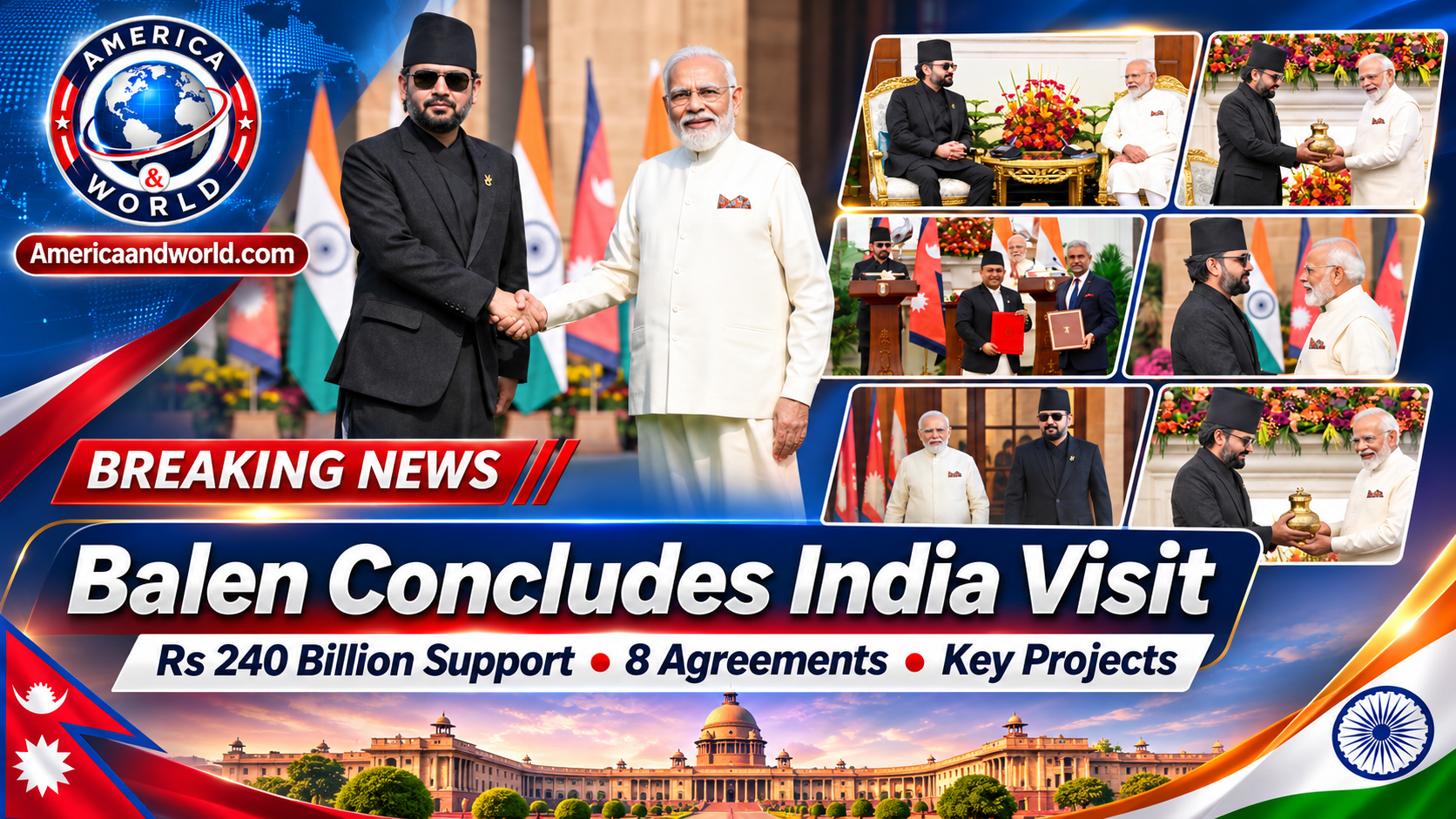
KATHMANDU, November 23, 2026 / Nepalese Prime Minister Balendra Shah, popularly known as Balen, returned home Monday evening after concluding a two-day state visit to India that produced a major economic assistance package, eight bilateral agreements and several significant infrastructure and connectivity commitments.
The visit, Shah’s first to India since assuming office, marked an important diplomatic engagement between Kathmandu and New Delhi, with both governments seeking to strengthen economic cooperation, rebuild mutual confidence and modernize their longstanding partnership.
During his visit, Shah held high-level bilateral talks with Indian Prime Minister Narendra Modi in New Delhi. The two leaders reviewed relations across multiple sectors, including economic development, trade, energy, transportation, border infrastructure, education and technology. Shah also met Indian President Droupadi Murmu.
The most significant announcement was India’s commitment to provide NPR 240 billion (INR 150 billion), approximately $1.62 billion, in development assistance to Nepal. The package includes NPR 56 billion in grants for post-disaster reconstruction and infrastructure projects and NPR 184 billion in concessional credit for energy development.
The assistance follows devastating floods that caused substantial damage in Nepal. The specific projects and financing arrangements will be finalized through further consultations between the two governments.
A major breakthrough came in aviation cooperation, with India agreeing to make the existing Kathmandu–Bhairahawa–Lucknow B345 air route bidirectional. Nepal has long sought improved access to Indian airspace to increase international flight operations, particularly at Gautam Buddha International Airport in Bhairahawa.
The agreement could improve Nepal’s international air connectivity and tourism prospects, although technical procedures must still be completed before the new arrangements become operational.
Trade and transit cooperation also received a significant boost. Modi announced that Nepal would gain additional access to India’s Deendayal Port at Kandla in Gujarat. Access to Paradip Port in Odisha will follow once the necessary infrastructure is established.
The additional ports are expected to provide alternative routes for Nepal’s international trade, potentially reducing transportation costs and improving access to overseas markets.
In another symbolic achievement, the two prime ministers jointly inaugurated the Sarayu–Kamala Express railway service connecting Ayodhya in India with Janakpur in Nepal. The service is expected to strengthen religious tourism and cultural ties under the Ramayana Circuit initiative.
Both governments also announced progress on the proposed Raxaul–Kathmandu electrified railway and agreed to cooperate on Nepal’s East–West Railway project.
Several cross-border infrastructure initiatives were advanced, including a new integrated check post at Banbasa and a motorable bridge connecting Dharchula in India with Darchula in Nepal.
Energy cooperation remained a central focus. Shah and Modi jointly laid the foundation stone for the 669-megawatt Lower Arun Hydroelectric Project and directed the relevant authorities to accelerate preparations for the long-delayed Pancheshwar Multipurpose Project.
The leaders also agreed to advance work on the Saptakoshi and Sunkoshi multipurpose projects, which are intended to support energy development, water management and flood mitigation.
Petroleum infrastructure featured prominently in the discussions. The second phase of the Motihari–Amlekhgunj petroleum pipeline was inaugurated, while the foundation stone was laid for a new petroleum terminal in Jhapa. Both countries committed to advancing the Siliguri–Jhapa petroleum pipeline and exploring cooperation on cross-border gas pipelines.
Education and technological development emerged as additional priorities. India agreed to establish an Indian Institute of Technology (IIT) campus in Nepal, a move expected to expand access to advanced technical education, research and employment opportunities.
India also announced support for an agro-industrial park in Chitwan, designed to promote agricultural processing and industrial development.
The two countries exchanged eight memoranda of understanding, covering forensic science and criminal investigation, police training, civil service capacity building, traditional medicine, satellite communications, sustainable urban development, healthcare, and livestock and fisheries development.
Beyond individual projects, the two leaders adopted a broader strategic framework titled Viksit Bharat and Samunnat Nepal, meaning “Developed India and Prosperous Nepal.”
The joint vision outlines cooperation in traditional areas such as trade, investment, energy and transportation while expanding partnerships in digital services, innovation, climate resilience, disaster management, sports and technology.
Importantly, the document also provides for the possible review of existing bilateral agreements, including the 1950 India–Nepal Treaty of Peace and Friendship, through mutual consent.
Both sides agreed that outstanding issues concerning borders, trade, energy and water resources should be addressed through diplomatic dialogue.
A high-level monitoring mechanism will meet at least once every six months to review the implementation of agreed projects and initiatives.
Before concluding his visit, Shah formally invited Modi to Nepal. The Indian prime minister accepted the invitation, with the dates to be determined through diplomatic channels.
Following Shah’s return, Nepalese Foreign Minister Shishir Khanal described the visit as an important step toward strengthening bilateral relations and opening new opportunities for economic cooperation.
The visit comes at a time when Nepal is seeking greater infrastructure investment, improved international connectivity and a stronger foundation for economic growth.
However, the announced NPR 240 billion package is not entirely grant assistance. Approximately 77 percent consists of credit facilities, while the remaining 23 percent is grant funding. The financial implications and benefits will therefore depend on project selection, financing terms and effective implementation.
Similarly, several agreements, including the proposed IIT campus, expanded port access, aviation arrangements and major hydropower projects, still require further planning or execution.
Ultimately, the success of Shah’s India visit will be measured not only by the scale of the announcements but by how effectively they translate into completed projects, economic opportunities and tangible improvements in the lives of Nepalese citizens.
The agreements signal renewed momentum in Nepal–India relations, with both governments presenting a shared commitment to transforming their historical partnership into a more practical, development-oriented relationship.
Research verified against the November 23, 2026 joint statement issued by India’s Prime Minister’s Office, the bilateral Joint Vision document, and contemporary international reporting.