
Trump’s Philippines Visit Sets Stage for Historic Talks With Xi and Putin in China as Global Security Tensions Rise

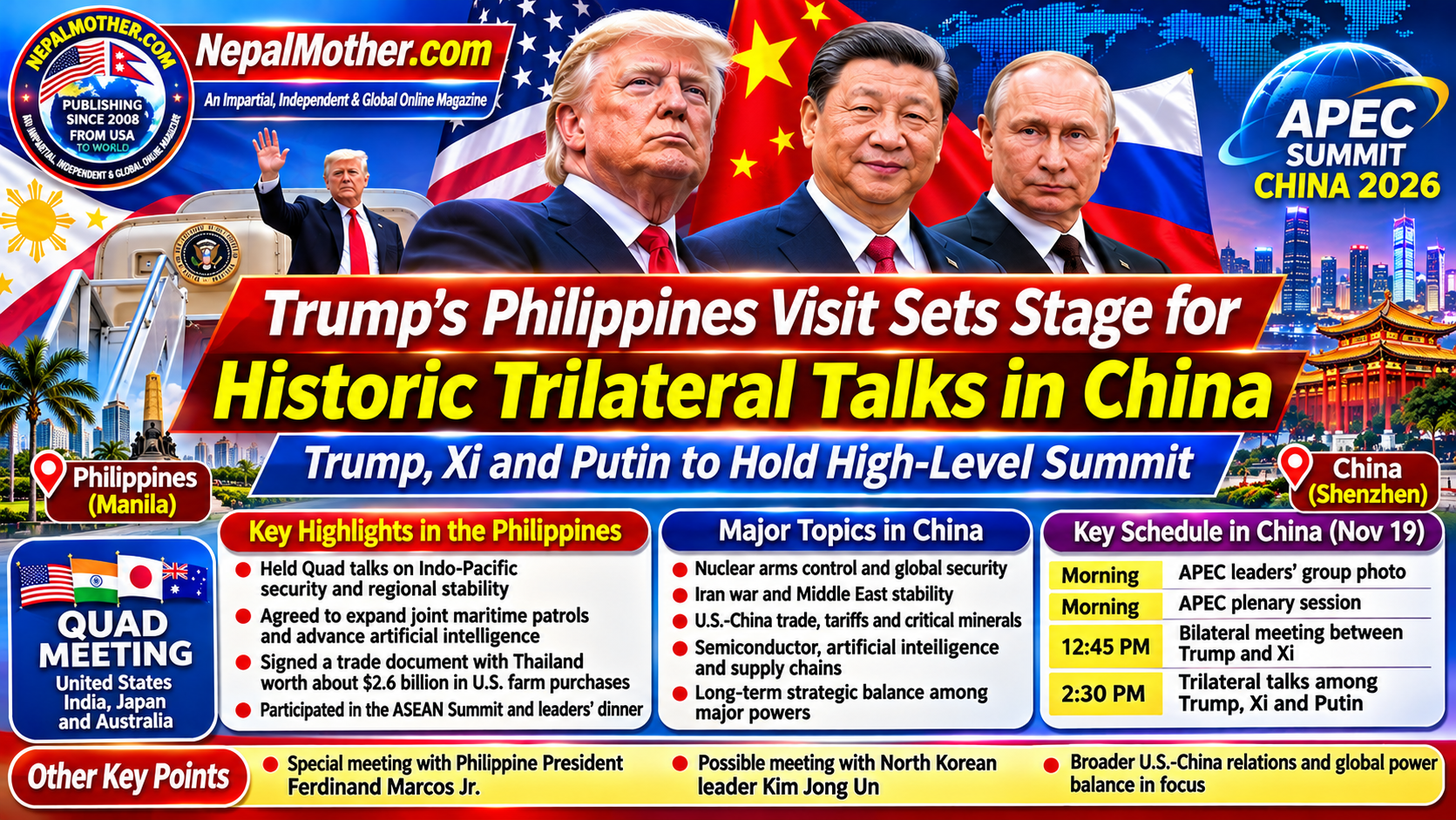
Manila, Philippines | November 17, 2026
U.S. President Donald Trump has launched a major diplomatic mission to Asia, beginning with security and trade discussions in the Philippines before traveling to China for an anticipated historic meeting with Chinese President Xi Jinping and Russian President Vladimir Putin.
The visit comes at a critical moment for international relations, with tensions surrounding the U.S. and Iran conflict, Russia’s invasion of Ukraine, growing competition between Washington and Beijing, nuclear arms control, and disputes in the South China Sea.
Trump arrived in Manila on Tuesday, November 17, where he participated in meetings with regional leaders, strengthened economic partnerships, and reaffirmed America’s strategic interests in the Indo Pacific.
His next destination is Shenzhen, China, where the leaders of the United States, China, and Russia are reportedly scheduled to meet on November 19 on the sidelines of an international economic summit. The proposed three way meeting could become one of the most consequential diplomatic events of the year.
Trump Holds Major Security Talks With Quad Leaders in Manila
One of the most important developments during Trump’s visit was his meeting with the leaders of the Quadrilateral Security Dialogue, commonly known as the Quad.
The four participating countries are the United States, India, Japan, and Australia.
Trump met Indian Prime Minister Narendra Modi, Japanese Prime Minister Sanae Takaichi, and Australian Prime Minister Anthony Albanese to discuss maritime security, economic resilience, advanced technologies, and regional stability.
The talks focused on maintaining a free and open Indo Pacific amid concerns about China’s growing military and economic influence.
The Quad countries announced initiatives involving maritime surveillance, critical mineral supply chains, cybersecurity, and artificial intelligence.
The leaders also outlined plans for maritime cooperation involving patrol aircraft and efforts to reduce dependence on individual countries for essential minerals and advanced technologies.
These initiatives are particularly significant because China maintains a dominant position in several critical mineral supply chains used in electric vehicles, advanced weapons, semiconductors, and modern communication systems.
Trump Announces Progress on Trade Agreement With Thailand
Trump also met Thai Prime Minister Anutin Charnvirakul and signed a joint statement advancing negotiations toward a reciprocal trade agreement.
Trump announced that Thailand was expected to purchase approximately $2.6 billion in additional American agricultural products.
He also said the proposed agreement would expand opportunities for American exporters and reduce barriers affecting several U.S. industries.
However, the announcement did not represent a fully finalized trade agreement. Both governments acknowledged that additional negotiations and formal procedures would be necessary before implementation.
Trump also participated in ASEAN related diplomatic gatherings and a leaders’ dinner, emphasizing the importance of Southeast Asia to American economic and security interests.
Trump to Meet Philippine President Ferdinand Marcos Jr.
On Wednesday, November 18, Trump is scheduled to meet Philippine President Ferdinand Marcos Jr. at the presidential palace in Manila.
The discussions are expected to emphasize the longstanding U.S. and Philippines defense alliance, military cooperation, trade, energy, and security challenges in the South China Sea.
Tensions between China and the Philippines have increased over competing territorial and maritime claims.
Manila has sought stronger American security assurances as confrontations involving Chinese and Philippine vessels continue in disputed waters.
The United States and the Philippines are bound by a mutual defense treaty, making their security relationship a major factor in regional stability.
Trump’s discussions with Marcos will therefore be watched closely by governments across Southeast Asia, particularly those concerned about China’s expanding influence.
Historic Trump, Xi and Putin Meeting Planned in China
Following his visit to the Philippines, Trump is expected to travel to Shenzhen on November 18 for an international economic summit.
On November 19, Trump is reportedly scheduled to meet President Xi Jinping for bilateral discussions, followed by a trilateral meeting involving Russian President Vladimir Putin.
The three leaders represent some of the world’s most influential geopolitical powers and control three of the world’s largest nuclear arsenals.
The proposed meeting would mark a significant diplomatic development if all three leaders participate together.
According to the reported presidential schedule, Trump is expected to meet Xi at approximately 12:45 p.m. China time, followed by the proposed trilateral meeting at 2:30 p.m.
However, diplomatic agendas and schedules remain subject to change, and the arrangements should not be considered final without official confirmation.
Nuclear Weapons, Iran War and Global Security Dominate the Agenda
Nuclear arms control is expected to be a central subject of the discussions.
Washington has expressed interest in bringing China into broader nuclear weapons negotiations involving Russia and the United States.
The ongoing conflict involving the United States and Iran could also become a major topic.
Russia and China maintain important relationships with Tehran, making their positions particularly significant as Washington considers future military and diplomatic options.
Ukraine remains another sensitive issue. Although American officials have reportedly indicated that the war is not a principal item on the proposed trilateral agenda, it could still arise during discussions.
The possibility of the three governments discussing major security questions without direct participation from other affected countries has also generated concern among some American allies.
Diplomatic observers caution that a comprehensive nuclear agreement or major geopolitical settlement is unlikely to emerge from a single meeting. Nevertheless, direct dialogue could establish a framework for future negotiations.
U.S. and China Trade and Technology Rivalry Take Center Stage
Trump’s bilateral meeting with Xi could be equally important for the global economy.
The United States and China remain deeply connected through international trade, manufacturing, technology, and financial markets, even as their strategic rivalry intensifies.
Their discussions are expected to address tariffs, Chinese restrictions on rare earth exports, American semiconductor export controls, and broader economic cooperation.
Advanced artificial intelligence chips have become a particularly contentious issue, as Washington seeks to protect sensitive American technology while Beijing pushes to strengthen its domestic semiconductor industry.
The discussions may influence future expectations for technology companies, manufacturing industries, global supply chains, and international investors.
While no major agreement has yet been announced from the anticipated talks, any movement toward reducing trade tensions could carry significant economic implications.
Latest Update: Trump Open to Separate Meeting With Putin
In a significant development on November 17, Trump reportedly indicated that he would be willing to meet Putin separately during the China summit if an opportunity becomes available.
Such a meeting would follow their August 2025 summit in Alaska, which did not produce a ceasefire in Ukraine.
Trump’s reported remarks have added another layer of diplomatic interest to the trip.
Ukraine has expressed concern about the proposed trilateral gathering, arguing that meaningful negotiations over the war should include Ukrainian participation.
A separate meeting between Trump and Putin, however, has not been formally confirmed.
Could North Korean Leader Kim Jong Un Join the Talks?
Another unexpected possibility has emerged involving North Korean leader Kim Jong Un.
Trump has reportedly suggested that Kim could travel to China for a meeting and indicated that Xi might help arrange an encounter.
However, neither a meeting with Kim nor his participation in the summit has been confirmed.
Any renewed direct engagement between Washington and Pyongyang would attract significant international attention because of North Korea’s nuclear weapons program and continuing tensions on the Korean Peninsula.
For now, the proposed encounter remains a diplomatic possibility rather than an established part of the itinerary.
Domestic Political Challenges Follow Trump Overseas
Trump’s Asian tour comes after Republicans reportedly suffered significant losses in the November 3 U.S. midterm elections, increasing political pressure on his administration.
The president has also faced domestic challenges involving disruptions to aviation and online services, alongside controversies affecting the technology sector.
During the Philippines visit, reporters questioned Trump about an intelligence report suggesting Iran had explored possible radiological or chemical attacks against targets in Washington, D.C.
Trump reportedly warned that Iran would face severe consequences if such an attack occurred.
The reported intelligence concerns, however, did not establish that an attack was imminent.
The combination of domestic political difficulties and international security crises makes Trump’s diplomatic trip particularly consequential for his administration.
Why the World Is Watching the China Summit
The coming meetings could offer important signals about the future relationship among Washington, Beijing, and Moscow.
Trump is attempting to strengthen alliances with Asian democracies while simultaneously seeking diplomatic engagement with America’s two most powerful strategic competitors.
China wants greater economic stability and a stronger international role, while Russia seeks to preserve its geopolitical influence despite continuing confrontation with Western countries.
For American allies, the principal question is whether cooperation among the three powers would reduce international tensions or create new uncertainty about existing security commitments.
As of November 17, Trump’s reported meetings in the Philippines have highlighted regional security cooperation and progress in trade negotiations, but the most consequential diplomatic discussions remain ahead.
The world will now turn its attention to the proposed November 19 meeting in China, where Trump, Xi, and Putin could address major questions involving nuclear weapons, the Iran conflict, Ukraine, global trade, and the international balance of power.
The summit’s success will ultimately depend not on the symbolism of bringing three powerful leaders together, but on whether their discussions produce meaningful diplomatic progress.