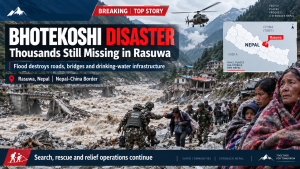
Nepal Flood Death Toll Rises to 1000, More Than 4,000 Still Missing as Tunnel Rescue Intensifies


KATHMANDU, Nepal / August 31, 2026 / The death toll from Nepal’s catastrophic Bhotekoshi–Trishuli flood has risen to 1000, according to an evening update cited by the National Disaster Risk Reduction and Management Authority, as rescue teams continue searching for thousands of people still unaccounted for across flood-ravaged districts.
Earlier Monday, the government’s 9 a.m. update had confirmed 903 deaths and 4,227 people missing, with 10,451 people rescued. Authorities have warned that the figures are likely to change as search teams recover more bodies, communications are restored and local governments reconcile lists of missing residents.
The flood began in Nepal’s high Himalayan region on August 26 and tore through the Bhotekoshi and Trishuli river systems, carrying enormous quantities of ice, rock, mud and debris downstream and devastating settlements, roads, bridges, hydropower facilities and other infrastructure.

Chitwan Records Highest Number of Recovered Bodies
According to the latest district-level figures in the evening update, 279 bodies have been recovered in Chitwan, followed by 216 in Nawalparasi East, 169 in Nawalparasi West, 95 in Nuwakot, 65 in Gorkha, 55 in Dhading, 38 in Tanahun and 23 in Rasuwa.
However, those district figures total 940, one more than the stated nationwide total of 939. The discrepancy highlights the difficulty of compiling real-time casualty data during a disaster of this scale and underscores the need for a unified and continuously verified national database.
Authorities say casualty and missing-person figures may continue to fluctuate as duplicate names are removed, people regain contact with their families and additional victims are identified.
Injured Toll Rises as Security Forces Expand Operations
The evening update states that 279 people have been injured, with 168 discharged from hospitals after treatment. The Nepali Army has also provided medical services to roughly 2,700 people through emergency treatment and health camps in affected communities.
A total of 20,819 security personnel have been mobilized for search, rescue, relief and rehabilitation operations, including 8,722 Nepali Army personnel, 7,894 Nepal Police officers and 4,203 members of the Armed Police Force. The same deployment figure was also reported in the government’s Monday morning update.
USGS: Disaster Was Triggered by Massive Glacier-Related Slope Failure, Not an Earthquake
Early speculation suggested that a glacial lake outburst in Tibet may have caused the disaster. Subsequent scientific analysis, however, has pointed to a different mechanism.
The U.S. Geological Survey says the catastrophe was likely triggered by a rapid slope failure involving a glacier in Langtang National Park, near Nepal’s border with China. The collapse generated a huge debris flow that travelled nearly 100 kilometres, or about 62 miles, through the Lende and Trishuli river systems.
USGS scientists determined that the initial collapse produced seismic energy equivalent to about a magnitude 5.2 earthquake, but emphasized that the signal was generated by a landslide or glacial collapse rather than an earthquake. A second landslide-related seismic event occurred roughly three hours later.
Scientists have not yet determined precisely how much climate change contributed to this individual event, but rising temperatures, glacier retreat and increasingly unstable mountain slopes are widely recognized as growing hazards across the Himalayan region.
Hydropower Tunnels Become Center of Rescue Mission
Some of the most difficult rescue operations are now concentrated around hydropower projects in Rasuwa and Nuwakot, where workers and other personnel remain missing inside or around damaged tunnels and project sites.
Reuters reported Monday that rescue teams, supported by experts from China and India, were working to reach hundreds of people believed to be trapped or missing at hydropower facilities. Nepal’s military has airlifted heavy machinery to inaccessible project areas, while engineers have used controlled blasting and excavation equipment to clear tunnel entrances buried by mud and debris.
At the Upper Trishuli-3B Hydropower Project, the source report says an internal project list places 198 employees, workers, consultants, security guards, relatives and interns still unaccounted for, although earlier figures from energy-sector organizations had put the number missing from the project at 122. Ninety-one people were previously rescued alive.
The conflicting figures again demonstrate the urgent need to consolidate personnel records from contractors, project companies, government agencies and security forces.
Search teams are also working at Upper Trishuli-1, Upper Trishuli-3A, Chilime, Langtang and other hydropower facilities. Reuters reported that hundreds of workers remain missing across multiple project sites.

Roads Destroyed, Heavy Equipment Airlifted
Floodwaters and debris have severed road access to some of the hardest-hit project areas. At Upper Trishuli-3B, offices, residential camps and construction zones have been buried beneath mud, sand and boulders.
Because heavy equipment cannot reach several sites by road, the military and rescue agencies have been attempting to move excavators and other machinery by helicopter. Search teams that entered some tunnels were reportedly able to advance only about 1.5 kilometres before deep mud, darkness and debris blocked further progress.
Survivors Say Relief Has Still Not Reached Some Remote Communities
While the government says large quantities of relief supplies are being dispatched, residents of several remote settlements say food, clean water, medicine, electricity and shelter remain in critically short supply.
Residents of areas in Gosainkunda Rural Municipality have said that assistance has either not arrived or remains insufficient several days after the disaster. Local officials have acknowledged severe logistical difficulties caused by destroyed roads, bad weather, limited helicopter capacity and isolated settlements.
The disaster authority says relief has been transported using 37 trucks, 35 Bolero vehicles and eight helicopter flights, but the continuing complaints illustrate what has become one of the response operation’s biggest problems: getting supplies from collection centers to the final affected household.
Large quantities of donated aid have reportedly reached military and distribution facilities in Nuwakot, but damaged highways, destroyed bridges and congestion on narrow alternative roads have slowed onward delivery.
Relief Fund Tops Rs 5 Billion
More than Rs 5.04 billion has been deposited into government disaster relief accounts at nine commercial banks, while an additional US$1.8 million has been collected in designated dollar accounts, according to the Prime Minister’s Office.
International assistance is also increasing. Nepal has received humanitarian supplies, technical support and rescue expertise from several countries and international institutions as the scale of the disaster becomes clearer.
Preliminary estimates suggest Nepal may require $4 billion to $5 billion for reconstruction and rehabilitation, an amount approaching one-tenth of the country’s economy.
Mobile Networks Gradually Returning
Communications failures have complicated efforts to establish an accurate missing-person count. According to the source report, 185 of 198 disrupted mobile sites had been restored by Monday afternoon, leaving 13 still out of service.
As telephone service returns, authorities expect some people currently classified as missing to re-establish contact with relatives or local officials.
Flood Causes Heavy Losses to Banks
The disaster has also hit Nepal’s banking infrastructure in the affected corridor.
According to the Nepal Bankers’ Association figures cited in the source, branches of 12 commercial banks in the flood zone suffered an estimated Rs 600 million in direct physical damage, excluding insured cash. Fifteen of 16 affected branches were reportedly completely destroyed and one was partially damaged.
Those branches served more than 78,000 depositors and had issued approximately Rs 2.43 billion in loans to 2,125 borrowers, excluding hydropower-sector lending.
The association said Agriculture Development Bank sustained particularly serious losses, including damage to a branch containing 64 customer locker boxes. Because banks generally do not know the contents of individual lockers and those contents are not normally insured by the bank, the final private losses may be impossible to determine quickly.
Three Urgent Challenges
Six days after the disaster, Nepal is confronting three simultaneous emergencies: finding and rescuing the missing, scientifically identifying and respectfully managing the dead, and delivering food, drinking water, medical care and safe shelter to survivors.
The scale of the tragedy has also raised longer-term questions about Himalayan glacier monitoring, early-warning systems, hydropower safety, settlement planning along vulnerable river corridors and cross-border disaster information sharing.
For the government, the test is no longer simply how much relief has been collected or how many trucks have been dispatched. The central question is whether assistance is reaching families in the most isolated communities — and whether the country can establish a transparent, unified and credible accounting of the dead, missing and rescued.