A Special Appeal to Nepal Police : The Shield of Truth, Service and Security!

– Ram Prasad Khanal, President, Federation of International Journalists of America (FIJA)
The guiding motto of Nepal Police is “Truth, Service and Security” (Satya, Sewa, Surakshanam). It is not merely an attractive phrase written beneath the police emblem; it represents an important commitment of trust between the state and its citizens. Governments may change, ministers may come and go, and political equations may shift, but the police remain a permanent security institution of the state. Therefore, when public confidence in the police weakens, the credibility of the state itself is ultimately weakened.
It is impossible to imagine a safe society or an orderly country without Nepal Police. From murder, violence, rape, fraud, smuggling, organized crime and cybercrime to the everyday peace and security of ordinary citizens, the police are needed at virtually every step. Whether responding to natural disasters, accidents, protests or criminal investigations, Nepal Police is among the institutions that reach the front line first.
It is therefore only natural that the public has high expectations of Nepal Police.
At present, however, one particular issue requires serious institutional self-reflection: the process of arrest and the quality of criminal investigation.
A Complaint Is Not the Same as Proof of a Crime
The filing of a complaint against someone is the beginning of an investigation; it is not proof that the person has committed a crime.
It cannot be considered just to arrest someone immediately merely because a complaint has been filed, put that person in handcuffs and detention, allow his or her public reputation to be damaged, and then release the individual a few days later because sufficient grounds could not be established.
On the other hand, when a serious crime has been committed and there is a genuine risk that a suspect may flee, destroy evidence, influence victims or witnesses, or commit further offenses, the police must act immediately in accordance with the law. The police cannot allow an offender to escape under the pretext of procedural formalities.
Distinguishing between these two situations is precisely what professional investigation requires.
The success of the police should not be measured by how many people they arrest, but by how thoroughly they investigate cases and how strong a case they are able to present before the courts.
Article 20 of Nepal’s Constitution guarantees fundamental rights relating to justice, including the right of an arrested person to be informed of the grounds for arrest, to consult and be defended by a legal practitioner, and to be produced before the competent judicial authority within 24 hours of arrest, excluding the time reasonably required for travel.
Therefore, just as the state’s authority to investigate crime is important, the protection of an individual’s liberty and dignity is equally important.
The Practice of “Arrest First, Find the Grounds Later” Must Change
This is not merely a theoretical concern.
A detailed study published in 2026 found that of 788 defendants in 490 cases brought before courts through government attorney offices in Kathmandu, Lalitpur and Bhaktapur, approximately 80 percent had been arrested using “urgent arrest warrants.” Similarly, a study conducted by the National Judicial Academy in various districts reportedly found that around 70 percent of arrests were carried out using urgent arrest warrants.
Under Nepal’s criminal procedure laws, an arrest normally requires judicial authorization. An extraordinary urgent-arrest procedure may be used under exceptional circumstances, such as when there is a genuine risk that a suspect will abscond or destroy evidence. But if a mechanism created as an exception begins to become routine practice, that deserves serious review.
More importantly, a report on criminal justice reform by the Office of the Attorney General has also reportedly warned that automatically arresting a person as soon as a complaint is filed can lead to unnecessary detention and damage to an individual’s reputation. It has recommended introducing a system under which, particularly in less serious cases, individuals may first be served with a notice requiring them to appear before authorities.
This makes one thing clear: this is not about one person or one isolated incident. Nepal needs an institutional reassessment of its culture of arrest.
Police Should Go to Court Fully Prepared
Whoever the person may be—a prime minister, former prime minister, minister, member of parliament, businessman, journalist, civil servant or ordinary citizen—the law must apply equally to everyone.
No one accused of a serious crime should receive immunity because of political, economic or social status.
At the same time, when the police move to arrest an individual, they should do so only after completing the necessary legal procedures and preparing the preliminary investigative grounds, facts, evidence and required documentation.
It is not a good sign when, after a case reaches court, investigative action is repeatedly halted because the court has to say:
“The required procedure was not followed.”
“The grounds are insufficient.”
“The documentation is incomplete.”
“The jurisdiction is incorrect.”
A situation in which police or investigative agencies repeatedly face such judicial objections cannot be considered healthy for a country governed by the rule of law.
Recently, in a high-profile arrest-warrant case, the Supreme Court invalidated an arrest warrant after concluding that adequate legal grounds had not been established, necessary procedures and formal requirements had not been fulfilled, and questions of jurisdiction remained. The Court made clear that although an investigative agency has the authority to make arrests, that authority must be exercised only in accordance with proper legal procedure.
Our appeal, therefore, is simple:
The courts should not have to send the police back. Instead, the police should arrive before the courts so thoroughly prepared—with law, evidence and procedure properly aligned—that there is little room for their lawful request to be rejected.
That would not diminish the reputation of the police; it would strengthen it.
Arrest Is Not Punishment
A dangerous mentality has developed in our society: once the police arrest someone, many immediately treat that person as if he or she has already been convicted.
Photographs spread across social media.
News reports publish the person’s name.
The family suffers humiliation.
Businesses and careers are affected.
A reputation built over decades can be destroyed within hours.
But if the court later finds that person innocent, who will restore that reputation?
The police administration must therefore reinforce through its own conduct the principle that arrest and conviction are not the same thing.
Immediate arrest may be necessary in serious criminal cases. But the mentality that detention must be the first response to every complaint should be abandoned.
Where an investigation can proceed by summoning a person, taking a statement, obtaining documents, and preserving digital or financial evidence, why make an unnecessary arrest?
Conversely, where there is a genuine danger that a suspect will flee, destroy evidence or intimidate a victim, the police must act firmly and immediately.
The professional quality of policing lies precisely in making this distinction wisely.
The Judiciary Must Also Put Its Own House in Order
On this issue, it would be wrong to point a finger only at the police while placing the judiciary beyond scrutiny.
There are many capable, impartial, honest and law-abiding judges in Nepal’s courts. We have the highest respect for an independent judiciary. In a democracy governed by the rule of law, if the judiciary becomes weak, citizens lose their final refuge for justice.
At the same time, questions concerning political influence, patronage, nepotism, favoritism and political power-sharing in judicial appointments have been raised in Nepal for many years.
These concerns can no longer simply be dismissed as gossip. A study associated with the Judicial Council made public in 2026 reportedly identified problems in past judicial appointments involving nepotism, favouritism, political patronage and political quota-sharing among major parties.
The judiciary, too, must therefore be willing to accept legitimate criticism.
Courts must be independent, but independence should not mean opacity. Judges should be appointed on the basis of qualification, competence, character, experience and judicial integrity—not proximity to a particular political leader or party.
The United Nations Basic Principles on the Independence of the Judiciary likewise recognize judicial independence as a fundamental foundation of the rule of law and impartial justice.
Just as the police must remain free from political pressure, the courts must remain free from political influence.
The police must uphold the rule of law, and the courts must demonstrate the rule of justice.
If the Laws Are Flawed, Parliament Must Correct Them
The police face another difficulty as well.
Some laws may be unclear, contradictory, outdated or difficult to implement. The police do not make laws; Parliament does.
However, the police are among the institutions best placed to understand which laws create practical difficulties during daily criminal investigations.
Nepal Police Headquarters should therefore bring together investigating officers, government attorneys, legal experts and human-rights specialists to conduct an institutional review addressing questions such as:
Which laws are unclear?
Which procedures make investigations unnecessarily difficult?
Which provisions are being misused?
Which laws require amendment?
On the basis of such a study, Nepal Police should submit formal recommendations to the Ministry of Home Affairs and the government.
The ruling party currently holds 182 of the 275 seats in the House of Representatives—close to a two-thirds majority. There is therefore no shortage of parliamentary strength for reforming ordinary legislation. If criminal laws, investigative procedures or arrest provisions are defective and require reform, there is little justification for the government to delay bringing amendments before Parliament.
The government cannot escape responsibility by blaming the police for weaknesses created by flawed laws, and the police cannot escape responsibility for inadequate preparation by blaming the law.
Let Us Make the Police More Citizen-Friendly
Citizens should not feel fear when they see a police station. They should feel confident that they can go there to seek justice.
The perception that the police treat poor citizens differently from powerful citizens must come to an end.
Nothing damages an institution more than public suspicion that a telephone call, political connection, official position, money or influence can change the course of an investigation.
From the smallest police post to Nepal Police Headquarters, a culture should be established:
Facts first, conclusions later.
Investigation first, then an assessment of whether arrest is necessary.
Law first, power later.
Nepal Police itself recognizes the protection and promotion of human rights as one of its institutional priorities. That commitment must now be visible in every arrest, every detention and every investigation.
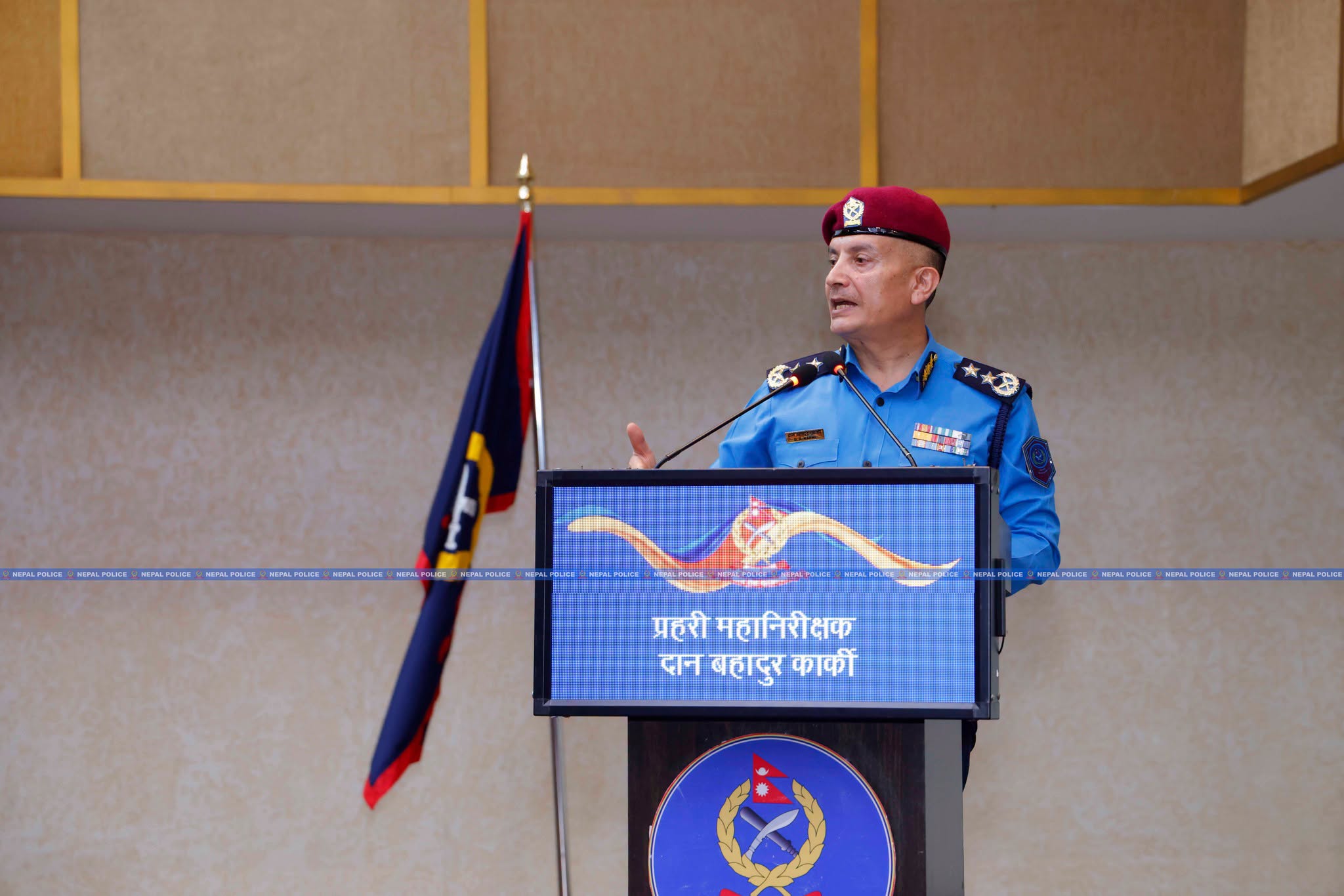
Expectations from Inspector General of Police Dan Bahadur Karki
With Dan Bahadur Karki currently serving as Inspector General of Police, this discussion about reform is particularly timely. Karki holds a master’s degree in Political Science as well as bachelor’s degrees in Law, Education, and Humanities and Social Sciences. Nepal Police itself, in introducing his leadership profile, has highlighted professionalism, integrity and a problem-oriented approach to policing.
Naturally, public expectations are therefore high.
IGP Dan Bahadur Karki, this is an opportunity to make Nepal Police even more professional.
Make arrest a measure of last resort where circumstances permit.
Restrict urgent arrest warrants to situations that are genuinely urgent.
Strengthen legal training for investigating officers.
Improve coordination with government attorneys from the earliest stage of an investigation.
Develop stronger evidence-based investigative systems.
Reduce unnecessary detention.
And ensure that every police action is capable of withstanding judicial scrutiny.
If these improvements can be made, the institutional standing of Nepal Police can rise significantly.
The police must not be weakened. Officers who confront criminals must be given sufficient legal authority to do their jobs. But power commands respect only when it is exercised within the boundaries of law.
We do not want a police force that is afraid of criminals.
We do not want a police force that bows before political power.
Nor do we want a police force that demonstrates its power against citizens before sufficient evidence has been established.
What we need is:
A police force that is fearless but restrained.
Powerful but lawful.
Firm but fair.
Independent but accountable.
Modern, transparent and citizen-friendly.
When citizens see the uniform—from a constable to the Inspector General of Police—they should feel trust, not fear. Parents should feel proud when their children join the police service. When a victim walks into a police station, that person should feel, “The process of justice has now begun.” At the same time, even an accused person should have confidence that “I will be treated in accordance with the law.”
That is the police force of a civilized state.
That is the rule of law.
And only then will the Nepal Police motto, “Truth, Service and Security,” move beyond being merely a slogan and become fully reflected in practice.
We hope Inspector General Dan Bahadur Karki, the entire leadership of Nepal Police, the Ministry of Home Affairs, the government, the Office of the Attorney General, Parliament, the Judicial Council and the judiciary will give these issues the serious attention they deserve.
When the police do the right thing, the people are not against them—the people are with them.
May Nepal Police become even more capable, more independent and more trustworthy.
Citizens should not have to fear the police; criminals should.