Bada Dashain: Nepal’s Greatest Hindu Festival of Faith, Victory, Family Unity, and Cultural Heritage

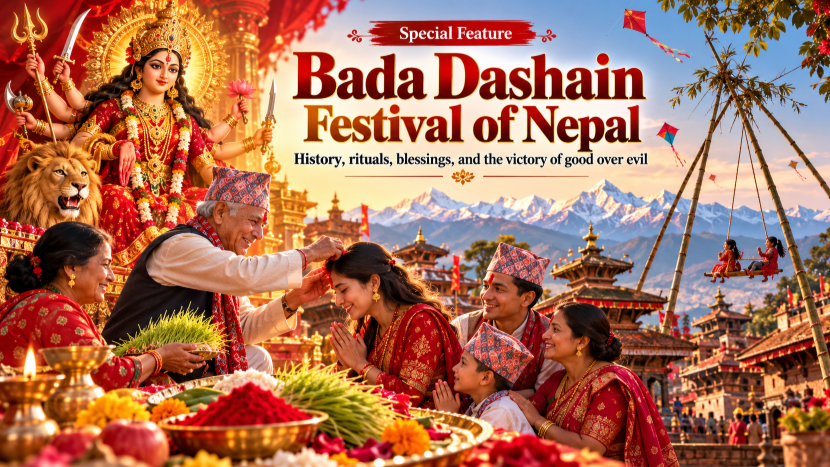
An exploration of the origins, history, religious significance, traditions, and enduring importance of Nepal’s most celebrated festival.
Bada Dashain, also known as Dashain, Bijaya Dashami, or Vijaya Dashami, is Nepal’s largest and most widely celebrated Hindu festival. Deeply rooted in ancient Hindu beliefs, religious traditions, and Nepalese cultural heritage, Dashain symbolizes the victory of good over evil, truth over falsehood, and divine power over injustice. It is also a celebration of family unity, respect for elders, prosperity, happiness, and spiritual renewal.
Celebrated over fifteen days, usually in September or October, Dashain brings families and communities together across Nepal and among Nepali communities living throughout the world. For millions of Nepalis, it is much more than a religious occasion. It is a powerful expression of national identity, ancestral traditions, emotional connections, and shared cultural values.
Historical Origins and Religious Background
The exact historical beginning of Dashain cannot be established with certainty. Its origins lie in ancient Hindu traditions of goddess worship, particularly the veneration of Goddess Durga, who represents divine feminine power, courage, protection, and the triumph of righteousness.
According to Hindu mythology, the powerful buffalo demon Mahishasura threatened the world and defeated many divine forces. The gods combined their spiritual energies to create Goddess Durga, who fought Mahishasura and ultimately defeated him. Her victory became a lasting symbol of the destruction of arrogance, cruelty, injustice, and evil.
Another important religious association comes from the Hindu epic Ramayana. Lord Rama’s victory over the demon king Ravana is commemorated during Vijayadashami, particularly in many Indian Hindu traditions. Both narratives reflect the central spiritual message that righteousness and truth ultimately prevail.
Dashain is closely connected with the ancient Hindu traditions of Navaratri, or nine nights of worship dedicated to the divine feminine. Religious texts, including the Devi Mahatmya, provide important scriptural foundations for the worship of Durga and her victory over destructive forces.
In Nepal, these religious traditions gradually became intertwined with local customs, agricultural cycles, royal ceremonies, and community celebrations. Goddess worship held particular importance among ruling dynasties, including the Malla and Shah monarchies. Historical royal rituals associated with Durga, Taleju Bhawani, and state institutions helped establish Dashain as a major national celebration.
Although its religious roots are ancient, Dashain developed into a distinctively Nepali festival through centuries of cultural adaptation and local tradition.
When Does Dashain Begin and How Is It Celebrated?
Dashain follows the Hindu lunar calendar and traditionally begins on the first day of the bright lunar fortnight of Ashwin, although its Gregorian calendar dates change annually.
The festival begins with Ghatasthapana, when families establish a sacred worship area and sow barley or other grains to grow Jamara, the yellowish-green shoots used during the main blessing ceremony.
The first nine nights are associated with the worship of Goddess Durga in her different manifestations. Devotees offer prayers, observe fasting, visit temples, and seek divine protection, strength, peace, and prosperity.
The principal religious and cultural observances include:
Ghatasthapana: The opening day of Dashain. Families prepare a sacred altar, establish a ceremonial vessel, and plant Jamara. This symbolizes fertility, prosperity, spiritual growth, and new beginnings.
Phulpati: The seventh-day celebration traditionally involves bringing sacred flowers, leaves, and other auspicious offerings into homes and temples. In Kathmandu, ceremonial traditions associated with the historic royal palace remain particularly significant.
Maha Ashtami: The eighth lunar-day observance is dedicated to the powerful forms of Goddess Durga, including Kali. Special prayers and religious ceremonies take place throughout Nepal. Some communities practice traditional animal sacrifice, while others offer fruits, coconuts, or symbolic offerings.
Maha Navami: This occasion emphasizes divine protection, craftsmanship, productivity, and respect for the instruments of daily life. Vehicles, machinery, tools, equipment, and workplaces are worshipped in many households and communities.
Vijaya Dashami: The most celebrated day of Dashain. Families gather to receive Tika, Jamara, and blessings from their elders. Tika, traditionally prepared from rice, yogurt, and vermilion, symbolizes blessings and good fortune. Elders offer prayers for longevity, health, wisdom, happiness, and success.
Kojagrat Purnima: The full-moon celebration marks the conclusion of Dashain. Goddess Lakshmi is worshipped in many homes, with prayers for prosperity, household well-being, and abundance.
While these rituals share a common religious foundation, specific practices can vary among Nepal’s geographical regions, ethnic communities, and family traditions.
Dashain as a Celebration of Family and Cultural Unity
Perhaps the most beautiful aspect of Bada Dashain is its extraordinary ability to reunite families.
Every year, countless Nepalis travel from cities to their ancestral villages, while those living abroad attempt to return home or organize celebrations within their overseas communities. Parents welcome children, grandparents bless grandchildren, and relatives who have been separated for months or years come together.
Families clean and decorate their homes, prepare special meals, purchase new clothing, exchange gifts, and organize religious ceremonies. Traditional bamboo swings, known as Ping, kite flying, community gatherings, and festive music create a joyful atmosphere across the country.
Dashain also has a strong agricultural connection. Traditionally celebrated near the autumn harvest, it represents gratitude for nature’s abundance and hopes for prosperity in the coming year.
Food is another important part of the celebration. Families prepare a variety of traditional dishes, including rice, vegetables, lentils, beaten rice, sel roti, sweets, and meat dishes where culturally appropriate.
Although Dashain is fundamentally a Hindu festival, its broader cultural significance extends into Nepal’s diverse society. Communities observe it differently, and not all Nepalis celebrate it religiously. Among Newar communities, the related festival of Mohani follows distinctive rituals and cultural traditions.
The festival therefore reflects both the richness of Hindu spirituality and the diversity of Nepalese cultural heritage.
The Meaning of Tika, Jamara, and Blessings
The tradition of receiving Tika and Jamara from elders is among the most meaningful elements of Dashain.
Tika represents auspiciousness, affection, and blessings. Jamara symbolizes life, fertility, prosperity, and the continuation of sacred traditions.
When elders place Tika on the foreheads of younger family members, they offer much more than a religious mark. The ceremony expresses generations of affection, responsibility, guidance, respect, and continuity.
It is a deeply emotional moment when grandparents, parents, and senior relatives pray for the happiness and well-being of their descendants.
These traditions remind younger generations that family relationships, respect, compassion, gratitude, and responsibility remain important foundations of society.
Dashain in Modern Nepal and Around the World
Dashain has expanded beyond Nepal’s geographical borders.
Nepali communities in the United States, United Kingdom, Australia, Canada, Europe, the Middle East, India, Bhutan, and many other countries celebrate the festival with religious ceremonies, cultural programs, family gatherings, and community events.
For Nepalis living overseas, Dashain carries special emotional significance. It renews memories of childhood, ancestral homes, parents, villages, temples, and family traditions.
Even when geographical distance prevents family reunions, modern communication allows relatives to exchange greetings and blessings across continents.
The festival has also evolved with changing social attitudes. Many families increasingly emphasize environmentally responsible celebrations, charitable activities, compassion toward animals, and the preservation of cultural practices without unnecessary extravagance.
Despite modernization, migration, and social change, the spiritual message and emotional significance of Dashain remain remarkably strong.
Bada Dashain 2026: Important Dates
In 2026, corresponding to the Nepali calendar year 2083 B.S., Dashain began on Sunday, October 11, with Ghatasthapana.
The principal celebrations fall on the following dates:
- October 11: Ghatasthapana
- October 17: Phulpati
- October 18: Maha Ashtami
- October 20: Maha Navami
- October 21: Vijaya Dashami, the main Tika day in Nepal
- October 25: Kojagrat Purnima, the conclusion of Dashain
Some dates and observances vary among published calendars because Hindu lunar days do not always align precisely with Gregorian dates. Families generally follow their local religious calendars and traditions.
The Timeless Message of Bada Dashain
Beyond its rituals, celebrations, and religious stories, Bada Dashain carries a universal message.
It teaches that good must overcome evil, truth must defeat dishonesty, and justice must prevail over oppression. It emphasizes respect for parents and elders, kindness toward others, compassion, spiritual discipline, and the responsibility to preserve cultural heritage.
For Nepal, Dashain is not merely an annual festival. It is a living connection between ancient civilization and modern society, between ancestral villages and global communities, and between the wisdom of older generations and the hopes of younger ones.
In a world often divided by political differences, social tensions, migration, and cultural change, Dashain offers an opportunity to strengthen relationships, forgive misunderstandings, restore harmony, and celebrate shared humanity.
Bada Dashain ultimately reminds us that the greatest victory is not only the defeat of external evil, but also the triumph of wisdom over ignorance, kindness over hatred, unity over division, and love over hostility.
May Goddess Durga bless Nepal, the Nepali people, Hindus around the world, and all humanity with peace, happiness, good health, prosperity, justice, and harmony.
Happy Bada Dashain! शुभ बडा दशैं!