U.S. Scientist: Massive Landslide and Glacier Collapse Generated Magnitude-5.2-Equivalent Seismic Signal Before Nepal’s Catastrophic Flood


Preliminary scientific analysis points to a huge ice-rock avalanche in the Himalayas that unleashed a chain reaction of ice, debris and water into the Bhote Koshi–Trishuli river system; death toll reaches 157 as hundreds remain unaccounted for
KATHMANDU, August 27, 2026
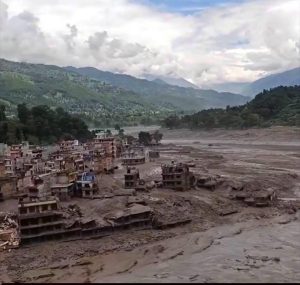
The catastrophic flood that originated in Nepal’s northern Rasuwa region and tore through the Bhote Koshi–Trishuli river system may not have been an ordinary monsoon flood at all. Preliminary scientific analysis indicates that the disaster was set in motion by an exceptionally large geophysical event high in the Himalayas, where a massive landslide appears to have dragged down a substantial portion of a glacier and unleashed a violent cascade of rock, ice, debris and water.
Professor Göran Ekström, a geophysicist at Columbia University’s Lamont-Doherty Earth Observatory, told ABC News that a huge landslide in the mountainous region brought down a large glacier, or a major part of one, creating a seismic disturbance so powerful that it was detected by instruments around the world.
According to Ekström, the event produced a seismic signal equivalent to approximately magnitude 5.2. Although such a signal can initially resemble an earthquake on seismographs, scientists believe the shaking was generated by the enormous mass of rock and ice crashing down the mountainside rather than by a conventional tectonic earthquake.
“This was a massive geophysical event,” Ekström said in describing the scale of the collapse. Similar ice-rock avalanches have occurred previously in the Himalayas, but the enormous size and energy involved in Wednesday’s event appear to have made its consequences exceptionally destructive.
A violent chain reaction in the Himalayas
Scientists believe that when an immense volume of rock plunged down the steep Himalayan slope, gravitational energy was converted into motion, friction and heat. The collision and grinding of rock, snow and glacier ice may have melted part of the ice almost instantaneously, adding enormous amounts of water to the avalanche.
The resulting mixture of rock, ice, mud, debris and water then rushed into the valley below, feeding into the river system and producing a surge fundamentally different from a conventional rainfall-driven flood.
Ekström estimated that the destructive flow could have reached extraordinary heights of roughly 130 to 160 feet in some locations, while parts of the mass may have travelled at speeds approaching 44 miles per hour, or about 70 kilometres per hour. These figures remain preliminary scientific estimates rather than final field measurements.
At such speed and volume, communities downstream would have had very little time to react.
The surge swept through the Bhote Koshi and Trishuli corridors, carrying mud, boulders, trees and structural debris downstream and devastating settlements, roads, bridges, power facilities and other infrastructure across several districts.
Satellite observations and subsequent analysis have also supported the presence of a massive debris-laden flood originating in the mountainous border region. Investigations are continuing to determine precisely where the initial collapse began, how much ice and rock fell, and how the enormous volume of water was generated.
Death toll reaches 157
The confirmed death toll in Nepal had reached 157 by late Wednesday, according to Nepal Police figures released at 11:05 p.m.
The bodies recovered included 34 women, 63 men, six girls and seven boys, while 47 victims had yet to be identified.
Police reported that bodies had been recovered in several districts:
- Rasuwa – 3
- Nuwakot – 13
- Dhading – 27
- Gorkha – 19
- Chitwan – 64
- Tanahun – 9
- Nawalparasi East – 22
Because bodies have been recovered far downstream from the original disaster zone, authorities fear that the final human toll could rise further as search operations expand along the river system.
At least 41 injured people were receiving hospital treatment under the latest Nepal Police update, while search-and-rescue teams continued looking for those still missing. More than 3,300 police personnel had been mobilized for rescue, recovery and relief operations.
Among those still unaccounted for were 28 police personnel deployed in the affected region. Hundreds of civilians, travelers and foreign visitors were also being traced, although lists released by different agencies remained preliminary and were still being verified.
Foreign tourists among the missing
The disaster struck a region used by tourists, trekkers and pilgrims travelling through northern Nepal and toward Tibet.
Nepalese tourism authorities have reported hundreds of travelers as unaccounted for, including foreign nationals from numerous countries. Because communications, roads and accommodation records have been severely disrupted, officials have cautioned that being listed as “missing” does not necessarily mean a person was physically swept away by the flood; some may simply remain out of contact.
Search efforts are continuing on both sides of the Nepal-China border.
At least 19 bridges and 40 kilometres of roads damaged
The flood has also caused enormous damage to Nepal’s transportation network.
The Department of Roads said its preliminary assessment showed that at least 19 bridges and approximately 40 kilometres of roads along the Trishuli corridor had been damaged, washed away or rendered unusable. Officials stressed that the assessment was still incomplete and the figure could rise as inaccessible areas are inspected.
The destruction has severed important road connections in Rasuwa, Nuwakot and Dhading, complicating rescue efforts and making it harder to deliver food, medicine, fuel and emergency equipment.
The flood has also damaged hydropower facilities, electricity networks, communication infrastructure, businesses, homes and government facilities.
Heavy machinery has been deployed to reopen critical roads, but officials say temporary restoration itself could be difficult because entire sections of road foundation have disappeared into the river.
Authorities reject rumors of another even larger flood
As frightened residents began sharing warnings on social media and through phone messages that an even larger flood was supposedly moving toward Rasuwa and Nuwakot, Nepal’s Flood Forecasting Division said there was no official or reliable basis for such claims.
The division said that rainfall could still cause river levels to rise and that residents in vulnerable areas should remain alert, but available information did not support rumors that another flood comparable to Wednesday’s catastrophic surge was immediately approaching.
Authorities have urged people to rely on official warnings rather than unverified audio recordings, social-media posts or forwarded messages.
If a serious upstream threat is detected, authorities said alerts would be distributed through official agencies, security forces, communications channels and emergency warning systems.
Was climate change involved?
Scientists are also examining whether a rapidly warming Himalayan environment contributed to the instability that produced the catastrophe.
Ekström emphasized that large landslides and ice avalanches can occur through natural geological processes even without climate change. However, rising global temperatures are accelerating glacier retreat and destabilizing frozen mountain terrain in many parts of the world.
As glaciers become thinner and permanent ice binding mountain slopes together disappears, rock faces can become increasingly unstable. Scientists have documented growing concern about the relationship between glacier retreat, thawing mountain terrain and large rock-ice avalanches in high-altitude regions.
That does not, however, mean climate change has already been proven to be the direct cause of this particular disaster.
Determining its role will require detailed satellite imagery, geological surveys, hydrological modelling, seismic analysis and reconstruction of the avalanche’s path.
The catastrophe therefore raises a much broader question for Nepal and the Himalayan region: whether existing disaster-warning systems are adequately designed for compound high-mountain hazards in which landslides, collapsing glaciers, debris flows and sudden floods occur as part of one rapidly evolving event.
Not simply a conventional river flood
The evidence emerging so far increasingly suggests that Wednesday’s disaster cannot be explained simply as a river overflowing after heavy rainfall.
Instead, scientists are examining a chain of events that may have begun with an enormous ice-rock landslide or avalanche, followed by glacier fragmentation or melting, an extraordinarily fast debris-and-water surge and then catastrophic flooding through the Bhote Koshi–Trishuli river system.
The exact starting point of the collapse, the volume of rock and ice involved, the quantity of water released and the precise mechanisms that transformed the mountain collapse into such an enormous downstream flood remain under investigation.
For Nepal, however, the immediate priorities are clear: finding the missing, treating the injured, identifying the dead, providing food and shelter to displaced families, reopening transportation routes, restoring electricity and communications and preventing misinformation from worsening an already extraordinary national disaster.
As rescue teams continue their work, the Rasuwa catastrophe is emerging not only as one of Nepal’s deadliest recent natural disasters, but also as a stark warning about the unpredictable and increasingly complex hazards facing communities beneath the world’s highest mountains.