Second Fire at Nepal’s Supreme Court Raises Questions Over Judicial Records, Security and Transparency

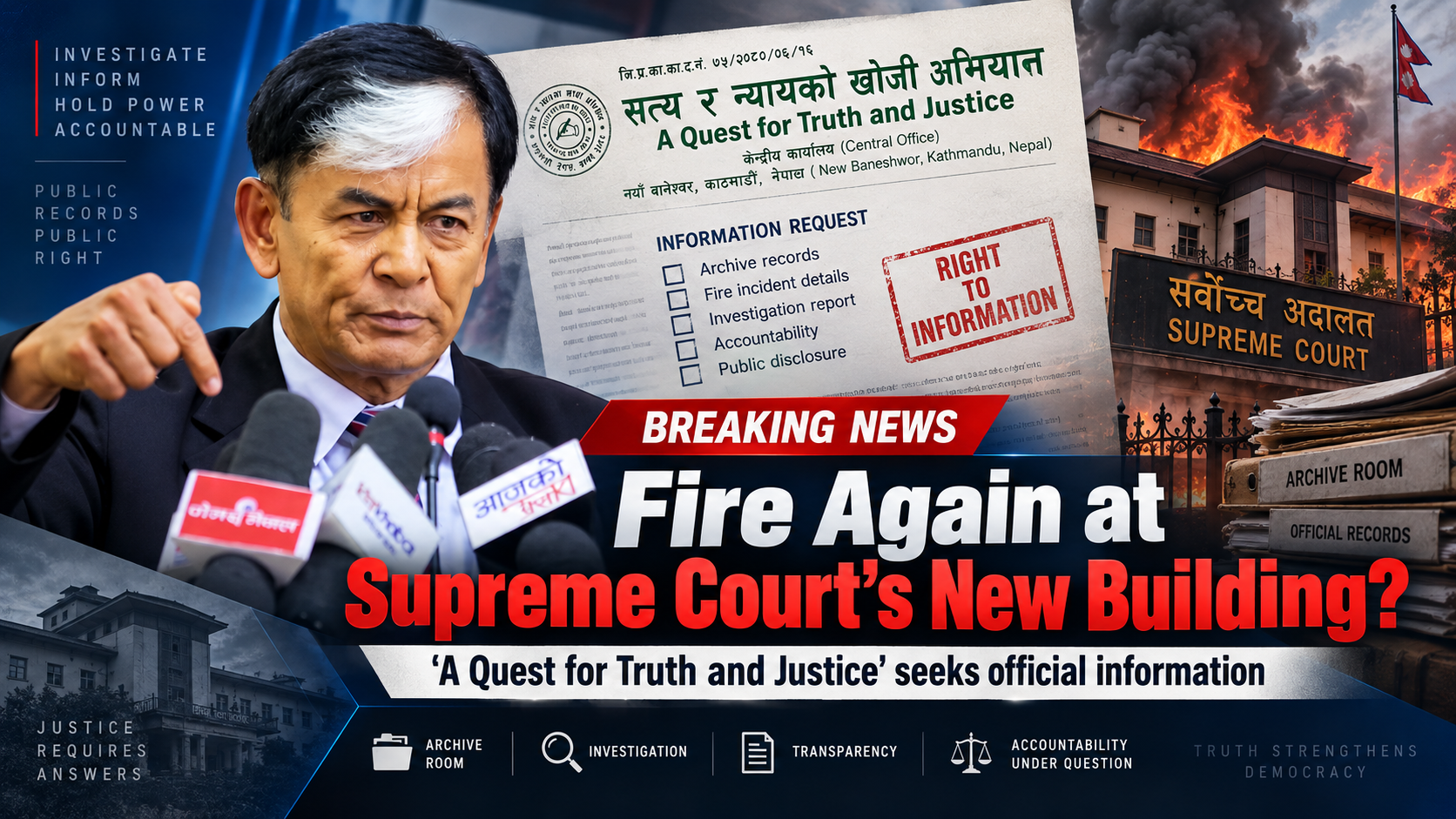
Rights campaign files 12-point information request after midnight blaze in new court building; initial claim of electrical short circuit challenged by reports of burned case and corruption files
KATHMANDU, Nepal — Nearly a year after a devastating arson attack during Nepal’s Gen Z uprising gutted the historic Supreme Court complex and destroyed tens of thousands of judicial files, another fire inside the records section of the court’s new, still-under-construction building has triggered fresh questions over document security, fire protection, surveillance, accountability and the preservation of potentially sensitive records.
The latest fire broke out around midnight on September 2–3, 2026, in a ground-floor records area of the new Supreme Court building at Ramshah Path in Kathmandu. Supreme Court spokesperson Arjun Koirala initially said the blaze appeared to have been caused by an electrical short circuit and had damaged only obsolete papers and copies of legal journals stored for disposal. He said documents connected to pending cases had not been affected and that the fire had remained confined to one room.
But subsequent reports have complicated that initial account.
Nepal Live reported that some evidentiary case files stored inside three steel cabinets had been burned. Baahrakhari later reported that remains of documents linked to corruption cases were visible among the debris and that forensic specialists had collected material from the scene. The outlet also cited a Supreme Court administrative source raising concern that records connected with construction of the new court building might have been affected, although no official conclusion has established that such construction records were destroyed.
Supreme Court officials themselves acknowledged shortly after the incident that both the court administration and Nepal Police were examining the cause from different angles. Police documented the scene, while forensic personnel collected material for examination. Koirala said at the time that investigators would have to determine whether the fire resulted from an electrical fault or some other activity.
No final investigation report had been made public in the latest reports reviewed for this article.
Against that backdrop, the anti-corruption and judicial accountability group “A Quest for Truth and Justice — Satya Ra Nyayako Khoji Abhiyan” has formally sought detailed information from the Supreme Court under Nepal’s constitutional and statutory right-to-information framework.
In a three-page application dated Bhadra 26, 2083 BS, campaign chair and senior advocate Dhruvalal Shrestha asked the Supreme Court’s information officer to disclose records concerning the fire, the building’s electrical and fire-safety systems, CCTV coverage, security arrangements, damaged documents, forensic investigation and any internal inquiry.
The campaign argues that a fire in an archive area of Nepal’s highest court cannot responsibly be dismissed as an ordinary electrical accident before the underlying physical, electronic and documentary evidence has been examined and disclosed.
Its demand carries additional significance because of what happened at the same institution a year earlier.
A judiciary still recovering from the 2025 inferno
During the violent phase of Nepal’s Gen Z protests on September 9, 2025, demonstrators and other crowds entered and set fire to major state institutions, including Parliament, Singha Durbar and the Supreme Court. The historic Supreme Court building was engulfed in flames, destroying courtrooms, offices, equipment and an extraordinary volume of judicial records. Contemporary reports described legal files and documents being gathered and burned before flames spread through the complex.
The scale of the archival destruction was later quantified.
Of 24,234 cases then pending before the Supreme Court, files belonging to 20,034 cases were destroyed. Only 2,509 writ-related files and 1,691 files from other categories survived. Around 197,000 files from already decided Supreme Court cases were also lost.
Across Nepal’s affected courts, approximately 933,000 active and archived case files were destroyed during the unrest—30,752 involving ongoing cases and more than 903,000 archived files.
The destruction severely disrupted the administration of justice. The Supreme Court had to reconstruct cases using copies supplied by litigants, lawyers, the Attorney General’s Office and other institutions. Months later, thousands of files were still being rebuilt. The disruption also contributed to a sharp fall in judicial case disposal during the following fiscal year.
That history is why a second fire—even one dramatically smaller than the 2025 disaster—inside an area associated with court records has attracted unusual scrutiny.
Twelve questions the campaign wants answered
The information request seeks documentary answers to the following issues:
- Electrical safety: Was the electrical system of the multibillion-rupee new Supreme Court building inspected, tested and formally approved before parts of the building were brought into use? If defective wiring or electrical leakage caused the fire, which entity—the court administration, construction company, contractor or another party—would bear responsibility?
- CCTV surveillance: Were CCTV cameras installed in the records room and on the access routes leading to it? If so, were those cameras operational when the fire began, and has the footage been preserved?
- Night security: Were court employees, police officers or private security guards deployed inside or outside the building at the time? Who was officially on duty, and who first detected or reported the fire?
- Emergency timeline: At precisely what time was the fire discovered? When was the fire brigade contacted, when did firefighters arrive, where did they come from, and how long did extinguishing the blaze take?
- Fire-protection systems: Did the new building have functioning fire alarms, smoke detectors, sprinklers or another automatic fire-suppression system? If those systems existed, why did they apparently fail to prevent or immediately suppress the fire?
- Preservation of the scene: Was the affected room immediately sealed as a potential evidence scene? Which authority—the Supreme Court, Nepal Police or another agency—controlled and preserved it?
- Nature of the burned records: Were the destroyed materials court case files and evidentiary documents, administrative records, obsolete papers, or documents connected with construction of the new Supreme Court complex?
- Inventory of losses: If case files were destroyed, how many and from which cases? If administrative or construction-related documents burned, what was their nature and official inventory?
- Forensic examination: Were samples collected from the burned doors, cabinets, electrical components, documents, debris and ash for scientific or forensic analysis? If so, which agency collected them and when?
- Possible unauthorized access: Did investigators discover signs of forced entry, broken locks, tampering or unauthorized access to the records area before the fire?
- Formal inquiry: Has the Supreme Court established an official investigation committee? If so, who are its members, what are its terms of reference and what deadline was given for completion?
- Investigation report: What investigations have been completed so far, where is the resulting report, and when will it be released? If no comprehensive investigation has been completed, what is the reason?
The questions effectively seek to reconstruct the entire chain of events—from building safety and access control to detection, firefighting, evidence preservation and identification of the documents that burned.
Conflicting descriptions of what was destroyed
The most consequential issue is not simply how large the fire was, but what exactly burned.
Immediately after the incident, Supreme Court officials emphasized that the damage was minor. Koirala told news outlets that the fire occurred among unused documents and legal publications and that pending case files had not been damaged.
Other reporting, however, presented a more complicated picture.
Baahrakhari quoted Koirala as saying that some files stored in the archive area had burned while investigators were examining whether the cause was an electrical short circuit, a discarded cigarette or something else. A later Baahrakhari investigation said burned remnants appeared to include records from corruption cases and that forensic experts had removed debris for testing.
Nepal Live separately reported that an employee said evidentiary files stored in three steel cabinets were damaged.
Those accounts do not, by themselves, prove deliberate destruction of evidence. Nor do they establish that any specific sensitive case was targeted. But the conflicting descriptions make a precise, independently verifiable inventory of the damaged material essential.
The distinction between “obsolete documents,” archived case records, evidentiary files and construction documents is significant both legally and institutionally.
Questions surrounding the new Supreme Court building
The new Supreme Court complex itself has long faced scrutiny over its procurement process.
Public reporting on the project shows that the approved cost estimate was approximately Rs 5.89 billion, while the construction contract was awarded for approximately Rs 5.87 billion after three of four bidders were deemed technically non-responsive and only one joint venture remained eligible.
The Office of the Auditor General questioned whether a procurement in which only one bid remained substantially responsive—and where the contract price was extremely close to the official cost estimate—could reasonably be considered fully competitive and economical.
The contract went to the Binapuri–Kalika–Samanantar joint venture, according to published procurement records. Questions surrounding the bidding process subsequently attracted complaints and investigations by state bodies.
That history explains why speculation has emerged over whether records connected with the construction project were stored in the room affected by the September 2026 fire.
However, claims circulating publicly that a particular amount—such as roughly Rs 2 billion—had already been conclusively proven to constitute corruption should be treated cautiously. The Auditor General raised serious questions over competition, procurement and economy, but such observations are not the same as a final judicial determination that a specific amount was stolen or corruptly obtained.
Whether corruption occurred, who might be responsible and in what amount can only be established through competent investigation and legal adjudication.
Similarly, there is presently no publicly established evidence demonstrating that the September 2026 fire was intentionally set to destroy construction records or corruption-related files.
Constitutional right to ask
The campaign has invoked Article 27 of Nepal’s Constitution, which guarantees citizens the right to demand and receive information concerning matters of personal or public interest, subject to information legally required to remain confidential.
Nepal’s Right to Information Act, 2064 (2007) further guarantees citizens access to information held by public bodies.
Section 3 establishes the right of access, while Section 7 allows citizens to apply to the relevant information officer. Information that can be provided immediately should be released immediately; when that is not possible, the law generally requires it to be supplied within 15 days, subject to statutory exemptions.
The Supreme Court, as a constitutional public institution, therefore faces not only a question of crisis management but also one of institutional transparency.
Broader allegations require evidence
In statements accompanying its information request, A Quest for Truth and Justice has also sharply criticized Nepal’s judiciary, legal profession and administrative establishment, alleging that the institutional “cleansing” and accountability expected after the Gen Z uprising never occurred.
The campaign argues that individuals responsible for corruption, administrative malpractice, concealment of reports and institutional misconduct remained protected even after a movement fuelled in large part by public anger over corruption and misgovernance.
Those are serious allegations and should be presented as claims made by the campaign, not established facts. Responsibility for corruption, evidence destruction, criminal misconduct or deliberate protection of wrongdoers must be established individually through credible evidence, investigation and due process.
The same evidentiary standard applies to the new fire.
An electrical short circuit remains one possible explanation. Supreme Court officials reported damage near a power circuit, and employees initially suspected an electrical plug. But an early hypothesis is not equivalent to a final forensic conclusion.
The decisive evidence should therefore come from the building’s electrical inspection records, CCTV footage, security logs, access records, fire-alarm data, eyewitness accounts, fire-brigade records and forensic examination of the debris.
The unanswered questions
The strongest public-interest questions are consequently not based on speculation over whether the fire was “accidental” or “deliberate.”
They are evidentiary:
Was CCTV operating?
Who entered the records area before the fire?
Who was on security duty?
When was smoke or fire first detected?
Did a fire alarm activate?
Were smoke detectors and automatic suppression equipment installed and functioning?
What does forensic examination of the electrical system show?
Exactly which documents were stored in the affected cabinets and room?
Which files can no longer be located after the fire?
Were any records associated with corruption cases or the construction contract destroyed?
And what have the police and the Supreme Court’s own investigation concluded?
Those questions can be answered through records and evidence rather than political accusation.
For Nepal’s judiciary, the stakes are unusually high. The September 2025 arson destroyed a vast portion of the institutional memory of the country’s court system and forced the Supreme Court into a lengthy reconstruction of thousands of case files. A second unexplained fire in a records area less than a year later inevitably raises concerns about whether lessons from that catastrophe were adequately applied to document protection, fire safety and security.
The September 2026 blaze was far smaller than the destruction of 2025. Yet its significance cannot be measured merely by the size of the burned room.
If only expendable papers were lost, a transparent inventory and investigation could quickly establish that fact and dispel suspicion.
If judicial evidence, corruption-related files or records concerning the building project were damaged, the public interest in knowing exactly what happened becomes considerably greater.
Either way, withholding or delaying verifiable findings risks deepening distrust at a time when Nepal’s judiciary is still recovering from one of the most destructive attacks on its records in modern history.
For that reason, the campaign says the most credible response is straightforward: preserve the evidence, identify every document lost, disclose the relevant CCTV and security information where legally permissible, complete an independent technical and forensic investigation, and publish its findings.
Ultimately, the credibility of the Supreme Court does not depend on proving one theory or another about the fire. It depends on demonstrating—through evidence—that the truth can be established transparently even when the institution examining the incident is itself the institution affected by it.