Nepal Flood Disaster Deepens: Death Toll Reaches 359 as Hundreds Remain Missing and New Upstream Threat Emerges


KATHMANDU, August 27, 2026 / The death toll from the catastrophic flood that began in the Bhotekoshi region of Rasuwa and surged through the Trishuli–Narayani river system has climbed sharply, with 359 bodies recovered from multiple districts as of 5 p.m. Thursday, according to the latest figures released by Nepal Police.
International reports citing local authorities have also placed the confirmed death toll at 359, while rescue officials warn that the final number could rise considerably as searches continue across hundreds of kilometers of riverbanks and downstream floodplains.
According to the latest district-wise breakdown, 17 bodies have been recovered in Rasuwa, 28 in Nuwakot, 33 in Dhading, 30 in Gorkha, 132 in Chitwan, 22 in Tanahun, 82 in Nawalparasi East and 15 in Nawalparasi West.
The extraordinary force of the flood appears to have carried victims far from the original disaster zone. Bodies have been recovered hundreds of kilometers downstream, particularly around Chitwan, Nawalparasi and the Narayani river corridor, forcing authorities to continuously expand search operations.
Identification and Management of the Dead Becomes a Major Challenge
As the scale of the human tragedy grows, authorities are facing another urgent problem: identifying, preserving and properly managing hundreds of recovered bodies.
Hospitals and health facilities in Chitwan and other affected districts do not have sufficient refrigerated mortuary capacity to handle such a large number of victims simultaneously.
Forensic specialists have stressed that unidentified bodies should not be cremated or buried hastily. The location and condition in which each body is found, along with clothing, jewelry, physical characteristics and other identifying information, need to be carefully documented.
Such records could prove crucial for families searching for missing relatives and for completing future legal and administrative procedures.
At Least 63 Injured as Hospitals Continue Treatment
Police figures indicate that at least 63 injured people are receiving treatment at hospitals and medical facilities.
Patients have been admitted to institutions including Tribhuvan University Teaching Hospital, the National Trauma Center, Bir Hospital, Norvic International Hospital, Manmohan Hospital and Birendra Military Hospital.
Authorities are still reconciling hospital records, as district-level and central figures have shown minor discrepancies. Fatality, injury and missing-person counts have changed repeatedly as new reports arrive from difficult-to-reach areas.
28 Police Personnel Still Missing
Nepal Police says 28 police personnel remain out of contact following the disaster.
Thousands of police officers have been mobilized for search and rescue, body recovery, relief operations and monitoring of vulnerable river corridors. Nepal Army and Armed Police Force teams are also operating on the ground and from the air.
Earlier estimates from Nepal’s disaster-management authorities indicated that more than 7,000 personnel from the country’s three security agencies had been deployed in rescue and emergency operations.
The destruction of roads, bridges and communication networks has made many affected areas inaccessible by vehicle. Helicopters, drones and search teams moving along riverbanks are therefore being used to reach isolated locations.
Hundreds of Tourists and Pilgrims Still Unaccounted For
The number of Nepali and foreign travelers listed as missing or unreachable also remains uncertain.
The Nepal Tourism Board reported Thursday afternoon that 644 travelers and tourists were out of contact, including 517 foreign nationals and 127 Nepalis.
The preliminary list reportedly included 178 Indians, 65 Americans, 53 Ukrainians, 35 Australians and 25 Canadians.
Separate compilations later suggested that the total number of uncontactable tourists and travelers could be as high as 668. However, authorities have emphasized that these figures remain provisional while travel companies, immigration authorities, tourist police, embassies and local administrations cross-check passenger and visitor records.
India’s Ministry of External Affairs has separately said that it has been unable to establish contact with 288 Indian nationals.
That figure should not be directly compared with Nepal Tourism Board’s count of Indian tourists because the Indian list reportedly includes Kailash Mansarovar pilgrims as well as 73 Indian workers associated with the Trishuli-1 hydropower project.
80 Members of Sadhguru-Linked Pilgrimage Group Reported Out of Contact
Among those reportedly missing are 80 members of a Kailash pilgrimage group associated with spiritual leader Sadhguru Jaggi Vasudev.
The group is said to include citizens of roughly 20 countries, including the United States, Canada, Australia, the United Kingdom, Germany, France and Nepal.
Preliminary information indicates that the group consists of 34 men and 46 women.
Of the 80 members, 77 were reportedly near the immigration area on the Tibet side when communications were lost, while three volunteers were believed to be around Timure on the Nepal side.
Their status remains under verification.
Scientists Reassess What Triggered the Disaster
Scientific understanding of the flood’s origin is also evolving.
Initial speculation suggested that an earthquake may have triggered a major Himalayan landslide. However, preliminary satellite analysis and geophysical evidence now point toward a different sequence of events.
Researchers are examining the possibility that a massive collapse of ice, rock and mountain debris in the high Himalaya crashed into the Lhende river system, temporarily blocking the river and creating an unstable natural dam.
Satellite imagery, including preliminary analysis of images from Planet Labs, reportedly shows a major ice-and-rock collapse roughly 20 kilometers northeast of the Rasuwagadhi border area.
Scientists believe the collapse may have temporarily impounded water before the natural blockage failed, releasing a destructive mixture of water, ice, mud, rock and debris downstream.
The U.S. Geological Survey has indicated that seismic signals initially interpreted as an earthquake may instead have been generated by the enormous mass movement itself.
The emerging hypothesis is therefore that a massive ice-rock collapse created earthquake-like seismic energy and subsequently triggered the devastating flood, rather than an earthquake necessarily causing the flood.
The precise chain of events remains under scientific investigation.
New Concern Over Another Upstream Natural Dam
One of the most serious continuing threats is the possibility of another natural blockage in the upper Lhende watershed.
Nepal’s National Disaster Risk Reduction and Management Authority has said that preliminary satellite analysis indicates that the river may again be obstructed above Rasuwagadhi, creating a new body of impounded water covering approximately 0.11 square kilometers.
If the natural barrier weakens or collapses suddenly, another major surge could move downstream.
Information attributed to Chinese water authorities indicates that approximately two million cubic meters of water had accumulated behind the blockage by Thursday morning, with water beginning to overflow.
Projections suggesting that another roughly three million cubic meters could enter the impounded area over the following three days have increased concern about the stability of the natural dam.
Authorities have therefore urged residents not only in Rasuwa but throughout vulnerable sections of the Bhotekoshi–Trishuli–Narayani river system to stay away from riverbanks, closely follow official warnings and be prepared to move immediately to safer ground if necessary.
Roads and Bridges Devastated
The flood has also caused enormous destruction to transportation infrastructure.
Government officials say approximately 40 kilometers of road have been completely destroyed in Rasuwa alone.
Sections of the road connecting Betravati, Mailung, Syabrubesi and Rasuwagadhi have been washed away or severely damaged, cutting off normal transportation.
Around 10 kilometers of road between Galchhi and Trishuli also remains blocked.
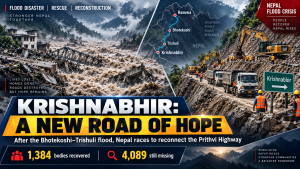
On the Prithvi Highway, approximately 13 kilometers of roadway have reportedly been covered by mud, rocks and flood debris. Clearing the highway and restoring essential traffic has been designated as one of the government’s immediate priorities.
The flood has also destroyed an estimated 41 bridges.
Nepal currently has seven Bailey bridge units capable of spanning distances of up to about 50 meters, and authorities are assessing where temporary bridges can be installed most effectively.
Government officials say India and China have also expressed readiness to provide Bailey bridges and other emergency reconstruction materials.
One of the first priorities is restoring access to Rasuwa and reopening the Prithvi Highway.
Authorities are preparing to install a temporary Bailey bridge in the Betravati area, a crucial step toward restoring road access toward Dhunche, Syabrubesi and the northern border region.
A total of 20 heavy machines — 10 provided by the government and another 10 mobilized from the private sector — have been deployed to remove debris, build temporary access routes and reopen damaged roads.
A National Disaster Still Unfolding
The catastrophe is no longer confined to Rasuwa.
Bodies being recovered as far downstream as Chitwan and Nawalparasi, hundreds of missing Nepali and foreign nationals, the destruction of roads, bridges and energy infrastructure, and warnings of a possible new upstream natural dam all show that the emergency remains far from over.
Even after 359 bodies have been recovered, a large number of people remain missing and search operations continue across a vast river corridor.
The final human toll may not be known for some time.
For now, the most urgent priorities remain locating and rescuing survivors, treating the injured, scientifically identifying the dead, providing shelter and essential assistance to displaced families, restoring critical transportation links, and protecting downstream communities from the possibility of another sudden flood surge.
With the river system still unstable and casualty figures continuing to change, authorities are urging the public to rely on verified emergency information and remain alert in all vulnerable downstream areas.