Middle East Tensions Deepen as Iran Reports Foiled Bomb Plot, Gaza Buries 105 Victims, Hegseth Attacks U.S. Media and Saudi Arabia Warns Houthis

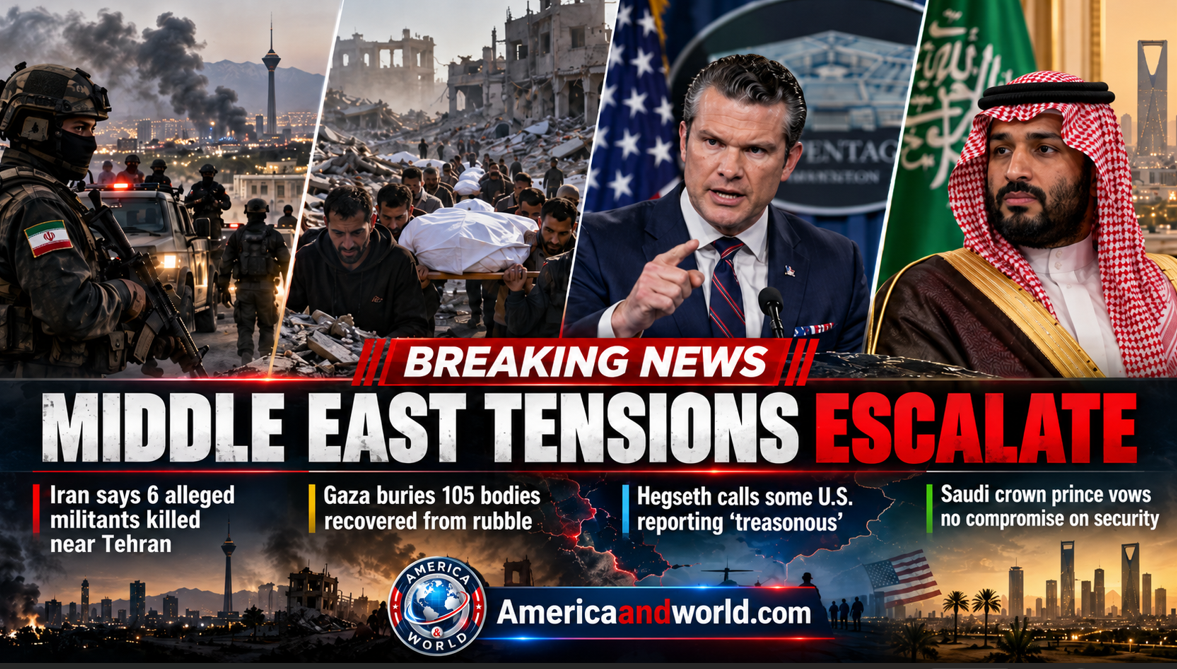
October 1, 2026 — Tensions across the Middle East intensified on Thursday as Iranian authorities reported killing six suspected members of what they described as a “terrorist group” allegedly preparing a bombing operation near Tehran, Palestinians in Gaza prepared another mass burial for more than 100 people recovered from beneath destroyed buildings, U.S. Defense Secretary Pete Hegseth sharply attacked American media coverage of the Iran war, and Saudi Crown Prince Mohammed bin Salman warned that Riyadh would respond firmly to threats from Yemen’s Houthis.
Iranian security forces said six alleged members of an armed group were killed during an operation in the Manjilabad area of Tehran Province, southwest of the Iranian capital. According to Iranian authorities, explosives were recovered from a residence during the raid, while security personnel continued searching and clearing the surrounding area.
Reports placed Manjilabad roughly 44 kilometers, or about 27 miles, southwest of central Tehran. Iranian officials said the suspects had been preparing a bombing operation, although authorities had not immediately released their identities, the organization to which they allegedly belonged, or the intended target of the purported attack. Independent verification of the Iranian government’s account was not immediately available.
The incident comes amid heightened internal security concerns in Iran during the continuing regional confrontation involving Tehran, Washington and Israel. Iranian officials have repeatedly accused the United States and Israel of supporting or financing armed opposition groups and efforts to destabilize the country. Washington and Israel have made their own accusations against Tehran concerning its regional military activities and its support for allied armed groups. The specific allegation connecting foreign governments to Thursday’s Manjilabad incident has not been independently established.
Confusingly, Iranian media also reported a separate counterterrorism operation Thursday in Zahedan, the capital of southeastern Sistan and Baluchestan Province. The Islamic Revolutionary Guard Corps’ Quds Base said six members of what it called a “Takfiri terrorist group” were killed there and explosive devices were seized. That appears to be a separate operation from the reported Manjilabad raid near Tehran, although both Iranian accounts involved six deaths and explosives, creating some potential for reports of the two incidents to be conflated.
Meanwhile, another painful recovery operation was unfolding in Gaza, where the remains of 105 Palestinians were being prepared for burial on Thursday. According to reports from Gaza, the bodies were recovered from the rubble of a residential area destroyed during Israeli attacks early in the war that began following the Hamas-led October 7, 2023 attacks on Israel.
The remains had been trapped beneath collapsed structures for nearly three years. Their recovery underscores the continuing challenge facing Palestinian rescue workers and families searching ruins for people who remain missing.
The October 1 burial follows several other large-scale recovery efforts in recent months. On September 6, families in Gaza held funeral ceremonies for about 100 Palestinians recovered from destroyed homes in the Zeitoun neighborhood of Gaza City. Civil defense workers said at the time that thousands of additional bodies could still be buried beneath damaged or collapsed buildings.
Another mass funeral was held in August after rescue teams recovered the remains of 112 Palestinians from the rubble of homes in Gaza City’s Sabra neighborhood. Those victims had reportedly been killed during an Israeli attack in November 2023.
Recovery work remains extremely difficult because large areas of Gaza were devastated during the war and heavy machinery, reconstruction equipment and safe access remain limited. Reuters reported in September that much of Gaza’s infrastructure remained destroyed or severely damaged and that large numbers of residents continued living in damaged buildings or temporary accommodation.
The humanitarian situation remains intertwined with unresolved disputes over reconstruction, Israeli military deployment, Hamas’s future and implementation of ceasefire arrangements.
Hegseth accuses parts of U.S. media of “treason”
In the United States, Defense Secretary Pete Hegseth escalated his criticism of American news organizations during his September 30 “State of the Force” address at Marine Corps Base Quantico in Virginia.
Hegseth accused some journalists covering the Iran war and U.S. military operations of publishing information that he said endangered American service members.
“Our so-called press makes Iranian state media look reasonable,” Hegseth said during the address. He argued that irresponsible reporting about issues such as troop movements and weapons stockpiles could provide useful information to adversaries.
Hegseth also described what he regarded as partisan reporting against U.S. troops and the administration as “a national betrayal” and “treason.” His remarks drew criticism because the U.S. Constitution provides broad protections for freedom of the press, while legitimate publication of government information by journalists is legally distinct from the constitutional crime of treason.
The comments came as Hegseth announced a broader restructuring of the U.S. military. Among the measures discussed were reductions in the number of senior generals and admirals, the creation of a new four-star command focused on autonomous and robotic warfare, and a study of future warfare involving technology figures including Elon Musk and Palmer Luckey and former House Speaker Newt Gingrich.
His confrontation with the press comes at a particularly sensitive moment as the United States remains deeply involved in the Iran conflict and public debate continues over military strategy, casualties, weapons inventories and Washington’s objectives in the region.
Saudi crown prince warns Houthis: Kingdom’s security is non-negotiable
At the same time, Saudi Crown Prince Mohammed bin Salman delivered one of Riyadh’s strongest recent warnings to Yemen’s Houthi movement, declaring that Saudi Arabia would not compromise its national security.
Speaking on behalf of King Salman during the opening of a new session of Saudi Arabia’s Shura Council on Wednesday, the crown prince said the kingdom would continue supporting diplomatic efforts but would “not hesitate to respond firmly” to threats or attacks against Saudi territory.
His remarks followed a renewed series of Houthi missile and drone attacks. Saudi Arabia said it recently intercepted six ballistic missiles targeting areas including Taif and the Red Sea port region of Yanbu, while the Houthis said they had attacked a sensitive target in Riyadh and Saudi Aramco facilities in Yanbu.
The crown prince also pointed to expanding Saudi security cooperation with Pakistan and Türkiye. Pakistan’s defense minister said this week that Islamabad would support Saudi Arabia under their mutual-defense arrangements if attacks continued, although he did not confirm that Pakistani forces had been ordered into combat.
Diplomatic efforts are continuing alongside the military escalation. U.N. envoy Hans Grundberg has held talks with Houthi representatives and Saudi officials in an effort to prevent the Yemen conflict from expanding further and becoming even more closely linked with the broader Iran confrontation.
Concerns are also growing over commercial aviation and shipping. The European Union Aviation Safety Agency issued new guidance on September 30 urging airlines to avoid Saudi airspace because of the increased risk associated with Houthi attacks. The agency has also maintained or expanded warnings covering several other parts of the Middle East.
Saudi officials have additionally emphasized threats to maritime traffic through the Red Sea and the Bab el-Mandeb Strait, one of the world’s most important shipping corridors.
Taken together, Thursday’s developments illustrate how interconnected the region’s crises have become. Iran is confronting both external military pressure and internal security threats; Gaza continues the long process of recovering victims from wartime destruction; Washington is facing an increasingly contentious debate over its Iran campaign and military information; and Saudi Arabia is strengthening its defenses as the Yemen conflict again spills across borders.
Diplomacy continues on several fronts, but the simultaneous security operations, military warnings and unresolved humanitarian emergencies show that the risk of further escalation across the Middle East remains substantial.