Why Has the United Nations Failed to Become Truly Effective? It Must Rise Above the Shadow of Great-Power Politics

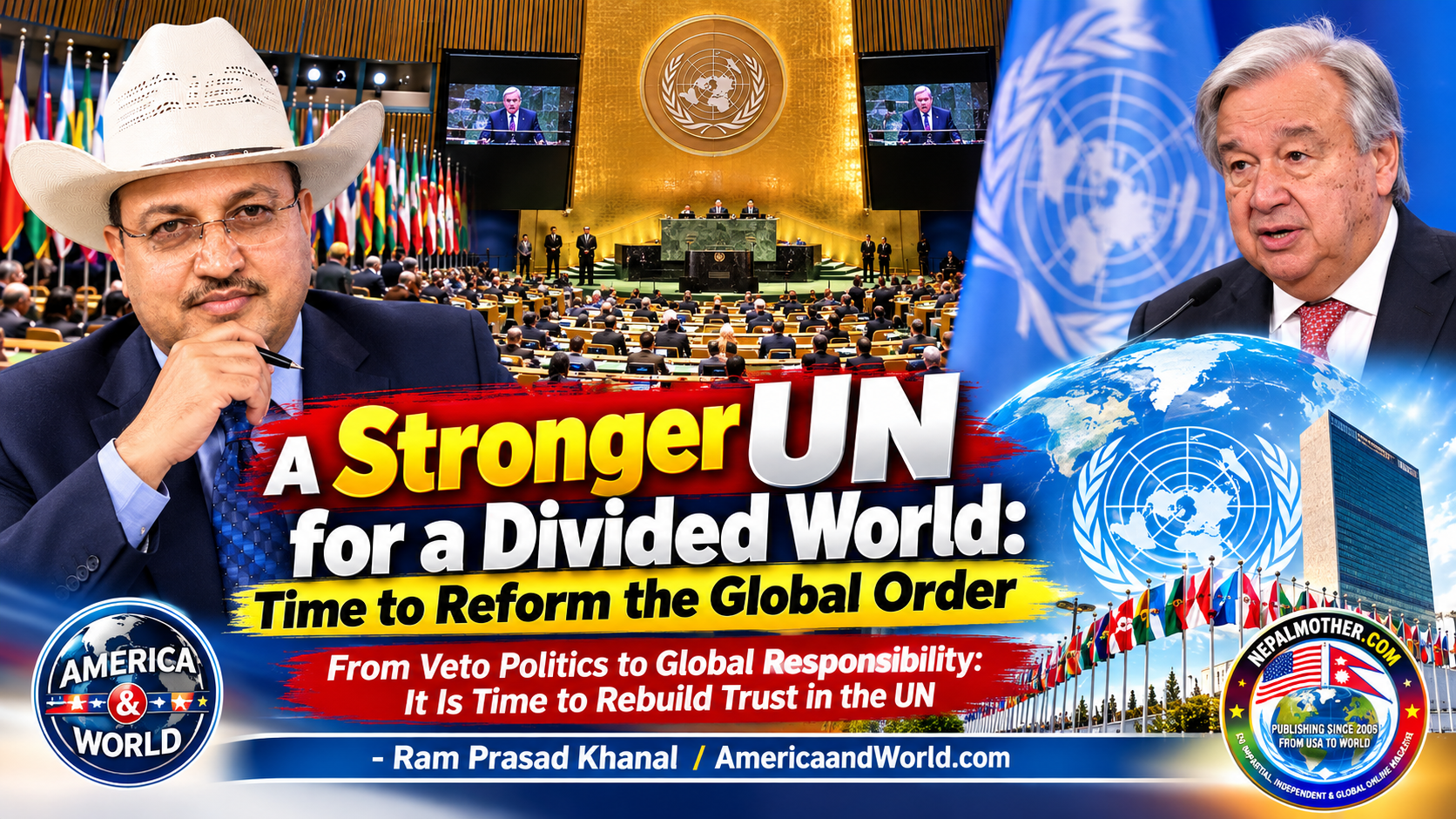
By Ram Prasad Khanal
The United Nations was born from the ruins of the Second World War. Its creation in 1945 reflected one of the most important lessons humanity had learned at an unimaginable cost: if nations had no credible common institution to resolve disputes, restrain the powerful and prevent conflict, the world could repeatedly descend into catastrophic war.
Today, the United Nations has 193 member states. In the General Assembly, the United States has one vote, China has one vote, and Nepal, Bhutan or a small island nation also has one vote. In principle, it is one of the most representative political forums ever created.
Yet more than eight decades after its founding, a fundamental question now confronts the world: why has an organization representing 193 countries failed to become as effective, strong and decisive as the world needs it to be?
The war in Ukraine continues. The Middle East remains trapped in recurring cycles of conflict and retaliation. Gaza and the Palestinian territories have endured immense human suffering. A lasting political settlement between Israelis and Palestinians remains elusive. Tensions involving Israel, Iran and the United States have repeatedly threatened wider regional confrontation. The Houthis, the conflict in Yemen, instability in the Red Sea and Bab al-Mandab, and insecurity around the Strait of Hormuz have affected not only regional security but global trade and energy markets. Sudan remains devastated by war. Myanmar’s crisis persists. Around the world, civilians continue to bear the cost of political failure.
At the same time, humanity faces crises that do not respect borders: widening economic inequality, unsustainable debt, climate change, global warming, melting glaciers, rising sea levels, food insecurity, pandemics, cyber threats, artificial intelligence, autonomous weapons and nuclear danger.
So the question becomes unavoidable: what is the United Nations for if it cannot act effectively at the very moments when the world needs collective action most?
The UN adopts resolutions. It issues appeals. It calls for ceasefires. It urges humanitarian access. The Secretary-General warns of escalating danger. The Security Council meets. The General Assembly debates. World leaders deliver speeches.
But wars continue.
Member states ignore appeals.
International law is applied inconsistently.
And people increasingly ask whether the United Nations has moral authority without sufficient political power to enforce its own principles.
To understand this problem, one must first understand the structure of the organization itself.
The General Assembly gives all 193 member states an equal vote. But responsibility for international peace and security rests primarily with the 15-member Security Council. Five countries—the United States, China, Russia, the United Kingdom and France—are permanent members and possess veto power.
That is where one of the UN’s deepest structural contradictions begins.
There are 193 member states, yet five countries hold exceptional authority over some of the most consequential decisions affecting international peace and security.
The world of 2026 is not the world of 1945. Political power, population, economic influence and regional importance have shifted dramatically. Africa now contains 54 sovereign states, yet it has no permanent seat on the Security Council. Asia, Latin America and much of the developing world remain underrepresented in a system designed at the end of World War II.
When the strategic interests of the United States, China, Russia or other permanent members collide, the Security Council often becomes paralyzed. In those moments, the United Nations can appear to fall under the shadow of Washington, Beijing, Moscow or competing geopolitical blocs.
But the problem is larger than any single country.
The deeper problem is a structure in which the geopolitical interests of five states can prevent action on matters affecting billions of people.
Recent history provides many examples. Russia used its veto to block a Security Council resolution condemning its 2022 invasion of Ukraine. In 2025, the United States vetoed a Gaza ceasefire resolution that had the support of the other 14 Security Council members, arguing that the text did not sufficiently address its security concerns and the issue of Hamas.
Such cases reveal the central contradiction of the system: even when an overwhelming majority supports action, the veto of one permanent member can stop it.
There is another misconception that must be clarified. General Assembly resolutions are usually not legally binding on member states. They can carry enormous political, diplomatic and moral weight, but they generally function as recommendations rather than enforceable orders.
Security Council decisions are different. Under Article 25 of the UN Charter, member states agree to accept and carry out Security Council decisions.
But once again the same question emerges: what happens when the Security Council itself cannot decide because of the veto?
The United Nations is not a world government. It has no permanent standing army of its own. UN peacekeeping missions depend on troops and police contributed by member states. Its diplomatic influence, financial capacity and operational reach ultimately depend on the cooperation of governments.
That is why it is not enough to blame only the UN Secretariat in New York when the system fails.
The United Nations is, fundamentally, its member states.
If governments invoke the UN Charter only when it supports their national interests, but ignore it when international obligations become inconvenient, the organization will inevitably become weaker.
This double standard must end.
International law cannot mean one thing for an ally and another for an adversary. Human rights cannot apply strongly to one population and selectively to another. Sovereignty, civilian protection, humanitarian access and the laws of war must apply consistently.
Without equal application of international rules, the credibility of the UN system will continue to erode.
The war in Ukraine has exposed this institutional weakness dramatically. One of the principal parties to the war is itself a permanent member of the Security Council with veto power. That reality has severely limited the Council’s ability to take unified action.
The United Nations can deliver humanitarian assistance. It can document civilian casualties. It can facilitate diplomacy. The General Assembly can adopt resolutions. The Secretary-General can call for peace.
But the UN cannot simply force a major military power to sign a peace agreement.
The Israeli-Palestinian conflict has presented a similar test. The Hamas attacks of October 7 and the devastating war that followed in Gaza have resulted in enormous civilian suffering, displacement and destruction.
Both terrorism against civilians and excessive or unlawful harm to civilians must be judged according to the same principles of international law.
If the United Nations cannot protect civilians, cannot secure humanitarian access and cannot create meaningful diplomatic pressure toward a political solution, its moral authority inevitably comes under question.
My concern is simple: if the international system cannot protect an innocent child because that child was born on the wrong side of a border, what does international law truly mean?
The Middle East has also demonstrated the need for a much more proactive United Nations.
Tensions involving Iran, Israel and the United States have repeatedly threatened escalation. The UN often calls for restraint only after confrontation has already begun.
That is not enough.
The United Nations should not merely become an institution that issues statements of concern after missiles are launched and people are killed.
It must become far more effective in preventive diplomacy.
It should intervene politically before conflicts explode, intensify mediation, establish continuous back-channel communication, bring regional rivals to the same table and strengthen early-warning systems capable of turning warnings into diplomatic action.
The conflict in Yemen and the activities of the Houthis present another example. Attacks affecting shipping in the Red Sea have disrupted international commerce and raised global security concerns.
But Yemen’s crisis cannot be solved simply by military responses to maritime attacks.
Its roots lie in civil war, regional rivalry, political fragmentation, poverty, humanitarian catastrophe and the involvement of outside powers. A lasting solution must therefore be political, regional and diplomatic.
This is why the current 81st session of the United Nations General Assembly is so important.
Its theme—“Restoring trust, managing transformation: a United Nations that delivers for all”—could hardly be more appropriate.
If ever there were a time for the UN to examine its own effectiveness, legitimacy and structural weaknesses, it is now.
The world is no longer asking whether the United Nations exists.
The world is asking whether it works.
The current General Assembly agenda extends far beyond war. It includes sustainable development, the right to development, climate action and a just transition, sea-level rise, pandemic prevention and preparedness, racial justice, nuclear disarmament and other global priorities.
These are important issues.
But declarations alone are no longer enough.
The world needs measurable results.
Today humanity faces at least four interconnected tests of global power: war and peace, wealth and inequality, climate change, and artificial intelligence.
The United Nations must prove its relevance in all four.
First, war and peace.
The world spends enormous sums on weapons and military competition, yet peacebuilding institutions often struggle for funding.
There is something deeply wrong with an international order in which governments can quickly find billions for missiles and weapons systems but struggle to finance conflict prevention, development, humanitarian relief and peacekeeping.
If nations want the UN to carry global responsibility, they must provide it with the political and financial resources required to perform that responsibility.
Second, economic inequality.
The world has made progress in clean water, electricity, public health, digital connectivity and poverty reduction. Yet war, debt distress, economic instability, climate shocks and declining development assistance threaten progress toward the Sustainable Development Goals.
Humanity now lives in two realities at once.
In one world, artificial intelligence is advancing rapidly, private companies are worth trillions of dollars and humans are preparing for deeper space exploration.
In another, children still lack basic education, families lack clean drinking water, patients cannot obtain basic medicines, and millions live without reliable food or shelter.
Such inequality cannot provide a stable foundation for lasting peace.
Peace is not simply the absence of gunfire.
Peace also requires dignity, opportunity, justice, education, economic security and hope.
Third, climate change.
Climate change is no longer a warning about the distant future. It is a crisis of the present.
Rising sea levels threaten the very existence of some island states. Heatwaves, droughts, floods and extreme weather are becoming more destructive. Glaciers are disappearing at alarming rates.
For Nepal and the wider Himalayan region, this is especially serious.
The melting of Himalayan glaciers is not merely a Nepali problem. It threatens river systems, agriculture, drinking water, hydropower and long-term water security across large parts of Asia.
Developing countries that contributed the least to historical greenhouse-gas emissions often suffer some of the greatest consequences.
That is why climate finance, adaptation assistance and loss-and-damage funding must move beyond promises.
Wealthy countries must translate commitments into real resources.
Climate justice cannot exist if the poorest countries are left to pay the highest price for a crisis they did the least to create.
Fourth, artificial intelligence.
AI may become one of the most transformative technologies in human history.
It can revolutionize medicine, science, education, agriculture, research, journalism and productivity.
But it also presents serious risks: job displacement, misinformation, cyber warfare, mass surveillance, extreme concentration of power and the development of autonomous weapons.
The future rules of AI must not be written only in Silicon Valley, Washington, Beijing or a handful of major capitals.
Nepal, African countries, South Asia, Latin America, small island states and the broader developing world must also have a meaningful voice.
If the benefits of AI are concentrated in a small number of companies and countries, artificial intelligence could deepen global inequality instead of reducing it.
I believe in the United Nations.
But I believe the world needs a stronger United Nations than the one we have today.
Criticizing its weaknesses should not mean rejecting the institution itself.
The UN has made enormous contributions in refugee protection, humanitarian relief, children’s welfare, health, development, food security, peacekeeping and international law.
The answer is not to dismantle it.
The answer is to reform it.
The Security Council must be restructured to better reflect the realities of the twenty-first century.
Africa, Asia, Latin America and the developing world need fairer representation.
The international community must seriously reconsider the scope and use of the veto.
At the very least, there should be much stronger constraints on veto use in situations involving genocide, mass atrocities, catastrophic civilian harm and major humanitarian emergencies.
Can one country continue to block the overwhelming will of the international community when thousands or millions of human lives are at risk?
That debate can no longer be avoided.
The UN also needs stronger financial foundations.
Member states must meet their financial obligations on time.
Preventive diplomacy must receive far more investment.
The General Assembly should have a stronger political role when the Security Council is deadlocked.
Accountability for violations of international law must be more consistent.
Above all, international rules must apply equally to powerful and weak states alike.
The United Nations does not belong to the United States.
It does not belong to China.
It does not belong to Russia, Britain or France.
It belongs equally to Nepal and to every small state.
It belongs to the African countries demanding greater representation.
It belongs to the child who has lost a home in war.
It belongs to the refugee mother seeking safety.
It belongs to the island nation watching the sea rise toward its shores.
It belongs to Himalayan communities watching glaciers disappear.
It belongs to developing countries seeking economic opportunity.
And most importantly, it belongs to future generations.
Great powers should not use the United Nations merely as an instrument of foreign policy.
They should accept the opposite principle: that the very purpose of a rules-based international system is to place limits even on great power.
Smaller states, too, must understand their collective strength. They should not simply align behind powerful blocs. They should work together for a fairer, more representative and more effective international order.
Today, world leaders gather in New York.
Speeches are delivered.
Applause fills the halls.
Diplomatic meetings take place.
Hands are shaken.
Photographs are taken.
Declarations are issued.
But the world is no longer impressed by speeches alone.
The world wants results.
Ukraine needs peace.
Israelis and Palestinians need security, dignity, justice and a sustainable political settlement.
Iran and regional powers need diplomacy rather than escalation.
Yemen needs a political settlement.
The Red Sea and Strait of Hormuz need security.
Sudanese civilians need protection.
People displaced from Myanmar need a future.
Developing countries need opportunity rather than endless debt.
The world needs real action on climate change.
Humanity needs responsible global governance of artificial intelligence.
And a nuclear-armed world urgently needs disarmament, restraint and diplomacy.
The 81st United Nations General Assembly should therefore not conclude as another annual diplomatic ritual.
It should become a moment of serious institutional self-examination.
The world needs a clear pathway toward Security Council reform.
It needs a meaningful debate over the veto.
It needs measurable commitments on economic inequality, debt, climate finance, AI governance, nuclear weapons, pandemic preparedness and international peace.
The world does not need a weaker United Nations. It needs a stronger one.
It does not need a United Nations operating under the shadow of powerful states. It needs an independent, credible and impartial institution.
It does not need double standards. It needs international law applied equally.
It does not need endless war. It needs diplomacy, negotiation and peace.
It does not need an arms race. It needs a race toward development, education, science, health and shared prosperity.
The opening words of the United Nations Charter are “We the Peoples.”
They are not “We the Powerful.”
That distinction matters.
The 193 member states must transform the United Nations from a forum that primarily speaks into an institution capable of producing results.
Great powers must stop treating it as an arena for geopolitical competition.
Smaller states must make their collective voice stronger.
International law must apply equally.
Human life must matter more than the veto.
Human development must matter more than weapons.
Peace must become stronger than war.
When the United Nations is weak, power politics and international disorder become stronger.
When the United Nations works, humanity still has a forum for diplomacy, law, cooperation and collective solutions.
That is why the answer is not to abandon the United Nations.
The answer is to reform it, strengthen it, democratize it, make it more accountable and ensure that it can act more effectively when the world needs it most.
That is not merely an institutional necessity.
It is one of the great shared responsibilities of our time.
- United States, September 23, 2026