
Bhotekoshi Catastrophe: Thousands Missing as Rasuwa Lies in Ruins

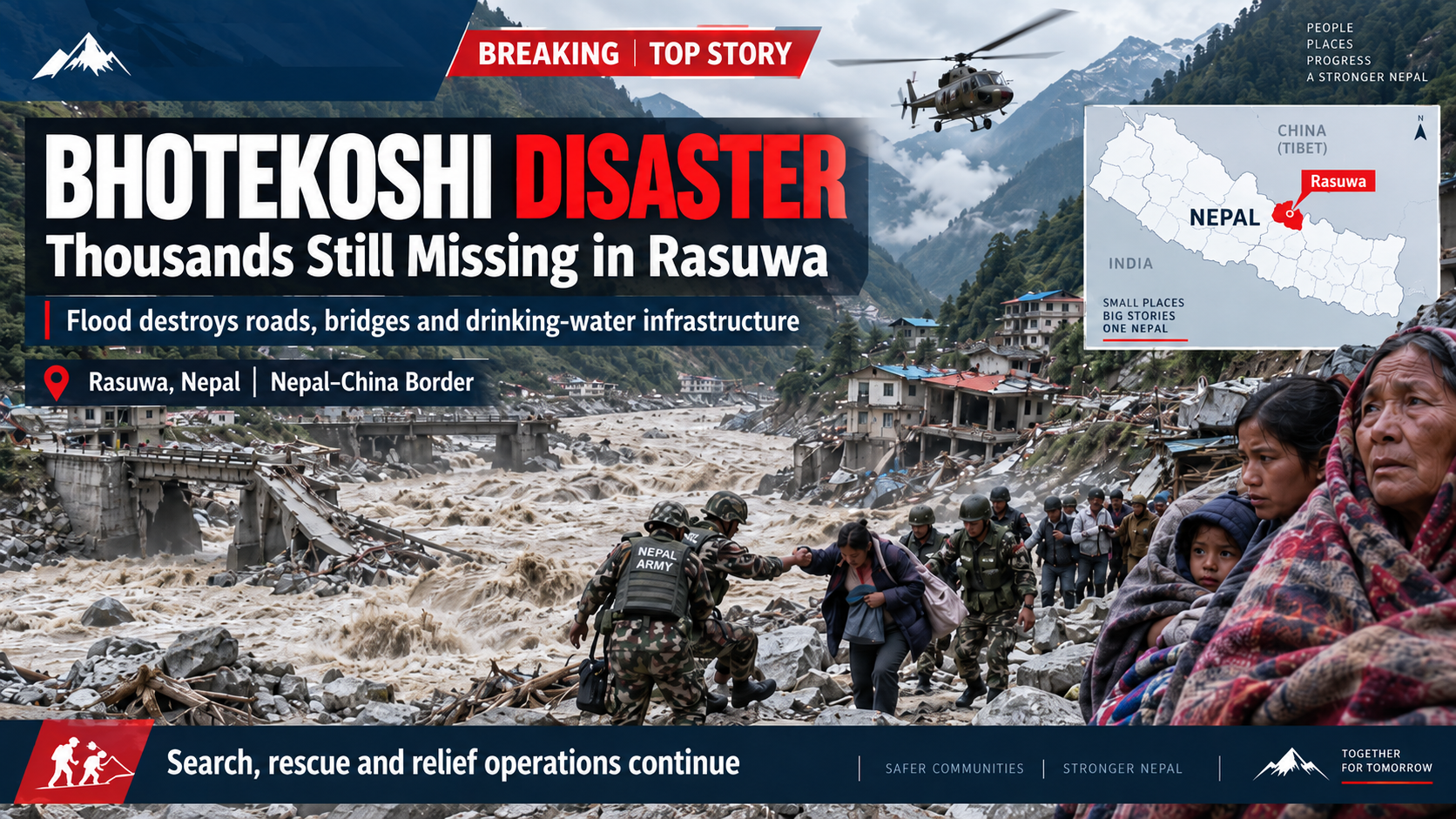
The disaster, which originated in the high Himalayan region and surged through Lhende Khola into the Bhotekoshi and Trishuli river systems, unleashed a massive flow of water, debris, rocks and sediment, sweeping through settlements and infrastructure with extraordinary force.
According to preliminary figures from the District Administration Office in Rasuwa, 1,313 people have been rescued alive so far, including 1,227 Nepali nationals and 86 foreign visitors. Security personnel, local authorities, volunteers and residents have been working continuously in difficult terrain to locate survivors and move stranded people to safer areas.
However, the scale of the humanitarian emergency remains alarming.
District-level records indicate that 3,071 people remain out of contact, although officials have cautioned that the figure is still being verified and may change as rescued individuals reconnect with families and duplicate names are removed from missing-person lists.
Among those still reported out of contact are members of Nepal’s security agencies, government employees, financial-sector workers, local residents, people from other districts and foreign tourists.
Preliminary figures include 27 Nepal Army personnel, 28 Nepal Police personnel, 13 Armed Police Force members, 79 government employees and 26 employees from banks and financial institutions.
Authorities have also listed 1,370 residents of Rasuwa, 1,262 people from other districts and 266 foreign tourists among those not yet confirmed safe.
In one of the most difficult rescue operations, 145 pilgrims and local residents stranded around the Gosainkunda region and other isolated areas were evacuated by helicopter to Nuwakot, Kathmandu and other safer locations. Helicopters have also been used to deliver food, medicine, drinking water and emergency relief supplies to communities cut off by damaged roads.
The flood has also created a major challenge in identifying victims. Several bodies recovered from disaster-hit areas have already been identified and handed over to families, while other remains are undergoing forensic examination and DNA-related identification procedures.
Among the confirmed victims are residents from Uttargaya Rural Municipality–5 and Gosainkunda Rural Municipality–6. Authorities are preparing legal documentation and forensic records for bodies that cannot immediately be identified.
The physical destruction across Rasuwa is enormous.
Preliminary assessments indicate that around 1,500 private homes have been either fully or partially damaged. At least 28 government and public buildings, eight community schools, three private schools and 14 bank and financial institution buildings have also sustained damage.
Transport infrastructure has been hit particularly hard.
Approximately 41 kilometers of highways and local road sections have been destroyed, washed away or rendered impassable. At least six concrete motorable bridges, eight truss or Bailey bridges, one arch bridge and 10 suspension bridges have reportedly been swept away or seriously damaged.
The destruction of road connectivity has left several settlements temporarily isolated and has complicated the movement of rescue teams, heavy equipment and humanitarian supplies.
The disaster has also badly affected eight hydropower projects in Rasuwa, damaging access roads, tunnels, power facilities, worker camps and transmission infrastructure.
Rescue teams have been working around hydropower tunnels amid fears that workers may have been trapped inside. In some cases, workers were rescued alive days after the disaster, giving families and emergency teams renewed hope that more survivors could still be found.
The humanitarian crisis extends far beyond damaged infrastructure.
At least 7,033 displaced people have been moved to 12 temporary shelters across the district, including facilities in Dhunche and nearby areas. Food, shelter, clothing, medicine and emergency supplies are being provided to affected families, with relief materials reportedly distributed in more than 130 separate operations.
Despite the destruction, authorities have made progress in restoring basic services. Electricity has reportedly been restored to around 83 percent of the district’s population, while telecommunications service has been re-established in most areas, improving coordination among rescue teams and allowing families to reconnect.
The Bhotekoshi disaster has also damaged drinking-water infrastructure beyond Rasuwa.
A total of 55 drinking-water projects in Rasuwa, Nuwakot, Dhading and Gorkha have been affected. The highest number of damaged projects has been reported in Nuwakot, followed by Dhading, Rasuwa and Gorkha.
Emergency measures have been introduced in heavily affected areas such as Bidur and Battar, including the use of diesel generators, temporary pumps, tankers and replacement pipelines to restore drinking-water supplies.
Authorities have also prepared additional pumps, water tanks and approximately 41.1 kilometers of HDPE pipeline for emergency installation in Trishuli Bazaar, Belkotgadhi, Kolputar, Galchhi, Gajuri, Bidur and surrounding areas.
Beyond the immediate rescue operation, the disaster is raising serious questions about Nepal’s long-term preparedness for high-Himalayan hazards.
Preliminary scientific assessments suggest that the Bhotekoshi catastrophe may not have been a conventional rain-driven flood. Experts have pointed to the possibility of a major rock-and-ice collapse in the upper Himalayan region, followed by a powerful debris-laden surge that moved rapidly downstream.
Disaster specialists have warned that Nepal’s Himalayan region is becoming increasingly vulnerable to interconnected hazards involving landslides, glacier instability, glacial lakes, river blockages and sudden flood events.
Experts have repeatedly called for 24-hour automated monitoring systems in upper watersheds, stronger cross-border information sharing, improved early-warning networks and strict enforcement of land-use regulations in flood plains and high-risk river corridors.
The disaster has also exposed Nepal’s limited capacity to manage complex emergencies involving hydropower tunnels, collapsed bridges, remote mountain terrain and large-scale rescue operations at the same time.
For now, the country’s most urgent priorities remain clear: locate the missing, rescue anyone who may still be alive, identify victims with dignity, support displaced families, restore drinking water, electricity, roads and communications, and reopen access to isolated communities.
But the broader warning from Bhotekoshi is even more serious.
Nepal can no longer treat Himalayan disasters as isolated incidents. The combination of fragile geology, unstable slopes, expanding infrastructure, growing settlements along river corridors and changing climatic conditions has created a new level of risk.
The Bhotekoshi catastrophe is not only a tragedy for Rasuwa.
It is a national warning.
And unless Nepal dramatically strengthens scientific monitoring, early-warning systems, land-use enforcement, emergency rescue capacity and cross-border disaster coordination, the next Himalayan disaster could strike another river valley with equally devastating consequences.