Norway’s King Harald V Dies at 89, Son Haakon Ascends Throne as King Haakon VIII

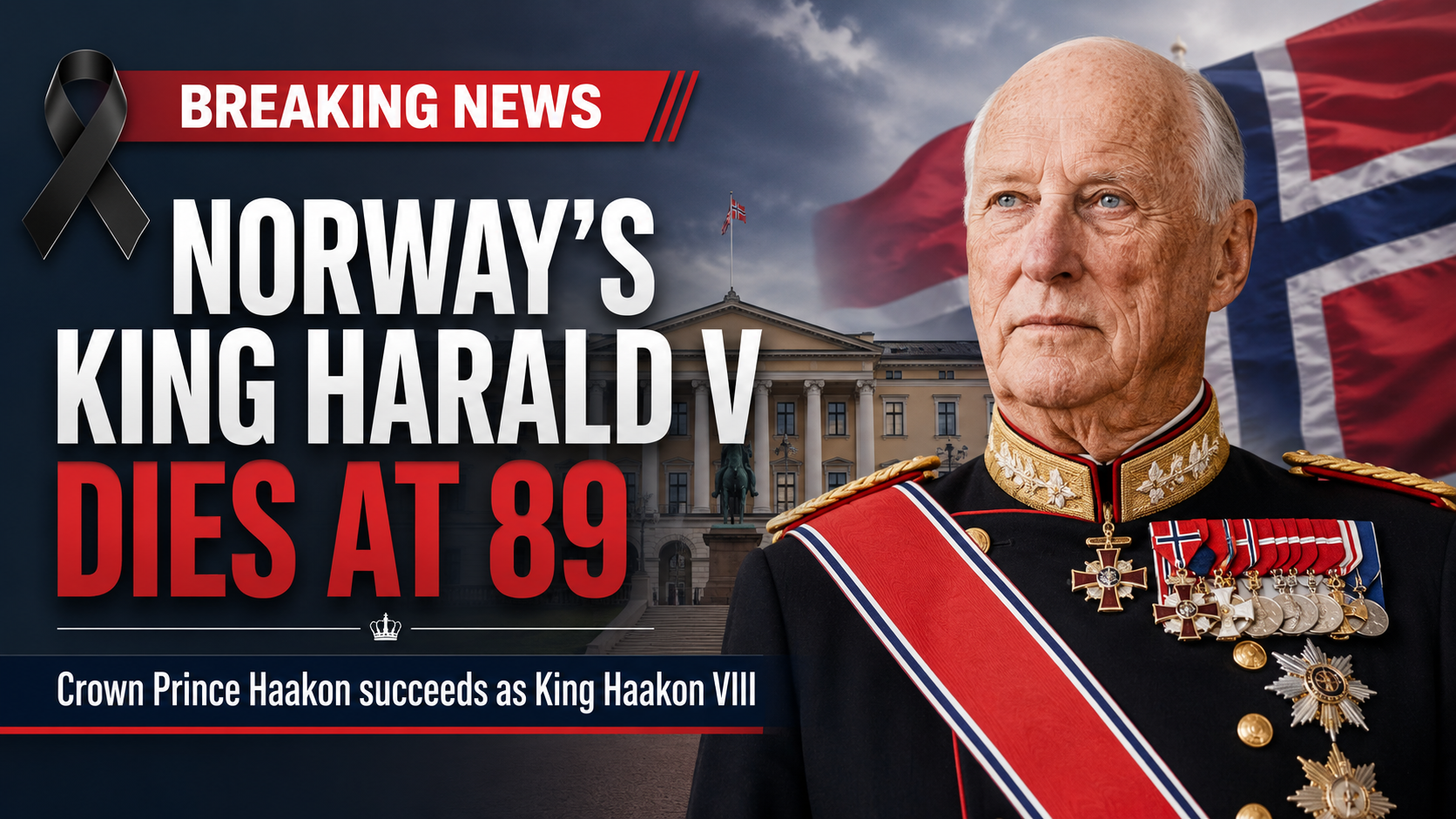
OSLO, Norway — August 28, 2026 / Norway’s King Harald V, one of Europe’s longest-serving and most respected monarchs, died Friday at the age of 89, bringing to an end a reign of more than 35 years that helped reshape the Norwegian monarchy for a modern democratic society.
The Norwegian Royal Court announced that King Harald died peacefully at Oslo University Hospital Rikshospitalet at 6:35 a.m. on Friday, August 28.
The king had experienced worsening health in recent years and had been hospitalized earlier this month with a bacterial bloodstream infection. He had also been receiving treatment for hemolytic anemia, and the Royal Palace said Thursday that his condition had become “very serious.”
Following his death, the Norwegian throne passed automatically to his 53-year-old son, Crown Prince Haakon, who has become King Haakon VIII. His wife, Mette-Marit, is now Queen, while their 22-year-old daughter, Crown Princess Ingrid Alexandra, becomes the heir apparent to the throne.
King Haakon VIII has adopted the traditional royal motto “Alt for Norge” — “All for Norway”, continuing a tradition followed by his father and previous Norwegian monarchs.
From Wartime Exile in America to Norway’s Throne
Harald was born on February 21, 1937, at Skaugum in Asker, the only son of Crown Prince Olav and Crown Princess Märtha. He was the first Norwegian prince born in Norway in 567 years.
His childhood was dramatically shaped by World War II.
When Nazi Germany invaded Norway on April 9, 1940, three-year-old Prince Harald fled the country with his mother and sisters. They first crossed into Sweden and later traveled to the United States at the invitation of President Franklin D. Roosevelt.
After briefly staying at the White House, the family lived at Pook’s Hill near Washington, D.C., for much of the war. Harald remained in the United States until Norway was liberated in 1945. He would later describe America as a “second home” and frequently recalled the hospitality shown to his family during those difficult years.
He returned to Norway on June 7, 1945, alongside his grandfather King Haakon VII, his mother and sisters, receiving an emotional welcome from large crowds in Oslo.
Became King in 1991
After the death of his father, King Olav V, on January 17, 1991, Harald immediately succeeded to the throne.
Four days later, on January 21, he formally swore before Norway’s parliament, the Storting, to uphold the Constitution and laws of the kingdom. King Harald and Queen Sonja were later consecrated at Nidaros Cathedral in Trondheim on June 23, 1991.
Like his father and grandfather, Harald adopted the royal motto “Alt for Norge,” commonly translated as “All for Norway” or “We give our all for Norway.”
Norway is a constitutional monarchy, meaning that while the king serves as head of state and the country’s foremost national symbol, his duties are overwhelmingly representative and ceremonial. Political authority rests with the democratically elected parliament and government.
A Monarch Who Helped Modernize the Royal Family
Over more than three decades on the throne, King Harald became known for helping make Norway’s monarchy more approachable, inclusive and closely connected to ordinary citizens.
Even before becoming king, Harald challenged royal convention by insisting on marrying Sonja Haraldsen, a commoner whom he had loved for years. They married in 1968 after a lengthy relationship that initially faced resistance because she was not of royal or noble birth. Their marriage was regarded as an important turning point in the modernization of Norway’s royal family.
Harald also became known for appearing personally at moments of national tragedy.
Following the July 22, 2011 terrorist attacks in Oslo and on Utøya island, which killed 77 people, the king became an important voice of national mourning, unity and resilience. The Royal Court has described his role during major tragedies as one of meeting victims and helping express the collective grief of the Norwegian people.
Historic 2016 Speech on Diversity and Equality
One of King Harald’s most remembered public addresses came during a royal garden party on September 1, 2016.
In the speech, Harald described a modern Norway made up of people with different backgrounds, beliefs, sexual orientations and ways of life.
He spoke openly of Norwegians who were gay and lesbian, people who believed in Christianity, Islam or no religion at all, and people who had come to Norway from other countries.
His central message was that despite their differences, they were all part of the same Norwegian community.
“My greatest hope for Norway,” he said, was that people would continue to care for one another and build the nation on trust, fellowship and generosity of spirit.
The address became one of the defining speeches of his reign and was widely viewed as an expression of the king’s support for diversity, tolerance, equality and social inclusion.
Sportsman, Sailor and National Symbol
Beyond his royal responsibilities, Harald was an accomplished sailor and lifelong sports enthusiast.
He represented Norway in sailing at several Olympic Games before becoming king and remained closely connected with international sport for decades.
Throughout his reign, he traveled extensively across Norway and abroad, promoted Norwegian businesses and cultural interests, and served as a highly visible symbol of continuity in a country where the monarchy retains substantial public support despite being politically powerless.
Reuters described Harald as a reform-minded monarch who emerged from the shadow of his immensely popular father and developed his own reputation for warmth, humor and empathy. At the time of his death, he was Europe’s oldest reigning monarch.
King Haakon VIII Begins a New Era
The transition to King Haakon VIII occurred immediately upon his father’s death under Norway’s constitutional system.
The new king has already spent years preparing for the role and repeatedly served as regent when Harald was unable to perform official duties because of illness. Educated in Norway, the United States and Britain, Haakon has focused much of his public work on sustainability, development, youth issues and international cooperation.
Norway will now enter a period of national mourning, with ceremonies honoring Harald’s life and reign. His death closes an extraordinary chapter that began with a young prince fleeing Nazi occupation and ended with one of Europe’s most enduring constitutional monarchs leaving behind a country profoundly different from the one he inherited in 1991.
For many Norwegians, Harald V will be remembered not simply as a king, but as a monarch who sought to represent an increasingly diverse and modern Norway while preserving the traditions and continuity of one of Europe’s oldest monarchies.