U.S. Army Secretary Dan Driscoll Resigns After 18 Months, Praises Hegseth Despite Reports of Deep Pentagon Tensions

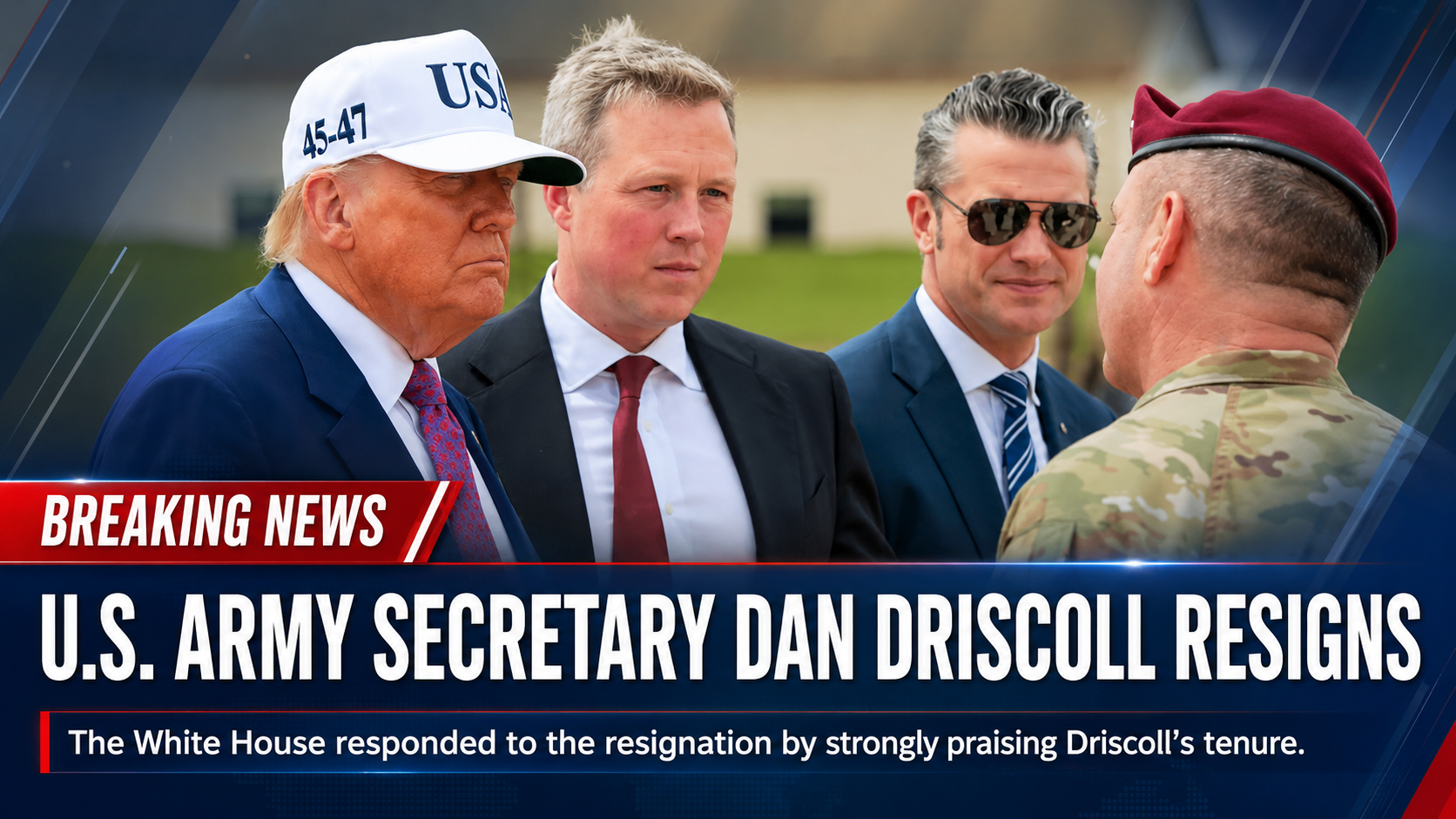
Departure of Trump’s high-profile Army reformer raises questions over military modernization, drone warfare strategy and widening leadership turnover at the Pentagon
WASHINGTON, D.C., September 2, 2026 — Outgoing U.S. Army Secretary Daniel P. “Dan” Driscoll has publicly addressed his resignation for the first time, thanking President Donald Trump and offering strong praise for Secretary of War Pete Hegseth even as multiple reports describe months of serious disagreements between the two officials over Army leadership, modernization and military readiness.
Driscoll, who has served as the Army’s top civilian official since February 2025, said Tuesday evening that Wednesday would be his final full day in office.
In a farewell message posted through the Secretary of the Army’s official social media account, Driscoll described serving in the Trump administration as the “honor of a lifetime” and expressed gratitude to soldiers, civilian employees and military families.
Most notably, Driscoll publicly credited Hegseth for supporting the Army’s progress during his tenure, striking a markedly conciliatory tone despite a growing body of reporting suggesting that their relationship behind the scenes had become increasingly strained. CNN reported that Driscoll said the Army could not have achieved its progress without Hegseth’s support.
The statement represents Driscoll’s first substantial public comments since his resignation became known earlier this week.
Resignation follows months of reported friction
Driscoll submitted his resignation to President Trump on Monday, August 31, after roughly 18 months leading the Army. Reuters reported that his departure followed prolonged tensions with Hegseth over the direction of the service, senior personnel decisions and the Army’s modernization efforts.
The Washington Post similarly reported that Driscoll had repeatedly clashed with Hegseth, including over the dismissal of senior Army officers. The paper said tensions had become both professional and personal, citing officials familiar with their relationship.
ABC News reported Tuesday that Driscoll had repeatedly raised concerns with senior White House officials about Hegseth’s removal of high-ranking military leaders and efforts to prevent some officers from advancing into the military’s most senior ranks.
Neither Driscoll nor the White House, however, has publicly said that disagreements with Hegseth were the official reason for his resignation.
That distinction is important. While several major U.S. news organizations have cited sources describing significant internal friction, Driscoll himself used his farewell statement to emphasize cooperation rather than conflict.
White House praises Driscoll’s record
The White House responded to the resignation by strongly praising Driscoll’s tenure.
White House spokeswoman Anna Kelly said Driscoll had been highly effective in advancing President Trump’s military agenda, citing his leadership during major military operations, his emphasis on readiness and lethality, and his involvement in diplomatic efforts involving Russia and Ukraine.
The White House did not publicly explain why Driscoll was leaving.
His departure comes at an especially sensitive moment for the U.S. military, with renewed fighting between the United States and Iran and continuing pressure on Washington to manage security challenges in Europe and elsewhere.
The resignation also adds to a broader series of departures and dismissals involving senior Pentagon and military leaders under Hegseth. The Washington Post reported September 1 that the turnover has included top Army, Navy and Air Force officials as well as several senior uniformed commanders.
From Iraq veteran to Army secretary
Driscoll became the 26th Secretary of the Army on February 25, 2025, after being nominated by President Trump and confirmed by the Senate.
Before entering civilian government leadership, he served as an Army armor officer with the 10th Mountain Division and deployed to Baghdad in 2009 during Operation Iraqi Freedom.
According to his official Army biography, Driscoll later attended Yale Law School and worked in investment banking, private equity and business operations. He also served as chief operating officer of a $200 million venture capital fund.
His family has a multigenerational military background: his grandfather served during World War II and his father served during the Vietnam era.
Driscoll is also a longtime friend and former Yale Law School classmate of Vice President JD Vance, who served in the U.S. Marine Corps before entering politics.
That relationship helped make Driscoll a particularly prominent figure inside the Trump administration and fueled speculation at different points that he could eventually take on an even larger national-security role.
The Army’s ‘change agent’
Driscoll’s relatively short tenure was defined largely by an aggressive effort to reshape how the Army prepares for future wars.
He became one of Washington’s most visible advocates for drones, autonomous weapons, artificial intelligence, faster weapons procurement and closer cooperation between the military and American technology companies.
His philosophy was heavily influenced by lessons emerging from modern conflicts, particularly the enormous battlefield role played by inexpensive drones, electronic warfare, long-range precision weapons and rapidly developed commercial technology.
Driscoll and then-Army Chief of Staff Gen. Randy George jointly launched the Army Transformation Initiative, or ATI, in May 2025.
The initiative argued that the Army needed to become smaller in some areas, faster in acquiring new technology and more lethal on the battlefield.
Their official directive said modern battlefields were changing rapidly as autonomous systems became cheaper and deadlier and commercial technologies evolved faster than traditional Pentagon acquisition systems could respond.
The Army began examining whether to eliminate or reduce older weapons and vehicles while redirecting money toward unmanned systems, long-range fires, modern communications and other technologies viewed as more relevant to future combat.
Driscoll frequently argued that traditional Pentagon procurement could take too long and cost too much, leaving U.S. forces vulnerable to adversaries that were adopting new technologies more rapidly.
That approach earned him a reputation as a military “change agent” and, informally, as one of the administration’s leading advocates for drone warfare.
Randy George’s removal became a major flashpoint
One of the most important reported sources of tension between Driscoll and Hegseth involved Gen. Randy George, then the Army chief of staff and Driscoll’s principal partner in the transformation campaign.
Hegseth removed George from his position in April 2026, well before the scheduled completion of his term.
The Washington Post reported that Driscoll had previously resisted efforts to remove George and believed that senior military officers should be evaluated primarily on performance and merit.
George’s departure was significant because he and Driscoll had jointly championed the Army Transformation Initiative and had publicly presented themselves as partners in restructuring the service.
After George’s removal, several reports described Driscoll’s relationship with Hegseth as deteriorating further.
At the time, however, Driscoll publicly rejected speculation that he was preparing to quit. On April 7, he told the Washington Post that he had no plans to resign as Army secretary.
Less than five months later, he submitted his resignation.
Drone warfare dispute highlights larger modernization debate
Driscoll’s exit has also intensified debate over whether the Army will maintain the pace of technological experimentation he promoted.
One recent controversy concerns an experimental unit associated with the 173rd Airborne Brigade in Europe that had been developing specialized drone warfare tactics informed partly by lessons from Ukraine.
A bipartisan group of lawmakers has asked the Army to explain why the unit was ordered to stop specializing in drone warfare and return to a more traditional infantry mission.
The lawmakers warned that dismantling such experimentation could slow the Army’s ability to adapt to a battlefield increasingly dominated by unmanned aircraft.
The issue has gained additional attention because both Driscoll and George were major supporters of incorporating drones more deeply into Army formations.
Business Insider reported September 2 that the Army has now lost two of the most prominent senior advocates of its transformation program, creating uncertainty about the future of a modernization effort involving tens of billions of dollars.
Pentagon leadership turnover raises broader questions
Driscoll’s departure is not occurring in isolation.
Hegseth has overseen an unusually extensive reshaping of the Pentagon’s senior leadership since President Trump returned to office.
Among the prominent leaders removed or departed during this period are former Joint Chiefs Chairman Gen. Charles Q. Brown Jr., former Chief of Naval Operations Adm. Lisa Franchetti, Gen. Randy George and several other senior military officials.
The administration has generally argued that leadership changes are necessary to restore a sharper focus on combat effectiveness, readiness and winning wars.
Critics, including some members of Congress and former defense officials, have questioned whether the rapid turnover risks weakening institutional experience and creating leadership gaps at a time of active conflict.
Driscoll’s resignation is particularly notable because he had attracted praise from lawmakers in both parties.
Republicans in Congress publicly defended him during earlier disputes inside the Pentagon, with some describing him as a transformational leader who was willing to challenge cumbersome military bureaucracy.
Hegseth’s unusual official title
The Trump administration now publicly refers to Hegseth as Secretary of War, although his statutory position remains Secretary of Defense.
President Trump signed an executive order on September 5, 2025 authorizing “Department of War” and “Secretary of War” as secondary titles for the Department of Defense and secretary of defense in executive-branch communications and ceremonial contexts. Permanently changing the department’s statutory name would require congressional action.
The White House currently lists Hegseth as Secretary of War, while Defense Department pages also continue to identify him by the statutory title Secretary of Defense.
A conciliatory farewell, but unanswered questions remain
For now, Driscoll appears determined to leave the administration without publicly escalating his disagreements with Hegseth.
His farewell message praised soldiers and Army civilians, highlighted the transformation accomplished during his tenure, thanked Hegseth for supporting that work and expressed gratitude to President Trump for giving him another opportunity to serve the country.
That public message stands in sharp contrast to reports describing months of internal disputes over senior officers, promotions, military modernization and the overall direction of the Army.
Whether those disputes ultimately triggered Driscoll’s resignation remains officially unanswered.
What is clear is that his departure removes one of the Army’s most prominent modernization advocates at a consequential moment for U.S. national security.
The next Army secretary will inherit not only a service operating during a period of active global conflict, but also a fundamental strategic question: Will the Army continue the rapid technology-driven transformation championed by Driscoll and George, or will a new leadership team take America’s largest military service in a different direction?