World Leaders Take the UN Stage as Wars, Climate and AI Shape UNGA 81; Nepal to Address Assembly Thursday


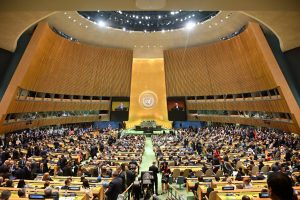
NEW YORK, Sept. 22, 2026 / The United Nations General Assembly’s 81st high-level General Debate opened Tuesday in New York with world leaders confronting a crowded global agenda dominated by wars, geopolitical rivalry, climate change, economic inequality, artificial intelligence and mounting questions over the effectiveness of the international system.
The General Debate, running from September 22 through September 26 and concluding on September 28, is being held under the theme “Restoring trust, managing transformation: A United Nations that delivers for all.” The broader High-Level Week includes separate meetings on development, climate action, sea-level rise, pandemic preparedness, racial justice and nuclear disarmament.
Brazil traditionally opened the country statements, followed by host nation United States, where President Donald Trump delivered a wide-ranging address focused heavily on Iran while also discussing Gaza, Russia’s war with Ukraine, Venezuela, drug cartels, Greenland, UN reform and artificial intelligence.
Leaders from Jordan, Türkiye, Qatar, Lithuania, Peru, Chile, France, Finland, Luxembourg, Angola and several other nations also took the floor during the opening day. By late Tuesday, more than a dozen national leaders had already addressed the Assembly, with the first-day session continuing into the evening.
The speeches revealed several recurring fault lines: the widening conflicts in the Middle East, the future of Gaza and Palestine, Iran’s nuclear program and regional role, the Russia-Ukraine war, reform of the UN Security Council, migration, international law, climate financing and the rapid development of AI.
Brazilian President Luiz Inácio Lula da Silva stressed national sovereignty and warned against foreign interference, while calling for international cooperation rather than outside intervention in combating organized crime. Turkish President Recep Tayyip Erdoğan again pressed for changes to the structure of the Security Council, an issue that has also drawn contrasting views from permanent members such as Russia.
Trump, meanwhile, used his address to issue a stark warning to Iran, insisting Tehran must abandon its nuclear ambitions and support for militant groups or face further pressure. He also promoted a stronger U.S. security role in the Western Hemisphere, including aggressive action against transnational drug cartels.

Guterres warns the world is facing four defining tests
UN Secretary-General António Guterres opened the debate with a warning that global divisions had widened to dangerous levels, saying the international community now faces four fundamental tests involving war and peace, inequality, climate change and artificial intelligence.
Guterres called for an end to escalating conflicts, stronger respect for international law, reform of the Security Council and a global framework to govern AI. He also argued that Africa’s continued absence from permanent membership on the Security Council is no longer defensible.
Climate change featured prominently in his final General Assembly opening address as Secretary-General. Guterres warned that climate impacts once regarded as future threats are now unfolding in real time and urged richer nations and major polluters to take greater responsibility.
Nepal was directly relevant to that message. Guterres recalled the rapidly changing Himalayan environment and the dangers created by melting glaciers, reinforcing an issue Nepal itself plans to place prominently before this year’s Assembly.
More than 130 heads of state and government expected
According to information provided to Nepal’s Ministry of Foreign Affairs by the United Nations, 81 heads of state and 50 heads of government, including Nepal’s prime minister, are participating at that level in this year’s session. Other countries are represented by vice presidents, foreign ministers or other senior officials.
The UN has 193 member states, and the annual General Debate gives member countries and eligible observers an opportunity to present their national and international priorities.
The debate itself will take place over six meeting days — September 22 to 26 and September 28. The broader High-Level Week continues with additional meetings, including a Right to Development event and climate gathering on September 23, a high-level meeting on the existential threat of sea-level rise on September 24, pandemic preparedness on September 25, the Durban Declaration anniversary on September 28 and a nuclear-disarmament meeting on September 29.
Nepal to address General Assembly on September 24
Nepalese Prime Minister Balendra Shah is scheduled to address the General Debate on Thursday, September 24, according to Nepal’s Ministry of Foreign Affairs.
Shah left for New York on September 22 leading Nepal’s high-level delegation. He is also scheduled to meet UN Secretary-General António Guterres during his stay. Foreign Minister Shisir Khanal is separately participating in ministerial meetings, side events and bilateral engagements.
The Nepali delegation also includes senior government officials, while Foreign Minister Khanal is expected to participate in meetings involving Least Developed Countries, Landlocked Developing Countries, the Non-Aligned Movement and the Group of 77 and China.
Climate justice expected to lead Nepal’s message
Climate vulnerability is expected to be one of Nepal’s most important messages in New York, particularly following the devastating August 26 flooding in the Bhote Koshi River area of Rasuwa.
Nepal’s Foreign Ministry says the disaster has once again demonstrated that the country stands on the front line of the global climate crisis despite contributing relatively little to the emissions driving global warming.
Nepal is also organizing a special UNGA side event titled “Sagarmatha to the Sea: A Call to Action for a Climate-Resilient Future.”
The event is designed to draw international attention to the interconnected consequences of climate change — from melting Himalayan glaciers and dangerous glacial lakes to floods, landslides, river systems and downstream communities.
Beyond climate change, Nepal intends to present the priorities of its current government, strengthen international cooperation and seek continued global support for the country’s development agenda. The government is also expected to emphasize the concerns of least-developed and landlocked developing countries and the need for a more inclusive multilateral system.
With conflicts intensifying across several regions and confidence in multilateral institutions under strain, UNGA 81 is emerging as more than the customary annual gathering of world leaders. The central question running through the opening speeches is whether an increasingly divided international community can still find enough common ground to respond collectively to war, climate disruption, economic inequality and rapidly changing technology.
For Nepal, Thursday’s address provides an opportunity to turn the global spotlight toward the Himalayan climate crisis — and to argue that what is happening in the mountains is not simply a national problem, but part of a wider global emergency.