Trump Says He Is Banning CNN, MS NOW and Politico From White House; CNN and Politico Vow First Amendment Fight

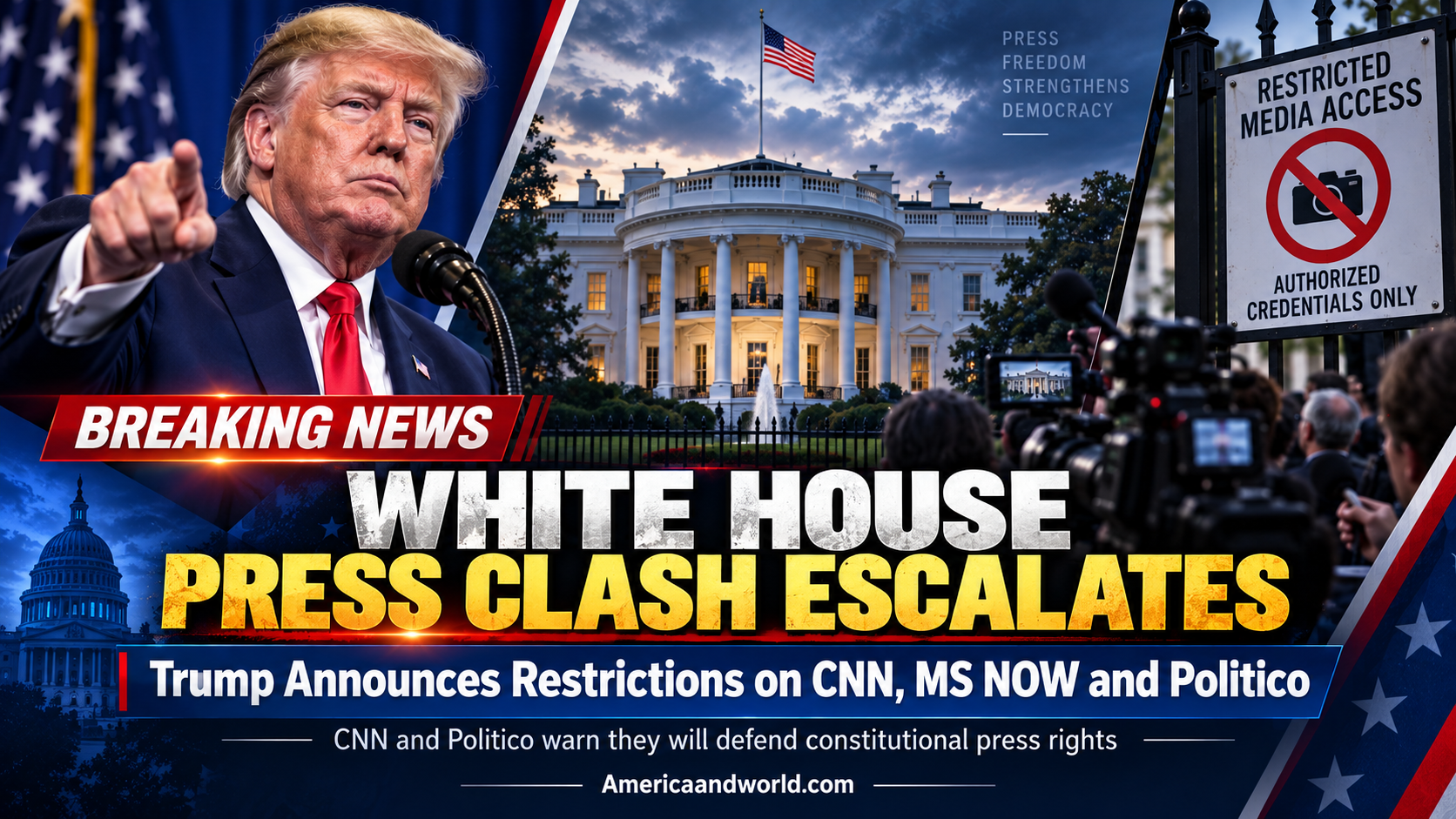
WASHINGTON, Sept. 18, 2026 — President Donald Trump announced Friday that he is banning CNN, MS NOW and Politico from the White House “effective immediately,” accusing the three major news organizations of repeatedly publishing what he called “fake news,” “fiction” and “lies” about his presidency and administration. He also warned that additional media organizations could face similar restrictions.
Despite the announcement, however, the practical scope of the ban remained uncertain Friday evening. Journalists representing CNN, MS NOW and Politico were still working on White House grounds after Trump’s statement, and the administration had not publicly clarified whether their permanent White House credentials would be revoked, whether they would be excluded only from presidential events and press pools, or whether they would lose access to broader White House press facilities.
Trump made the announcement on Truth Social, saying the three organizations were being barred because of their coverage. He wrote that media organizations should not be allowed to continually report what he described as “FICTION and LIES” about the president, his administration or the United States, adding that other outlets could follow.
Asked about the decision later during an Oval Office event, Trump did not identify a single article or broadcast that triggered the action. Instead, he said the decision resulted from the cumulative effect of coverage over several years.
When asked which organizations might be targeted next, Trump criticized The New York Times and The Washington Post, although he did not announce formal restrictions against either outlet Friday.
CNN responded by strongly defending its White House journalists and their reporting.
The network said it has a constitutional right to report on the presidency without government obstruction and said that, if Trump’s threatened ban is implemented, CNN considers it an unlawful infringement of that constitutionally protected right. CNN described its White House team’s journalism as “fair and accurate.”
Politico issued a similar response, saying it would continue reporting fairly on the current White House and future administrations and would “vigorously defend” its First Amendment rights against efforts to restrict them. MS NOW had not issued a substantive public response when Reuters and AP published their Friday updates.
The dispute also revived questions about two claims Trump has previously made concerning MS NOW and Politico.
MS NOW is the successor to MSNBC. The network says the name stands for “My Source for News, Opinion, and the World.” Its rebranding was part of the corporate separation of MSNBC and other cable properties from NBCUniversal, rather than simply a response to television ratings or credibility concerns. MS NOW became part of Versant, which formally separated from Comcast on January 2, 2026 and began trading as an independent public company on Nasdaq on January 5.
Trump has also repeatedly cited approximately $8 million in federal payments to Politico, portraying the money as improper government support for the news organization during the Biden administration.
Federal spending records examined by FactCheck.org and other fact-checkers showed something different. Federal agencies collectively spent more than $8 million in fiscal 2024 on subscriptions and professional information products from Politico, including its higher-priced Politico Pro services. Those payments were purchases of subscriptions and information products rather than an $8 million government grant or subsidy to keep Politico operating.
FactCheck.org reported that payments specifically associated with USAID totaled about $44,000 in 2023 and 2024, rather than $8 million. Government agencies purchased Politico and other commercial information services under both Democratic and Republican administrations. Whether government agencies should spend that amount on premium news and policy subscriptions is a separate policy question, but available spending records do not establish that Politico received an illegal $8 million subsidy.
The larger question surrounding Friday’s announcement is constitutional.
The First Amendment protects freedom of speech and the press, but the legal implications of Trump’s action could depend heavily on what the White House actually does. Courts have recognized presidential discretion in deciding which journalists can enter highly restricted spaces or participate in small events where access is necessarily limited. Broader exclusion from established White House press facilities or denial of credentials because of a news organization’s editorial viewpoint could present different constitutional issues.
A frequently cited precedent is the 1977 federal appeals court decision Sherrill v. Knight. The court held that although the White House is not constitutionally required to establish press facilities, once it provides press access and credentials, decisions denying access are subject to constitutional safeguards and procedural protections.
The Reporters Committee for Freedom of the Press said Friday that excluding organizations because the administration dislikes their reporting would constitute viewpoint discrimination and would be vulnerable to a First Amendment challenge. The Committee to Protect Journalists also said the announced restrictions raise serious press-freedom concerns. Those statements represent the organizations’ legal and advocacy positions; the ultimate legality of any implemented restriction would depend on its specific form and, if challenged, the courts.
Trump has faced similar disputes over White House media access before.
During his first administration, the White House suspended CNN correspondent Jim Acosta’s press credential in 2018. A federal judge subsequently ordered the credential restored while litigation continued. Reuters notes that the administration also sought to suspend or revoke credentials belonging to other journalists during Trump’s first term.
During Trump’s second term, the Associated Press sued after the administration restricted its reporters’ access to the Oval Office, Air Force One and certain other limited-access presidential events following the AP’s decision to continue using “Gulf of Mexico” while acknowledging Trump’s order directing federal agencies to use “Gulf of America.” A lower court sided with the AP, but an appeals court stayed that order, allowing the White House restrictions to remain while the broader litigation continued.
A comprehensive ban on CNN could also have practical consequences beyond the network itself. CNN is traditionally part of the five-network television pool that helps provide shared television coverage of the president’s activities to other news organizations. AP reported that removing CNN entirely could disrupt the longstanding pool system used to provide continuous independent coverage of the presidency.
As of Friday evening, therefore, Trump had publicly declared CNN, MS NOW and Politico banned from the White House and suggested that other organizations could follow. CNN and Politico had responded by invoking their First Amendment rights, while journalists from all three organizations were still present at the White House after the announcement.
The next significant question is how — and whether — the administration formally implements the restrictions. The answer will determine whether Friday’s announcement remains primarily a presidential declaration or develops into another major court battle over the boundaries between presidential control of White House access and the constitutional protections afforded to the press.