Fed Rate Hike Hits Borrowers as Inflation and Energy Costs Keep Pressure on U.S. Economy

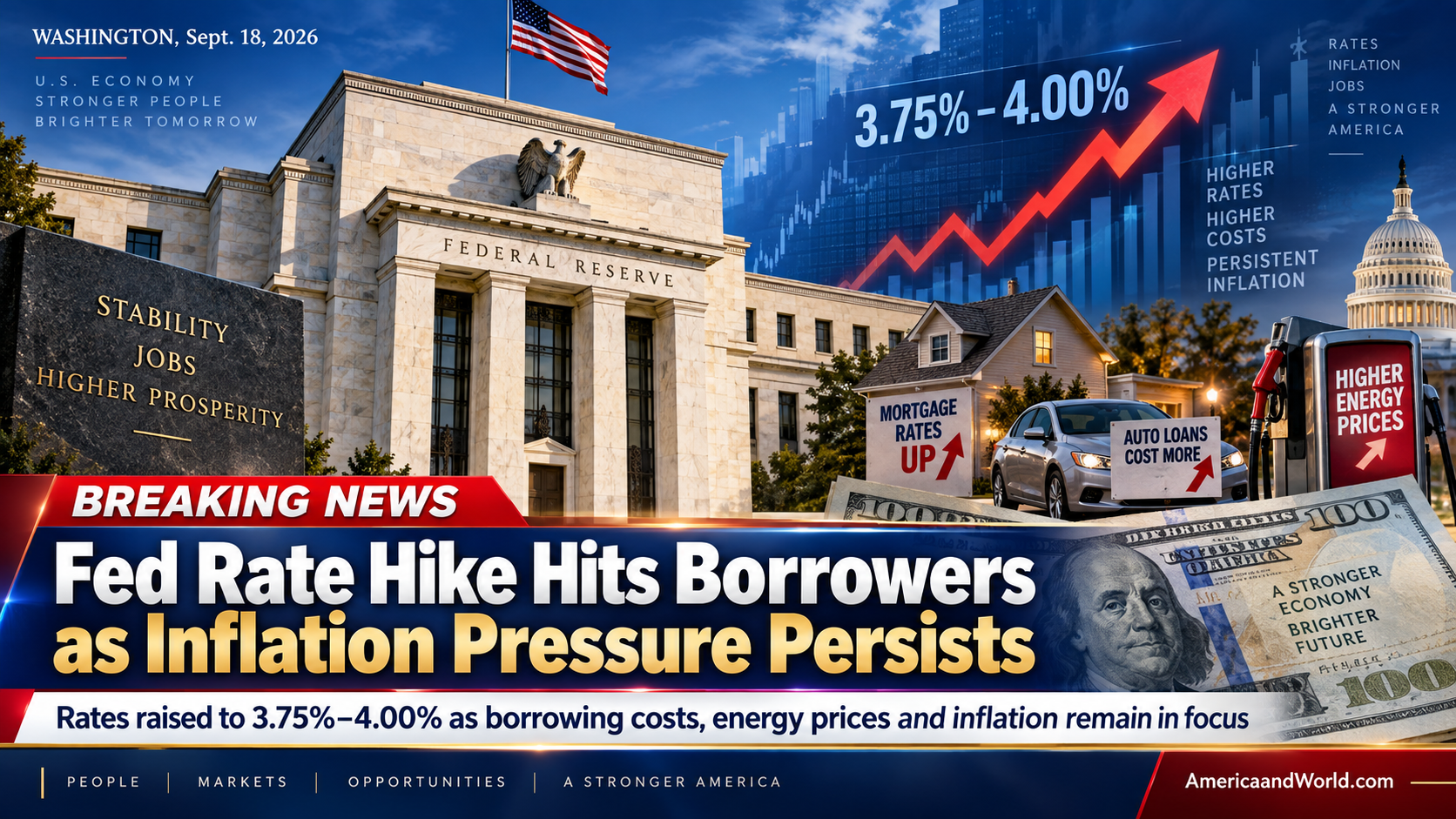
WASHINGTON, Sept. 18, 2026 — Americans already struggling with high prices are facing another financial squeeze after the Federal Reserve raised interest rates for the first time in more than three years, a move aimed at controlling renewed inflation but one that could also increase borrowing costs and slow parts of the U.S. economy.
The Federal Open Market Committee voted unanimously Wednesday to raise its benchmark federal funds rate by 0.25 percentage point to 3.75%–4.00%. The Fed said inflation remains elevated and that the increase is intended to help return inflation toward its long-term 2% target.
The decision follows a fresh acceleration in consumer prices. The Consumer Price Index rose 0.4% in August and 3.4% from a year earlier, according to the Bureau of Labor Statistics. Gasoline prices jumped 3.9% in August alone and accounted for more than one-third of the monthly increase.
Higher Fed rates do not automatically translate into an identical increase in mortgage or auto-loan rates, but tighter monetary policy generally makes credit more expensive. Consumers carrying variable-rate debt, businesses seeking financing and prospective homebuyers could face additional pressure. The original report also highlighted concerns about housing, automobiles, credit-card debt and farm financing costs.
Federal Reserve Chair Kevin Warsh said inflation pressures remain serious enough to justify tighter policy. The central bank has also signaled that additional rate increases could be considered if inflation does not ease sufficiently.
President Donald Trump, who has repeatedly called for lower borrowing costs, criticized the decision and said U.S. interest rates should be around 1% or lower. Trump nevertheless said he retained confidence in Warsh, whom he appointed to lead the central bank.
The rate hike comes as other parts of the economy are also under strain. The U.S. Department of Agriculture forecasts net farm income at $158.4 billion in 2026, down 2.6% from 2025 in nominal terms and 5.5% after adjusting for inflation.
For financial markets, the central question is now how long interest rates will remain elevated and whether additional increases will follow. Investors are also watching energy prices, Treasury yields, corporate earnings and geopolitical tensions for signs of where inflation and economic growth are headed.
The Fed now faces a difficult balancing act: bringing inflation under control without unnecessarily weakening employment, housing, consumer spending and business investment.
With the November 2026 midterm elections approaching, inflation, interest rates, housing affordability and the cost of living are also likely to remain prominent issues in the national economic debate.