U.S. Opens New Economic Front Against Iran, Warns Trade Partners They Could Lose Access to Dollar System

WASHINGTON/TEHRAN, August 25, 2026
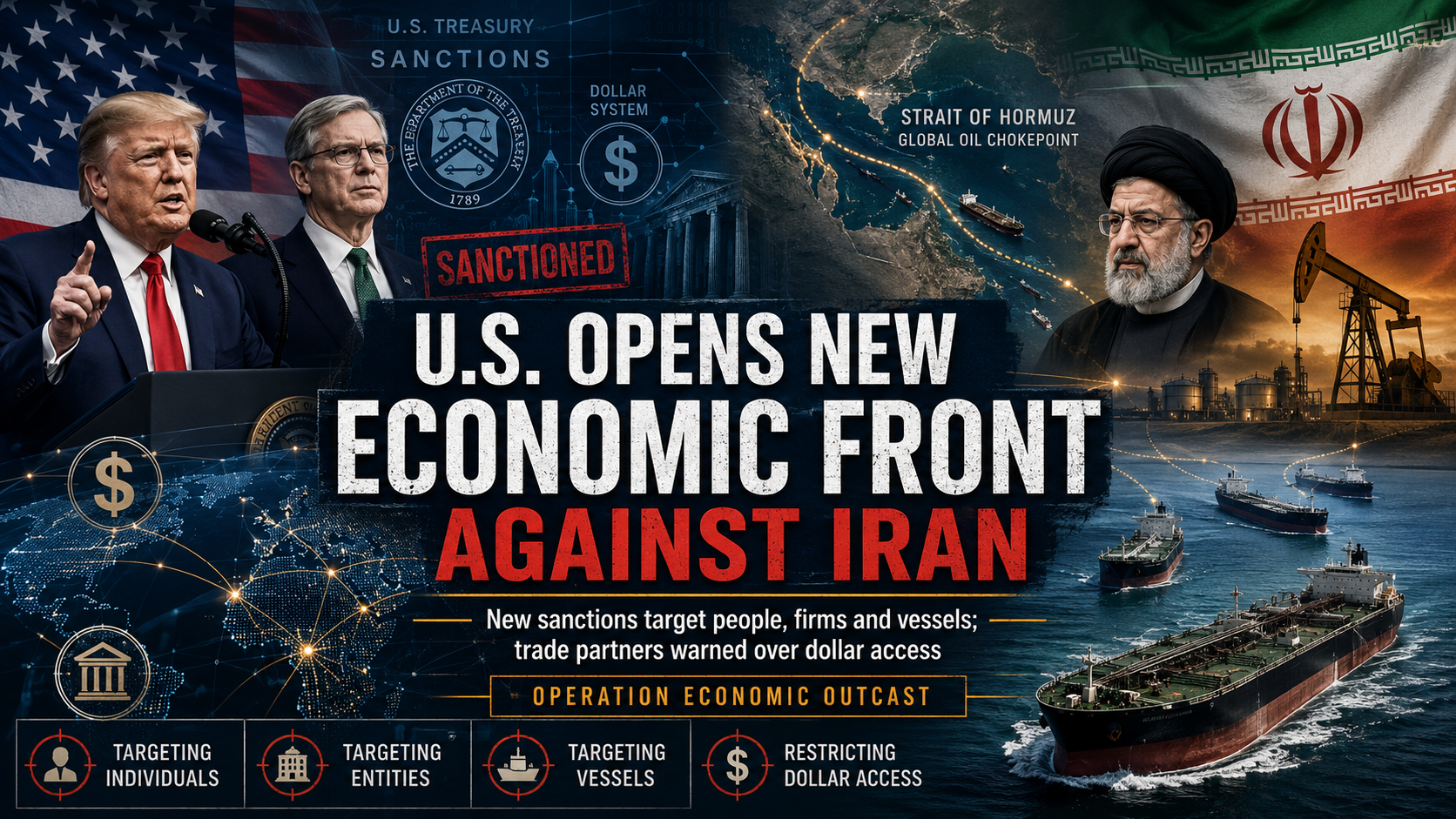
The United States has dramatically expanded its economic campaign against Iran, sanctioning nearly 60 individuals, companies, financial and commercial networks and vessels while warning governments and businesses around the world that continued dealings with Tehran could eventually cost them access to the U.S. financial system.
The new campaign, announced by the Treasury Department on Monday under the name “Operation Economic Outcast,” represents one of the Trump administration’s broadest attempts yet to isolate Iran economically as the nearly six-month conflict involving the United States, Israel and Iran continues without a comprehensive political settlement.
Treasury Secretary Scott Bessent described the initiative as a sustained effort to sever Iran’s international financial connections and reduce its ability to sell oil, obtain sensitive technology, move money and circumvent existing sanctions. The Treasury Department said the campaign would extend beyond Iranian companies themselves by increasing pressure on foreign entities that continue to provide Tehran with economic or financial support.
The most significant change may not be the list of entities sanctioned immediately, but Washington’s decision to substantially broaden the range of Iran-related business that could trigger secondary sanctions in the future.
The Treasury Department formally identified five additional sectors—digital assets, technology, gold, aviation and shipping—in which foreign companies, financial institutions or individuals doing business connected to Iran could face U.S. penalties.
Secondary sanctions are particularly powerful because they can target non-American companies for transactions that may be legal in their own countries. In the most serious cases, foreign institutions could be restricted or effectively excluded from the U.S. financial system, making access to dollar transactions significantly more difficult.
The administration said governments around the world would be given defined periods to shut down Iran-related activities identified by Washington. Treasury officials, however, have not publicly specified which countries will receive which deadlines or exactly when penalties will begin.
That distinction is important: the United States has not yet imposed blanket sanctions on every country trading with Iran.
Instead, Washington has issued a warning that countries and companies continuing specified activities after being given an opportunity to disengage could face enforcement action. Bessent said institutions facilitating Iranian money laundering or sanctions evasion risk being cut off from the American financial system.
The strategy gives Washington considerable leverage because the U.S. dollar remains central to international banking and trade. But using that leverage against major economies or globally important banks could also carry substantial risks for the United States, potentially disrupting oil markets, international finance and relations with countries such as China.
Despite the administration’s description of the initiative as an unprecedented economic offensive, Washington stopped short of some of the most aggressive measures analysts had anticipated.
Notably, the latest sanctions list did not include major Chinese financial institutions suspected by U.S. officials of facilitating Iranian oil trade, even though China has for years been Iran’s largest oil customer. Reuters reported that the omission highlighted the difficult choice facing Washington: imposing severe penalties on major Chinese institutions could increase pressure on Tehran but also trigger a much broader confrontation with Beijing.
Nuclear, missile and technology networks targeted
A large portion of the new sanctions focuses on networks that Washington says have helped Iranian defense-linked organizations acquire sensitive equipment for ballistic-missile development and nuclear research.
More than 20 individuals and entities in Asia and the Middle East were targeted over alleged financial, procurement and logistical support for Iranian programs.
Among them are China-based companies accused by the Treasury Department of supplying dual-use equipment to an Iranian technology institute that was already under U.S. sanctions.
Dual-use technology refers to products that have legitimate civilian applications but can also be used for military, nuclear or weapons-related purposes.
The Treasury Department said its sanctions were intended to disrupt procurement networks supporting entities connected to Iran’s Ministry of Defense and Armed Forces Logistics.
Washington has also widened its ability to sanction foreign companies operating in Iran’s technology sector, arguing that Tehran has sought access to advanced equipment for use in domestically produced weapons systems.
Oil traders and five ‘shadow fleet’ tankers blacklisted
Iran’s oil-export system is another central target.
The United States imposed new restrictions on vessel brokers, bunkering providers, traders and financial intermediaries accused of helping move or finance Iranian petroleum.
The sanctions include individuals and businesses in the United Arab Emirates, Singapore and Hong Kong, among other jurisdictions.
Five tankers were identified by Washington as part of what it describes as Iran’s “shadow fleet” and designated as blocked property. The designation generally prohibits U.S. persons from conducting transactions involving the vessels and freezes property under U.S. jurisdiction.
Iran has long relied on networks of intermediaries, ship-to-ship transfers, ownership changes, reflagging arrangements and other techniques to continue exporting oil despite U.S. restrictions.
Washington is now signaling that the companies enabling those transactions—not merely Iranian exporters—could increasingly become direct targets.
Cryptocurrency, gold and aviation enter the spotlight
The inclusion of digital assets and cryptocurrency reflects growing U.S. concern that Iran and sanctioned organizations have been using alternative financial channels to reduce their dependence on traditional banking.
Treasury officials also identified gold as an area of concern, saying Tehran has increasingly used precious metals as a hedge against pressure on its currency and financial sector.
The aviation designation could expose foreign companies servicing Iranian aircraft or providing certain forms of assistance to Iranian aviation networks to greater sanctions risk.
Washington argues that some Iranian airlines and aviation companies have been used to transport weapons, sensitive equipment, money or personnel connected with the Islamic Revolutionary Guard Corps and allied organizations.
The shipping designation similarly gives U.S. authorities wider authority to target foreign individuals and companies operating in or supporting Iranian maritime businesses.
Cyber networks also targeted
The new campaign also extends into cyberspace.
The Treasury Department said it was targeting a group linked to Iran’s Ministry of Intelligence and Security that Washington accuses of compromising American critical infrastructure and carrying out financially motivated cyber theft.
Iran has repeatedly rejected U.S. accusations regarding state-backed cyber operations, portraying many American allegations as politically motivated.
The expanded designations show that Washington intends its economic campaign to encompass not only Iran’s oil and defense sectors but also technology, cyber activity and financial networks operating far beyond Iranian territory.
Some remittance and academic licenses suspended
In a less publicized but potentially significant move, the Treasury Department also suspended several general licenses that had previously permitted certain remittance payments to Iran and facilitated some Iranian access to U.S. cultural and academic activities.
The decision illustrates how the pressure campaign is extending beyond energy and military procurement into selected areas of civilian and financial interaction.
The precise practical effect will depend on the scope of the suspended licenses and how U.S. authorities implement the restrictions.
China pushes back
The ultimate effectiveness of Washington’s strategy may depend heavily on the reaction of Iran’s principal trading partners, particularly China.
Beijing responded by saying its cooperation with Iran is conducted within the framework of international law and should not be subject to outside interference.
Chinese officials have also argued that sanctions and coercive pressure are unlikely to resolve the underlying confrontation.
China has been Iran’s most important oil customer for several years, making Beijing central to any American strategy designed to substantially reduce Tehran’s export revenue.
But Washington faces a difficult calculation.
Sanctioning smaller intermediaries is relatively straightforward. Cutting major Chinese banks out of the dollar system would be far more consequential and could provoke retaliation, destabilize financial markets and deepen tensions between the world’s two largest economies.
For now, the Trump administration appears to be preserving that option while stopping short of using it.
Tehran calls campaign unlawful
Iran, meanwhile, has rejected the new sanctions and indicated it believes Washington will struggle to persuade major countries to participate in the isolation campaign.
Iran’s Foreign Ministry described the measures as a challenge to international law and accused the United States of systematic coercion against sovereign states.
Iranian Economy Minister Ali Madanizadeh said Tehran believed China and Russia would resist the American pressure campaign and predicted that other countries could also refuse to comply.
Iranian officials have maintained that decades of U.S. sanctions have forced Tehran to develop alternative trading, financial and transportation networks that make complete economic isolation difficult.
At the same time, the combined impact of war, disrupted shipping and restrictions on oil exports has placed significant pressure on Iran’s economy.
An Iranian Revolutionary Guards spokesman also warned that any new threat to Iranian infrastructure could trigger retaliation against American interests or strategically important energy routes.
Hormuz remains the crucial economic battlefield
The confrontation is unfolding alongside continuing uncertainty over the Strait of Hormuz, one of the world’s most important energy corridors.
Before the conflict began in February, roughly one-fifth of global oil and liquefied natural gas shipments passed through the waterway.
Commercial traffic has fallen dramatically during the war, making the strait a central factor in global energy security.
Iran and neighboring Oman said Tuesday they had resumed discussions over establishing a “joint temporary navigational corridor” through Hormuz that could allow limited maritime traffic to move more safely through the area.
The two countries also discussed clearing mines from the waterway.
President Trump has repeatedly said U.S. forces have already removed or detonated mines in international waters and has warned that any vessel caught laying new mines could be destroyed.
Despite a reduction in large-scale American and Iranian strikes in recent weeks, the waterway remains dangerous. A tanker was struck near the entrance to the strait on Tuesday by an unidentified projectile and was disabled near Oman, according to the United Kingdom Maritime Trade Operations agency.
The prospect of an Iran-Oman arrangement helped ease some market fears on Tuesday, with oil prices falling as traders assessed the possibility that maritime traffic could gradually stabilize.
Diplomacy remains fragile
Political efforts to resolve the conflict have produced only limited progress.
An interim understanding reached in June was intended to move the confrontation toward an end, but it quickly weakened. Pakistan and Oman have since continued diplomatic efforts aimed at reopening the Strait of Hormuz and preventing renewed military escalation.
Reuters reported that Pakistan recently conveyed messages between Washington and Tehran and that Iranian officials expressed a general willingness to resume negotiations, although major disagreements remain unresolved.
The United States has also begun returning some personnel to diplomatic missions in the Middle East that were evacuated or reduced during periods of heightened tension, suggesting Washington may currently see a lower immediate risk of large-scale escalation.
That does not mean the underlying confrontation has ended.
Iran’s nuclear program, missile capabilities, oil exports, regional alliances and demands concerning Hormuz remain major points of dispute.
Washington shifts from military pressure to financial warfare
The launch of Operation Economic Outcast suggests that the Trump administration is placing greater emphasis, at least for now, on financial and commercial pressure rather than a new major military escalation.
But announcing secondary sanctions is easier than enforcing them against the world’s largest economies.
The decisive question will be whether Washington is ultimately prepared to penalize large banks, refiners, shipping companies and multinational firms in countries that refuse to cut economic links with Tehran.
If major Iranian trading partners comply, Tehran could face increasingly severe difficulties selling oil, obtaining advanced technology and accessing international finance.
If they refuse—and Washington hesitates to punish institutions whose exclusion could destabilize global markets—the campaign may fall short of its stated ambition of economically isolating Iran.
The consequences extend far beyond Iran itself.
A serious attempt to exclude major Chinese or regional financial institutions from the dollar system could reverberate through global banking, oil markets, maritime trade and U.S.-China relations, turning sanctions enforcement into a geopolitical confrontation of its own.
For that reason, the real test of Operation Economic Outcast will not be the nearly 60 names and vessels added to sanctions lists this week.
It will be what Washington does next.
Whether the United States can persuade—or compel—Iran’s largest commercial partners to sever economic ties will determine whether the campaign becomes a decisive instrument of pressure or another layer in a sanctions regime Tehran has spent years learning to circumvent.
With the dollar system, Iranian oil exports, the Strait of Hormuz and diplomatic negotiations now intertwined, the next phase of the U.S.-Iran confrontation may be fought as much through banks, tankers and trade routes as through missiles and military forces.