Iran Weighs Strikes on U.S. Military Sites in Europe if Trump Escalates War as Washington Prepares ‘Economic D-Day’

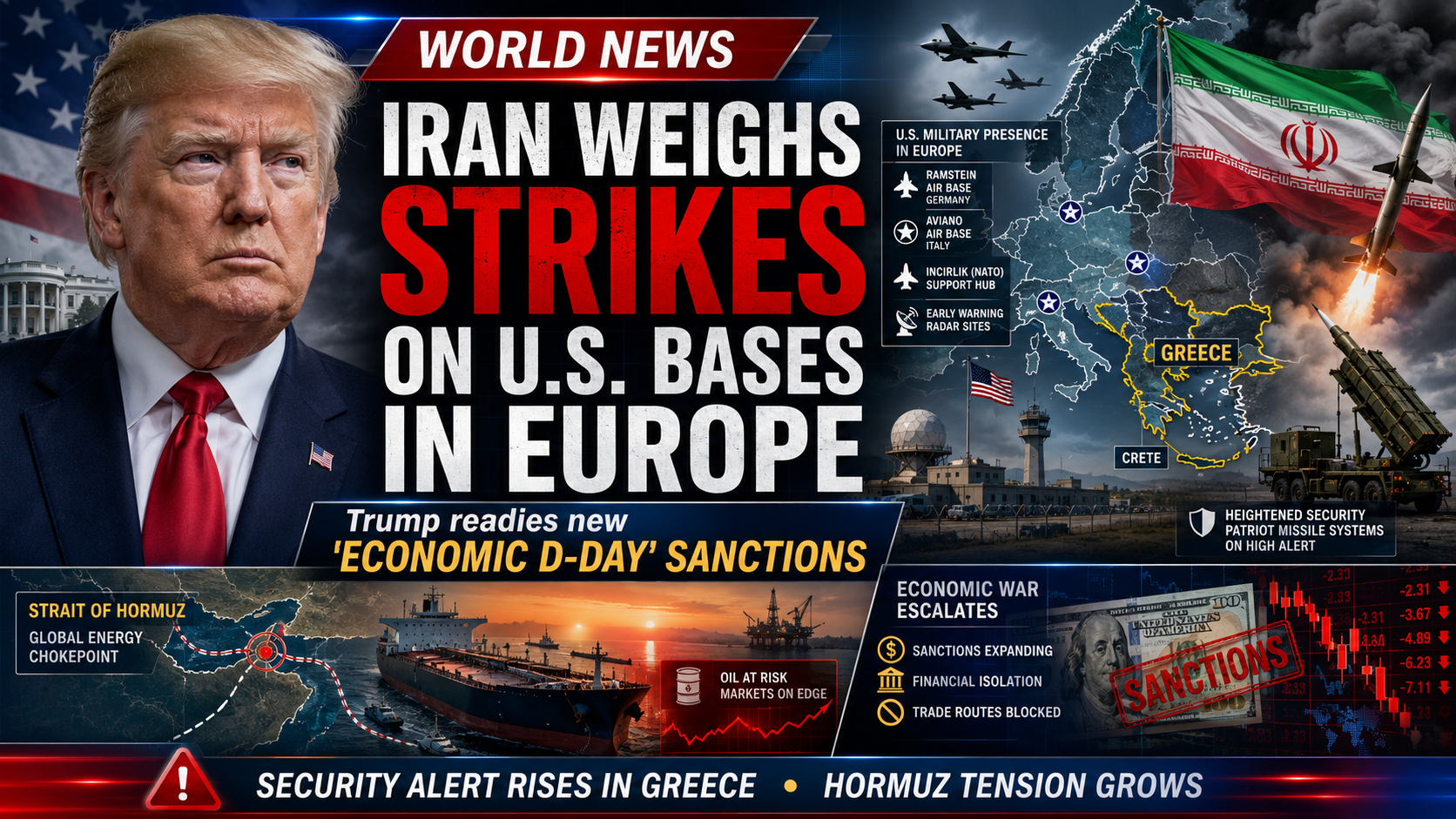
Tehran reportedly studies retaliation against U.S. assets in southeastern Europe; Greece shifts a Patriot air-defense system to Crete as Washington prepares broader secondary sanctions targeting Iran’s oil trade, banking links and global sanctions-evasion networks
WASHINGTON/TEHRAN — August 24, 2026
Iran has reportedly examined options for striking U.S. military assets in Europe if President Donald Trump significantly expands military operations against Tehran, raising fears that a conflict largely concentrated in the Middle East and Persian Gulf could spread directly into European security territory.
The Financial Times, citing people familiar with Iranian strategic thinking, reported that Iranian forces have assessed potential targets in southeastern Europe, including facilities connected to U.S. military operations. Bulgaria has drawn particular attention because its Bezmer Air Base has been used by U.S. aircraft, while Cyprus has also reportedly figured in Iranian contingency planning. Iran, however, has not publicly announced a decision to attack Europe, and the reported discussions are better understood as contingency planning for retaliation if Washington launches a renewed or substantially expanded offensive.
The distinction is important. Tehran has repeatedly warned countries that allowing their territory, airspace or military infrastructure to be used for attacks on Iran could expose those facilities to retaliation. The latest reports therefore suggest Iran is examining how far it could expand its response rather than demonstrating that an attack on Europe has already been authorized.
The possibility has nevertheless prompted heightened security concerns among NATO members. A NATO official said the alliance was prepared to address threats and would take necessary measures to defend its members. Bulgaria’s leadership has also discussed the reported Iranian threat with NATO officials.
Greece, meanwhile, has moved a Patriot missile-defense battery from the island of Karpathos to Crete, according to reports Monday. The deployment is intended to strengthen air defenses around strategically important naval and air facilities at Souda Bay, which support Greek, U.S. and NATO operations. The Greek Defense Ministry had not publicly commented on the reported transfer at the time of publication.
The European security concerns are emerging as the Trump administration shifts greater attention toward a potentially sweeping economic offensive designed to further isolate Iran without immediately returning to large-scale military strikes.
As of midday Monday, Treasury Secretary Scott Bessent was expected to outline the administration’s next phase of pressure at a 1 p.m. EDT news conference. Bessent and Trump have described the campaign as an “economic D-Day,” with the Treasury Department preparing to broaden the circumstances under which secondary sanctions can be imposed on foreign countries, companies, banks and other institutions that continue doing business with Iran.
Unlike sanctions aimed only at Iranian entities, secondary sanctions can punish non-U.S. companies and financial institutions for certain dealings with Iran, potentially forcing governments and businesses to choose between continued Iranian commerce and access to the U.S. dollar-based financial system.
Reuters reported that the Treasury Department is preparing to make additional Iranian sectors and transactions vulnerable to such sanctions. In some sectors, activity conducted even through a third country could become grounds for U.S. penalties. Officials also say Washington has mapped networks used by Iran to move oil, establish front companies, register vessels and circumvent existing restrictions.
The strategy could reach far beyond Tehran. Oil refiners, tanker operators, shipping intermediaries, financial institutions and companies facilitating Iran-related transactions may face increasing scrutiny. Bessent has warned that countries continuing to provide Iran with economic and financial channels risk deeper isolation from Western capital and the dollar-based financial system.
The administration argues that intensified financial warfare could reduce the need for renewed large-scale military operations. Bessent has described the coming measures as part of the toughest sanctions campaign yet imposed on Iran, while Trump has portrayed Tehran as increasingly vulnerable under combined military, maritime and economic pressure.
One of the biggest tests will be China, which has been Iran’s dominant oil customer in recent years.
Iranian crude shipments to China have already fallen sharply amid U.S. pressure and disruptions to maritime trade. Reuters reported that flows declined to roughly 534,000 barrels per day in August from about 823,000 barrels per day in July. Washington has previously sanctioned Chinese independent refiners and companies connected to Iranian oil purchases, but targeting major Chinese banks would represent a considerably more consequential step and could complicate broader U.S.-China economic relations.
Tehran, for its part, is signaling that it may view participation in Washington’s new campaign as more than a routine sanctions dispute.
Senior Iranian officials have warned that countries supporting what Tehran calls America’s “economic war” could be treated as participants in hostile action. Mohsen Rezaei, secretary of Iran’s Supreme National Security Council, warned that continued economic warfare could trigger disruption of oil exports through the Strait of Hormuz and elsewhere in the Gulf. Iranian officials have separately warned that the country’s response to renewed U.S. threats could be “devastating.”
That rhetoric has placed renewed attention on the Strait of Hormuz, one of the world’s most strategically important energy corridors.
Iran said Monday that it had blacklisted 45 tankers for allegedly violating its rules governing passage through the strait. Tehran warned that vessels on the list could face fines, detention or confiscation of cargo, while ships conducting transfers with blacklisted vessels could themselves face penalties.
Before the current conflict disrupted tanker traffic, the Gulf accounted for roughly 20 percent of the world’s daily crude-oil and liquefied-natural-gas supply. U.S.-coordinated efforts have helped restore part of that flow, with U.S. Energy Secretary Chris Wright saying the seven-day average of oil leaving the strait had risen above eight million barrels per day.
Any renewed military escalation or prolonged confrontation over shipping could therefore affect far more than Iran and the United States. Oil supplies, tanker insurance premiums, shipping costs, inflation and energy prices across Asia and Europe could all be exposed to another shock.
Financial markets were already showing caution Monday. Oil prices slipped by more than $1 a barrel after a recent rally as traders took profits and waited for details of Washington’s sanctions package. The decline did not necessarily signal easing geopolitical concerns; instead, markets remained focused on whether the new measures would significantly restrict Iranian exports and how Tehran might retaliate.
The emerging confrontation now has two interconnected fronts.
On one side, Washington is attempting to squeeze Iran’s remaining access to oil revenue, international finance, shipping networks and foreign commercial partners while presenting economic pressure as an alternative to another major round of military strikes.
On the other, Tehran is signaling that severe economic coercion may be treated as an extension of the military conflict and is reportedly studying retaliatory options that could reach beyond the Persian Gulf and Middle East.
For Europe, the most consequential question is whether those contingency plans remain deterrent threats or evolve into operational decisions.
There is currently no evidence that Iran has made a final decision to attack U.S. or NATO-linked facilities in Europe. The available reporting indicates that possible targets and retaliatory scenarios have been studied in the event of a renewed American offensive. That distinction remains critical.
But if Iran were ultimately to strike U.S. or allied military infrastructure on European territory, the consequences would be profound. A conflict centered for months on Iran, the Gulf and surrounding Middle Eastern states could become directly entangled with European security and potentially NATO’s collective-defense calculations.
For now, the immediate focus is Washington’s “economic D-Day” and whether the administration is prepared to extend secondary sanctions deeply enough to confront major foreign banks, energy companies and trading partners.
What happens after that announcement — particularly Tehran’s response in the Strait of Hormuz and its calculations regarding U.S. military assets abroad — could determine whether the confrontation moves toward renewed negotiations or into a substantially more dangerous phase.