Fed Raises Interest Rates for First Time Since 2023, Signals More Hikes as Inflation Pressures Intensify

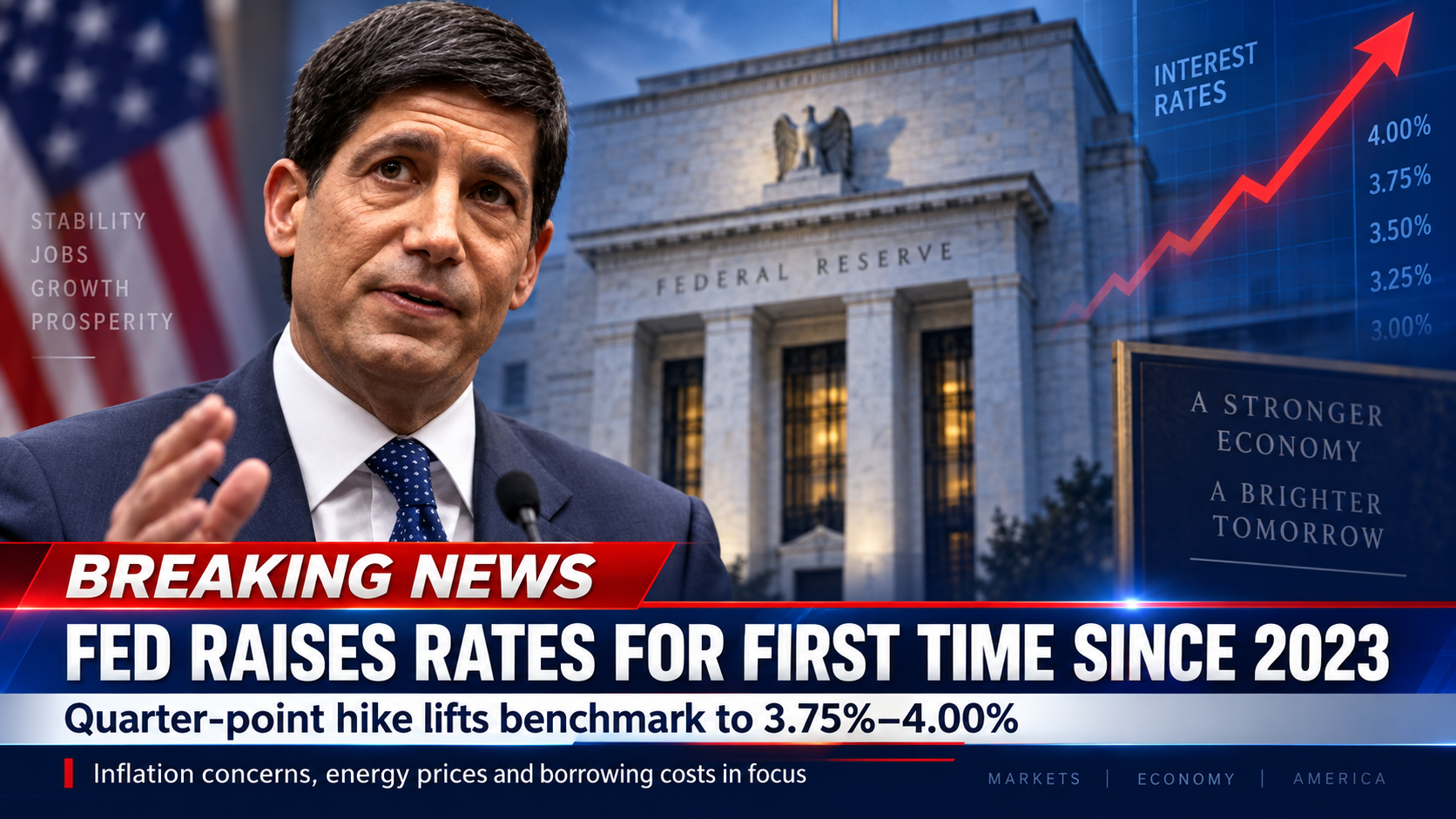
WASHINGTON, Sept. 16, 2026 — The Federal Reserve raised U.S. interest rates Wednesday for the first time in more than three years, reversing course as policymakers confront renewed inflation pressures fueled by higher energy costs, resilient consumer spending and broader price increases across the American economy.
The Federal Open Market Committee unanimously voted 12–0 to increase its benchmark federal funds rate by 0.25 percentage point, lifting the target range to 3.75%–4.00%. The move marked the Fed’s first rate increase since July 2023.
The original report noted that the decision represents a sharp shift in monetary policy and could raise borrowing costs at a time when many Americans are already struggling with housing, automobile and other major expenses.
The Fed said the U.S. economy continues to expand at a “solid pace,” with resilient domestic spending, strong productivity and robust capital investment. Employment growth has broadly kept pace with labor-force expansion, while unemployment has changed little.
But policymakers emphasized that inflation remains elevated, saying the rate increase was intended to accelerate progress toward the central bank’s long-standing 2% inflation target.
The latest economic projections suggest Wednesday’s increase may not be the last.
Fed officials now project a median federal funds rate of 4.1% at the end of 2026, implying at least one additional quarter-point increase if the economy develops broadly as expected. Of the 18 policymakers submitting projections, 16 indicated rates should be higher by year-end than they are following Wednesday’s decision.
The Fed also raised its inflation forecast. Policymakers now expect PCE inflation to reach 3.7% in 2026, compared with their 3.6% projection in June, while core PCE inflation is projected at 3.4%. Inflation is not expected to return to approximately 2% until later in the forecast period.
Energy shock complicates Fed’s inflation battle
The decision comes amid renewed pressure on energy markets linked to conflict in the Middle East. Higher oil, gasoline and transportation costs have begun feeding into prices across other parts of the economy.
Federal Reserve Chairman Kevin Warsh acknowledged after the meeting that monetary policy cannot directly control individual commodity prices such as oil or food. Instead, the Fed is trying to prevent an initial energy shock from spreading into a broader and more persistent inflation cycle.
Recent inflation data have reinforced those concerns. U.S. consumer prices rose 3.4% from a year earlier in August, while gasoline prices jumped sharply amid disruptions to global energy supplies. Core inflation, which strips out food and energy, also remained well above the Fed’s target.
At the same time, the economy continues to show considerable strength. U.S. retail sales jumped 1.2% in August, suggesting consumers remain willing to spend despite higher prices and borrowing costs.
That combination — persistent inflation alongside continued economic growth — gives the Fed more room to tighten policy but also raises the risk that higher rates could eventually weaken employment, housing and business investment.
Warsh faces political pressure over rates
Wednesday’s move is also politically significant.
President Donald Trump, who appointed Warsh to succeed Jerome Powell earlier this year, has repeatedly advocated lower interest rates and cheaper borrowing costs. During Warsh’s confirmation process, however, the new Fed chairman said he had made no promise to lower rates and would operate independently as head of the central bank.
The unanimous decision therefore highlights the Fed’s determination to prioritize inflation control even as the White House has publicly pushed for easier monetary policy.
Warsh’s first major interest-rate move as chairman is effectively the opposite direction from the lower-rate environment Trump has publicly sought.
What it means for American consumers
Higher Fed rates do not automatically translate into identical increases for every consumer loan, but they generally place upward pressure on short-term borrowing costs.
Consumers could see:
- Higher credit-card interest rates
- More expensive auto and personal loans
- Continued pressure on mortgage affordability, although mortgage rates are influenced heavily by longer-term Treasury yields rather than the Fed rate alone
- Higher financing expenses for businesses
- Potentially better returns on savings accounts, money-market funds and certificates of deposit
The greatest challenge for the Fed is that raising rates can reduce demand, but it cannot directly increase oil supplies or eliminate geopolitical disruptions. That creates the possibility that monetary tightening could slow economic growth without immediately removing the main source of some inflation pressures.
Wall Street takes the hike largely in stride
Financial markets reacted relatively calmly because investors had widely expected Wednesday’s quarter-point increase.
Shortly after the announcement, the S&P 500 was modestly higher, the technology-heavy Nasdaq was also up, and Treasury yields changed relatively little. Reuters reported the 10-year Treasury yield at around 4.95%, while the dollar strengthened modestly.
The muted reaction suggests investors were focused less on Wednesday’s widely anticipated increase and more on what comes next.
The Fed’s updated projections now indicate policymakers expect tighter monetary conditions to continue into 2027. The median projected federal funds rate remains 4.1% for 2027, before gradually declining to 3.9% in 2028 and 3.6% in 2029.
A difficult balancing act ahead
The Fed now faces one of its most difficult policy environments in years: inflation remains above target, energy prices are vulnerable to geopolitical shocks, government and consumer borrowing costs are already elevated, and economic growth remains surprisingly resilient.
The central bank currently projects 2.3% U.S. economic growth in 2026, slightly stronger than its June forecast, while unemployment is expected to average around 4.1% in the fourth quarter.
Those figures suggest policymakers do not currently anticipate a recession. But further rate increases could eventually slow housing, business investment and consumer demand.
For now, the message from the Federal Reserve is clear: bringing inflation under control has again become the central bank’s immediate priority — even if doing so means Americans face higher borrowing costs and Washington faces a new debate over the direction of U.S. monetary policy.