RSP chair says party leaders must act with discipline and accountability

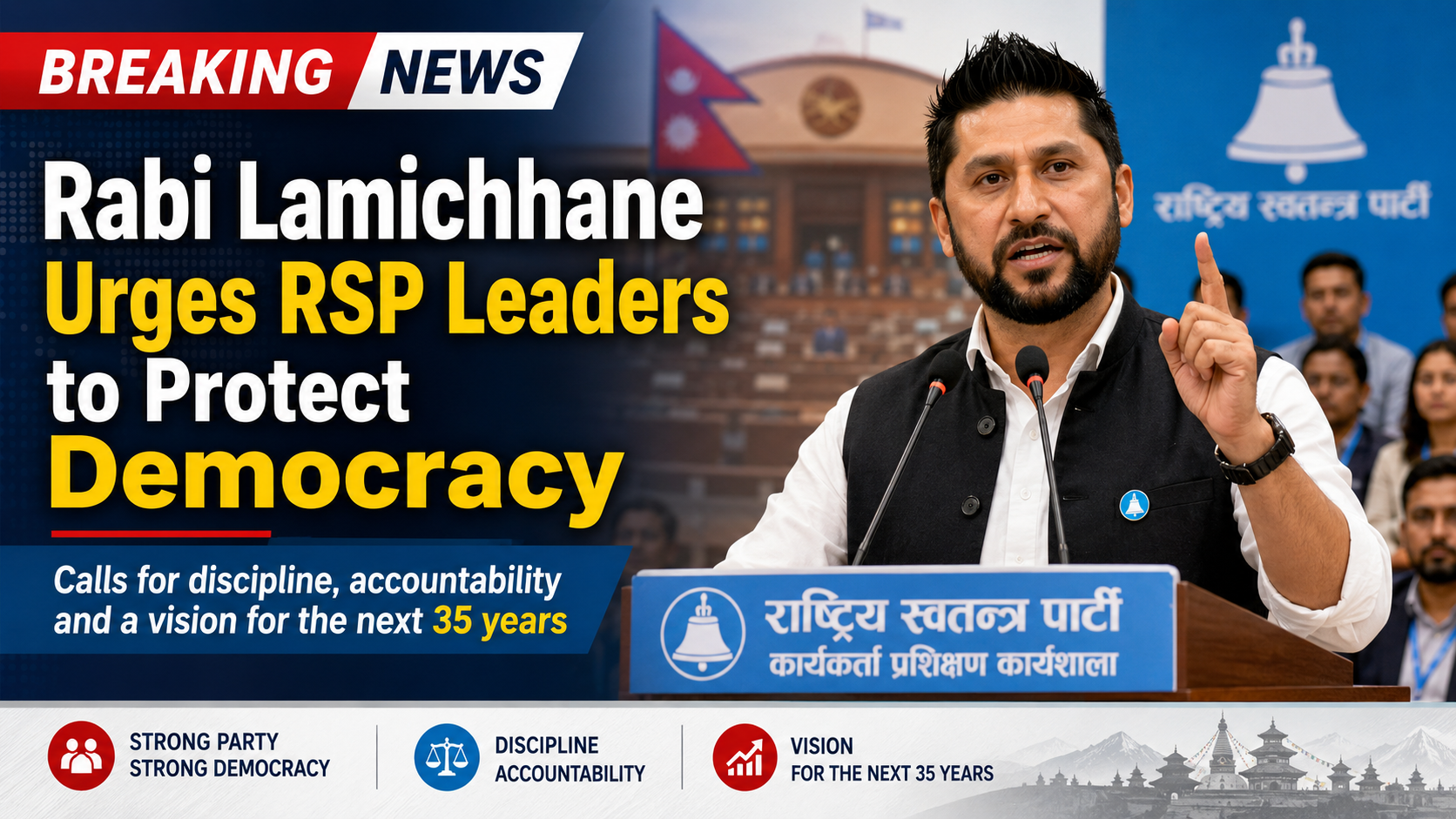
RSP chair says party leaders must act with discipline and accountability, claims he once turned down an offer to become prime minister, and calls for stronger grassroots organization ahead of local elections
Kathmandu, August 23, 2026
Rastriya Swatantra Party (RSP) Chair Rabi Lamichhane has instructed party leaders, lawmakers and activists to ensure that none of their actions weakens democratic institutions, damages the party’s credibility or undermines the public trust placed in the country’s emerging political leadership.
Addressing the party’s policy, organization and leadership workshop on Sunday, Lamichhane said the RSP had reached a stage where it could no longer rely on its image as a new political force to excuse mistakes or shortcomings. He said the party must now answer public questions through its conduct, performance and political maturity.
Lamichhane acknowledged that the RSP is being watched closely by both supporters and critics because people from diverse professional, social and political backgrounds have entered politics through the party. With greater public attention, he said, comes a greater responsibility to demonstrate integrity and discipline.
He told party members that he would not knowingly do anything that would force them to lower their heads in embarrassment and urged others to make the same commitment.
“If I make a mistake unknowingly, I will correct it. Every one of you should also be able to say that the party will never have to bow its head because of your actions,” Lamichhane told participants.
The RSP chair placed particular emphasis on protecting democratic institutions. He warned that democracy cannot remain strong if institutions are continuously weakened, discredited or treated merely as instruments of political power.
Lamichhane said political parties must understand that democracy extends beyond elections and government formation. Parliament, constitutional bodies, the judiciary, public institutions and systems of accountability all need to retain public confidence for democracy to function effectively.
“Our activities must never create a situation in which democracy itself becomes weaker,” he said, cautioning leaders against actions that could fuel the perception that democratic power becomes unsafe when concentrated in the hands of one political force.
A major part of Lamichhane’s address focused on moving beyond constant criticism of Nepal’s political past. He urged party leaders to stop building their politics around complaints about what previous governments and parties had or had not done over the last 35 years.
Instead, he asked them to prepare a vision for the next 35 years.
“We are no longer in a position to keep complaining about the past 35 years. Whatever others could do, they did. Thank them and move forward. Now bring a plan for the next 35 years,” he said.
Lamichhane’s message reflected a broader shift he wants within the RSP—from opposition-style criticism toward long-term governance, policy planning and institutional responsibility.
He said the party must be able to explain how Nepal should develop in the coming decades, including in areas such as economic growth, employment, education, healthcare, public service delivery, good governance and democratic reform.
Lamichhane also used his own political experience to argue that leadership sometimes requires giving up opportunities for power.
He claimed that when he was leading a 21-seat party, he had once received a proposal to become prime minister, with only his signature remaining for the arrangement to move forward. According to Lamichhane, he chose not to pursue the opportunity because he believed accepting a short-term premiership could undermine a broader political movement and the expectations placed on a new generation of leaders.
“I can say with pride that I respectfully declined a prime minister’s position that had been offered to me on a platter,” Lamichhane said.
He added that becoming prime minister for only a few months and having his photograph displayed at Singha Durbar would have meant little if it came at the cost of a larger political purpose.
Lamichhane presented the episode as an example of the kind of sacrifice he expects from party leaders, arguing that public office should never become more important than political values, public trust or long-term national interest. His description of the prime ministerial offer remains his own political account of those events.
The RSP chair also stressed that the party now carries far greater responsibilities than it did during its early years.
He said the party has talented leaders and that he is proud of the people working within it, but added that managing a large political organization naturally creates additional concern because even relatively small mistakes can have national consequences.
Lamichhane also urged RSP lawmakers and political leaders to maintain parliamentary discipline and avoid unnecessary confrontation. He said political disagreements should be answered through facts, policy and performance rather than personal attacks or constant political argument.
He described the opposition as politically strong and warned party leaders against assuming that numerical strength in government alone guarantees political success.
“The government may be strong, but the opposition is even stronger in its own role,” he said. “If we fail to respond politically and responsibly to a strong opposition, it can take us in a very different direction.”
Lamichhane said the RSP must also remain consistent on its core agenda of good governance and accountability.
The party built much of its political identity by questioning corruption, irregularities and poor governance, but Lamichhane said governing parties must also be prepared to answer difficult questions about their own decisions.
“When the public asks questions about the government’s work, we must have answers,” he said.
He indicated that ministers, lawmakers and party officials should be able to explain government decisions, respond to criticism and remain accountable for both achievements and failures.
Lamichhane also made grassroots expansion a major priority of his speech.
With future local elections in mind, he instructed party leaders to move beyond Kathmandu and central-level politics and establish a stronger presence in villages, wards, municipalities and communities across the country.
He warned that a party unable to build credibility and organization at the local level would struggle to meet the daily expectations of citizens, regardless of its strength in national politics.
“If we cannot establish a strong presence in local government, we will fall behind in many areas,” he said.
Lamichhane said central committee members would be given responsibilities and sent to different parts of the country to expand organization, engage directly with citizens and explain the party’s policies and the government’s performance.
He also said he himself would travel to the Madhesh region as part of the effort.
The RSP has increasingly emphasized grassroots organization as it prepares for future local-level contests. The party has been working to identify potential candidates, strengthen local structures and connect national policy positions with issues that directly affect communities.
Lamichhane said the current period should be treated as a foundation-building phase for the party rather than simply a moment to enjoy electoral success or political power.
He urged party members from different professional and ideological backgrounds to unite around a common political purpose and move forward in a disciplined, democratic and accountable manner.
His broader message was that the RSP can no longer define itself primarily by what it opposes. As a major national political force, it must increasingly be judged by what it builds, how responsibly it governs and whether it can protect democratic institutions while delivering tangible results.
Lamichhane’s message to party leaders was therefore straightforward: stop relying on the failures of the past as a political shield, prepare for the future, strengthen democracy, remain accountable to the public, expand the party to the grassroots and be ready to sacrifice personal ambition when the larger political mission demands it.