
Nepal Flood Catastrophe Deepens: 1,204 Bodies and Human Remains Recovered, 4,216 Still Missing

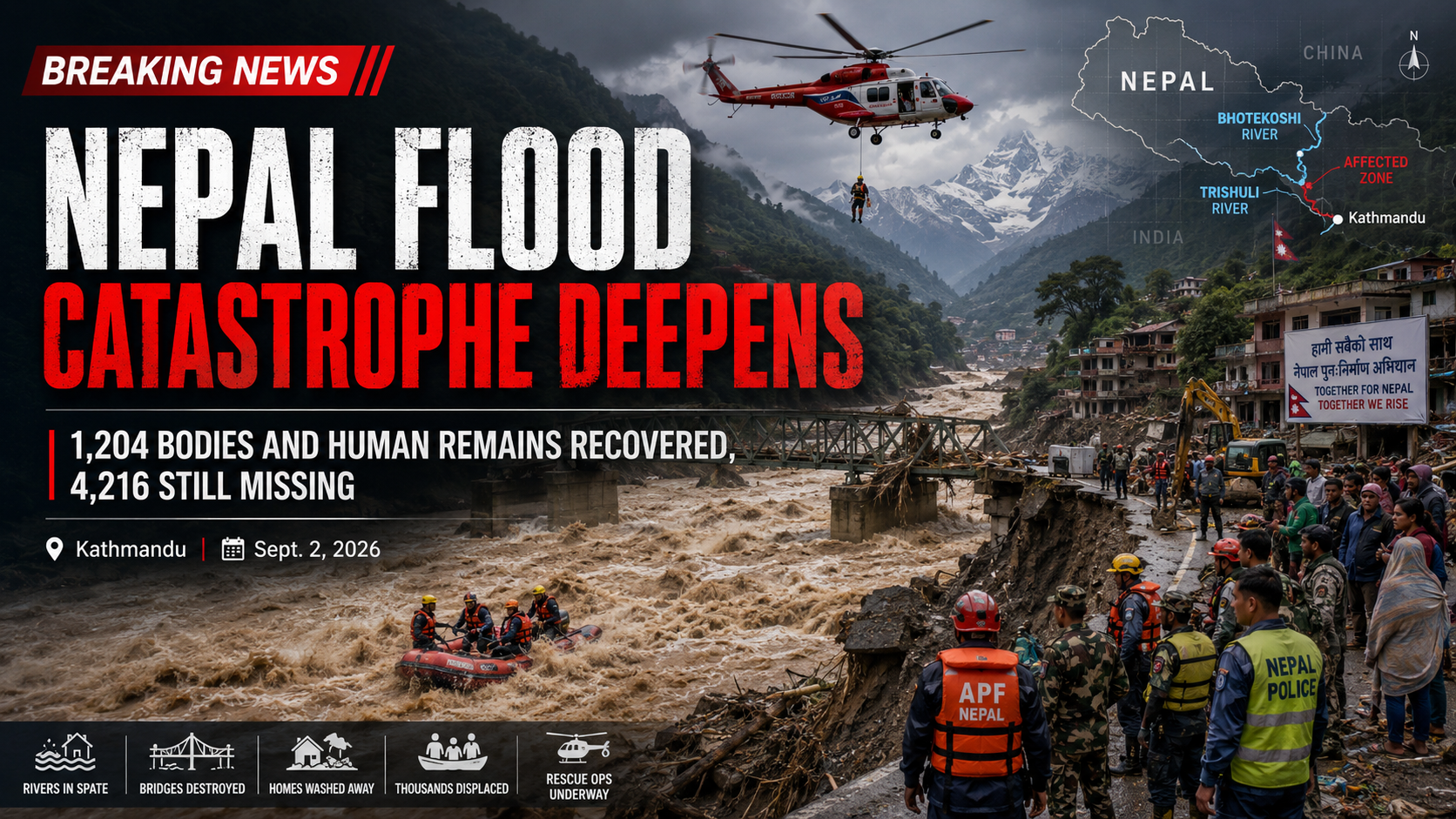
KATHMANDU, September 2, 2026 – The scale of Nepal’s catastrophic Bhotekoshi–Trishuli flood disaster continues to grow, with authorities reporting that 1,204 bodies and sets of human remains have now been recovered while 4,216 people remain unaccounted for, more than a week after a massive rock-and-ice collapse in the Himalayas unleashed a devastating torrent through central Nepal.
According to the latest update from Nepal’s National Disaster Risk Reduction and Management Authority (NDRRMA), issued at 6 p.m. Wednesday, recovery teams have collected bodies and human remains from eight districts stretching from the disaster zone in Rasuwa to the lower Narayani river basin.
The highest number has been recovered in Chitwan, where 348 bodies or remains have been found. Authorities have reported another 217 in Nawalparasi East, 202 in Nawalparasi West, 155 in Nuwakot, 115 in Rasuwa, 69 in Gorkha, 60 in Dhading and 38 in Tanahun, bringing the total to 1,204.
The latest figures represent a significant increase from statistics released earlier Wednesday. A morning NDRRMA bulletin had listed 1,114 recovered bodies and 3,916 people missing. Continued searches in Rasuwa and downstream districts, together with revised lists from hydropower projects and local authorities, pushed both figures higher by the evening.
Officials have cautioned that the numbers remain provisional and could continue to change significantly as missing-person lists are verified, duplicate names are removed and additional remains are recovered.
Only 95 of the recovered victims have so far been formally identified and returned to their families, illustrating the enormous forensic challenge facing Nepal.
Authorities are preserving photographs, DNA samples, forensic records and other identifying information from unidentified victims. Bodies that cannot immediately be identified are being temporarily managed or buried according to legal and forensic procedures so that they may potentially be identified later.
The situation has placed extraordinary pressure on hospitals, morgues, police forensic units and local governments. Earlier official reports showed that hundreds of unidentified bodies had already required temporary burial because existing mortuary facilities could not accommodate the unprecedented number of victims.
The greatest uncertainty, however, surrounds the 4,216 people still officially listed as out of contact.
The updated missing-person list includes approximately 900 people connected with hydropower project sites, 583 foreign nationals and 164 Nepali guides, trekking workers and others travelling with foreign visitors. Also missing are dozens of soldiers, police officers, Armed Police Force personnel, government employees and local officials.
Authorities stress that being listed as “out of contact” does not necessarily mean a person has died. Communications were destroyed across parts of the disaster zone, residents were displaced to different locations, and some people initially listed as missing have subsequently re-established contact.
One of the most urgent rescue operations is now focused on hydropower tunnels and underground facilities along the Bhotekoshi–Trishuli corridor.
Reuters reported Wednesday that rescuers were racing to reach workers who may have survived inside underground chambers after floodwater, mud and enormous quantities of debris engulfed several power projects. At the 111-megawatt Rasuwagadhi project, officials have expressed hope that dozens of workers could still be alive in protected sections with access to food, water or air. Rescue teams have also been attempting to reach underground areas at other damaged power stations.
Heavy mud, unstable slopes, damaged access roads and the risk of additional landslides have made those operations exceptionally difficult.
The disaster has injured at least 301 people, according to the latest official figures, while 11,993 people have been rescued from affected areas.
Nepal has mobilized 21,314 security personnel for search-and-rescue operations, relief distribution, evacuation and body recovery. The deployment includes approximately 9,199 Nepal Army personnel, 7,912 Nepal Police personnel and 4,203 members of the Armed Police Force.
Thousands of people who lost their homes or cannot safely return to flood-stricken communities have been moved to temporary shelters and holding centers.
NDRRMA data show that 3,453 people were staying in holding centers in Nuwakot, Rasuwa, Dhading and Kathmandu, including 2,466 in Nuwakot, 398 in Rasuwa, 329 in Kathmandu and 260 in Dhading. That figure is also expected to fluctuate as displaced residents move, reunite with relatives or return to communities declared safe.
The government has been sending food, medicine and essential supplies by both road and air. Official figures released Wednesday said emergency food and supplies had been dispatched using 37 trucks and 37 smaller vehicles, while helicopters continued delivering relief to areas inaccessible by road.
The government has also released Rs 67.5 million to 15 flood-affected local governments to support immediate emergency operations.
The physical destruction extends far beyond the extraordinary loss of life.
Government assessments indicate that approximately 40 kilometers of road in Rasuwa were completely destroyed, including important sections connecting Betrawati, Mailung, Syafrubesi and Rasuwagadhi. Around 10 kilometers of the Galchhi–Trishuli road were closed, while sections of the Prithvi Highway were buried beneath mud and debris.
At least 41 bridges were completely destroyed, severely disrupting transportation and complicating rescue and reconstruction efforts. Nepal has begun planning temporary Bailey bridges, with India and China among the countries offering additional bridge equipment and emergency assistance.
Schools, health posts, drinking-water systems, telecommunications networks and electricity infrastructure have also suffered extensive damage.
The flood has delivered a particularly severe blow to Nepal’s rapidly expanding hydropower industry.
Prime Minister Balendra Shah, briefing the House of Representatives on Wednesday, said eight operating hydropower projects representing about 281 megawatts of capacity and four projects under construction representing roughly 388 megawatts had sustained damage along the Bhotekoshi–Trishuli corridor.
Separate assessments cited by Reuters indicate that approximately 431 megawatts of Nepal’s existing power-generation capacity — around 10 percent of the national total — has been affected, forcing the country to reconsider electricity exports and exposing the vulnerability of major energy infrastructure constructed in fragile Himalayan river valleys.
Prime Minister Shah told Parliament that restoring electricity, roads, communications and other essential services remained among the government’s highest priorities.
The catastrophe began on the morning of August 26, 2026, when an enormous mass of rock, glacier ice and debris collapsed in the high Himalayan region near Langtang Lirung and the Nepal–Tibet border.
Satellite imagery examined by scientists indicates that part of a glacier and underlying bedrock suddenly detached and plunged hundreds of meters into the valley.
The collapse generated an immense avalanche of rock, ice and debris. Scientific assessments suggest that material from the avalanche temporarily obstructed the Lhende/Bhotekoshi river system, creating a short-lived natural dam or debris lake. When the blockage failed, an enormous volume of water, sediment, rock and ice surged downstream.
Seismic instruments also detected an unusually large signal associated with the collapse. Scientific reconstructions have described the event as producing a seismic signature comparable to a magnitude-5.2 event, although the signal is understood to have been generated by the enormous landslide rather than a conventional tectonic earthquake.
The torrent raced through the steep Himalayan valleys into the Bhotekoshi and then the Trishuli river system, devastating Timure, Syafrubesi and Betrawati, before sweeping through communities around Trishuli Bazaar and Devighat and continuing downstream through Dhading, Gorkha, Chitwan, Tanahun and the Nawalparasi districts.
The recovery of hundreds of bodies far downstream demonstrates the extraordinary force and distance of the flood.
Scientific investigation into exactly why the mountain mass failed is continuing.
Satellite analysis reported by Nature indicates that the glacier-rock mass may have been showing signs of accelerated movement in the days and weeks before the collapse, potentially providing important lessons for future satellite-based monitoring and early-warning systems.
Scientists are also examining the role of rapidly changing Himalayan temperatures.
Higher temperatures can accelerate glacier melting, weaken ice structures, thaw mountain permafrost and destabilize rock faces that were previously held together by frozen material. The Hindu Kush Himalaya is already considered one of the regions most vulnerable to a warming climate.
However, scientists caution against attributing a single collapse entirely to climate change before detailed attribution studies are completed. Climate warming can increase the background conditions that make rockfalls, ice avalanches and glacial floods more likely, but the precise combination of geological, hydrological and climatic factors behind the August 26 disaster remains under investigation.
The disaster has also exposed serious weaknesses in cross-border and high-altitude early-warning systems.
Nepal is now considering rebuilding and expanding monitoring infrastructure near its northern border, including seismic sensors, cameras and satellite-based communication systems designed to continue operating when conventional mobile networks fail. Authorities are also seeking stronger real-time sharing of glacier, river and satellite information with China.
Prime Minister Shah has increasingly framed the catastrophe as not only a national disaster but also a warning to the international community about the vulnerability of Himalayan nations to a rapidly changing climate.
Addressing Parliament Wednesday, he called for stronger international recognition of the growing climate risks confronting Nepal and other mountain countries.
The House of Representatives unanimously approved a special motion on Wednesday concerning the Bhotekoshi–Trishuli disaster.
The resolution paid tribute to Nepali citizens and foreign nationals who lost their lives and urged the government to accelerate search and rescue operations, ensure treatment for the injured, provide safe shelter to displaced families and guarantee special protection and access to essential services for women and children.
Parliament also emphasized psychological support, rehabilitation and longer-term reconstruction for communities devastated by the flood.
Eight days after the disaster, Nepal remains in an emergency phase.
Search teams are continuing to examine riverbanks, collapsed settlements, tunnels, hydropower facilities, debris fields and downstream areas for survivors and victims. With more than 4,200 people still officially unaccounted for, the final human cost of the disaster remains unknown.
For Nepal, the immediate priorities are finding the missing, identifying the dead, protecting survivors and restoring essential infrastructure.
The longer-term challenge will be even greater: rebuilding destroyed communities and transportation networks, reassessing the safety of Himalayan hydropower and other infrastructure, strengthening cross-border early-warning systems and preparing for a future in which extreme mountain hazards could become increasingly difficult to predict and contain.
The August 26 Bhotekoshi–Trishuli catastrophe has therefore become more than one of Nepal’s worst natural disasters. It is also a stark warning about the growing vulnerability of the Himalayas — and about the potentially devastating consequences when unstable mountains, retreating glaciers, major river systems and densely populated downstream communities collide.
*******************************************


AN URGENT HUMANITARIAN APPEAL TO PRESIDENT DONALD J. TRUMP AND THE UNITED STATES OF AMERICA
Washington, D.C.
September 1, 2026
The Honorable Donald J. Trump
President of the United States of America
The White House
1600 Pennsylvania Avenue NW
Washington, D.C. 20500
Subject: Respectful Appeal for Expanded U.S. Humanitarian Assistance to Nepal Following the Catastrophic Flood Disaster
Dear Mr. President:
With profound respect, I write to you at an exceptionally difficult moment for Nepal and the Nepali people from Federation of International Journalist, America – FIJA Family.
Nepal deeply appreciates the humanitarian assistance, friendship, and support already extended by the Government and people of the United States following the catastrophic floods and natural disaster that have devastated large areas of the country.
Thank you, Mr. President. Thank you, America.
The magnitude of this tragedy, however, has created an extraordinary humanitarian emergency requiring greater international assistance.
More than a thousand people have reportedly lost their lives, thousands remain missing, and countless families continue desperately searching for their loved ones. Foreign nationals, including Americans and citizens of other countries, Journalists, Mideas have also been affected by this devastating disaster.
Entire communities have been destroyed or severely damaged. Thousands of survivors have lost their homes, livelihoods, property, and access to essential services. Roads, bridges, communications systems, and other critical infrastructure have been swept away or seriously damaged. Search, rescue, relief, medical, and recovery operations continue under extremely challenging geographic and weather conditions.
At this critical hour, Nepal urgently needs stronger international humanitarian assistance, and continued American leadership can make an immediate and life-saving difference.
Mr. President, I respectfully appeal to you and your Administration to consider expanding United States humanitarian assistance to Nepal, particularly in the areas of:
- Search-and-rescue operations and specialized rescue equipment;
- Emergency medical personnel, medicines, and field medical support;
- Food, safe drinking water, sanitation, and emergency supplies;
- Temporary shelters and assistance for displaced families;
- Helicopters, transportation, and logistical support for inaccessible areas;
- Emergency communications and disaster-response equipment;
- Technical expertise in disaster management and recovery;
- Identification and support for victims and missing persons;
- Rehabilitation of damaged communities and essential infrastructure; and
- Long-term reconstruction and disaster-resilience assistance.
I also respectfully appeal to the United States Congress—including the Speaker and Members of the House of Representatives, the leadership and Members of the United States Senate, and the leadership of both the Republican and Democratic parties—to give this humanitarian emergency urgent consideration and support additional assistance for Nepal.
Nepal and the United States share a longstanding friendship built over decades of diplomatic relations, development cooperation, democratic values, mutual respect, and strong people-to-people ties. Generations of Nepalis have regarded the United States as an important friend and partner.
This appeal transcends politics, parties, governments, and national boundaries.
This is about saving human lives.
It is about parents searching for missing children, children waiting for missing parents, and families desperately hoping to find brothers, sisters, relatives, and friends.
It is about survivors who saw their homes and livelihoods disappear within moments.
It is about providing hope to people who have lost almost everything.
And it is about helping a friendly nation recover from one of the most painful humanitarian tragedies in its recent history.
I therefore also respectfully appeal to the American people, humanitarian organizations, charitable foundations, faith-based organizations, businesses, medical institutions, Nepali-American communities, and all friends of Nepal throughout the United States: Please stand with Nepal during this hour of extraordinary need.
The United States has a long and distinguished tradition of humanitarian leadership and of standing beside people facing disasters and tragedies around the world. The people of Nepal will always remember those who stood with them during this darkest and most difficult period.
Mr. President, Nepal needs America’s continued friendship, compassion, leadership, and greater humanitarian support now.
On behalf of the victims, survivors, grieving families, displaced communities, and all those who continue searching for their loved ones, I respectfully make this humanitarian appeal:
PLEASE STAND WITH NEPAL.
PLEASE HELP SAVE LIVES.
PLEASE HELP FIND THE MISSING.
PLEASE HELP THE SURVIVORS.
PLEASE HELP NEPAL RECOVER AND REBUILD.
With profound respect, appreciation, and gratitude,
Ram Prasad Khanal
President
Federation of International Journalist, America (FIJA)
Washington, D.C.
United States of America
CC:
The Speaker of the United States House of Representatives
Members of the United States House of Representatives
The Majority and Minority Leadership of the United States Senate
Members of the United States Senate
Republican Leadership of the United States Congress
Democratic Leadership of the United States Congress
The United States Department of State
The United States Agency for International Development and relevant U.S. humanitarian and disaster-response agencies
The Embassy of the United States of America in Nepal
American Humanitarian and Charitable Organizations
Nepali-American Community Organizations Across the United States
The American People
Members of the Media