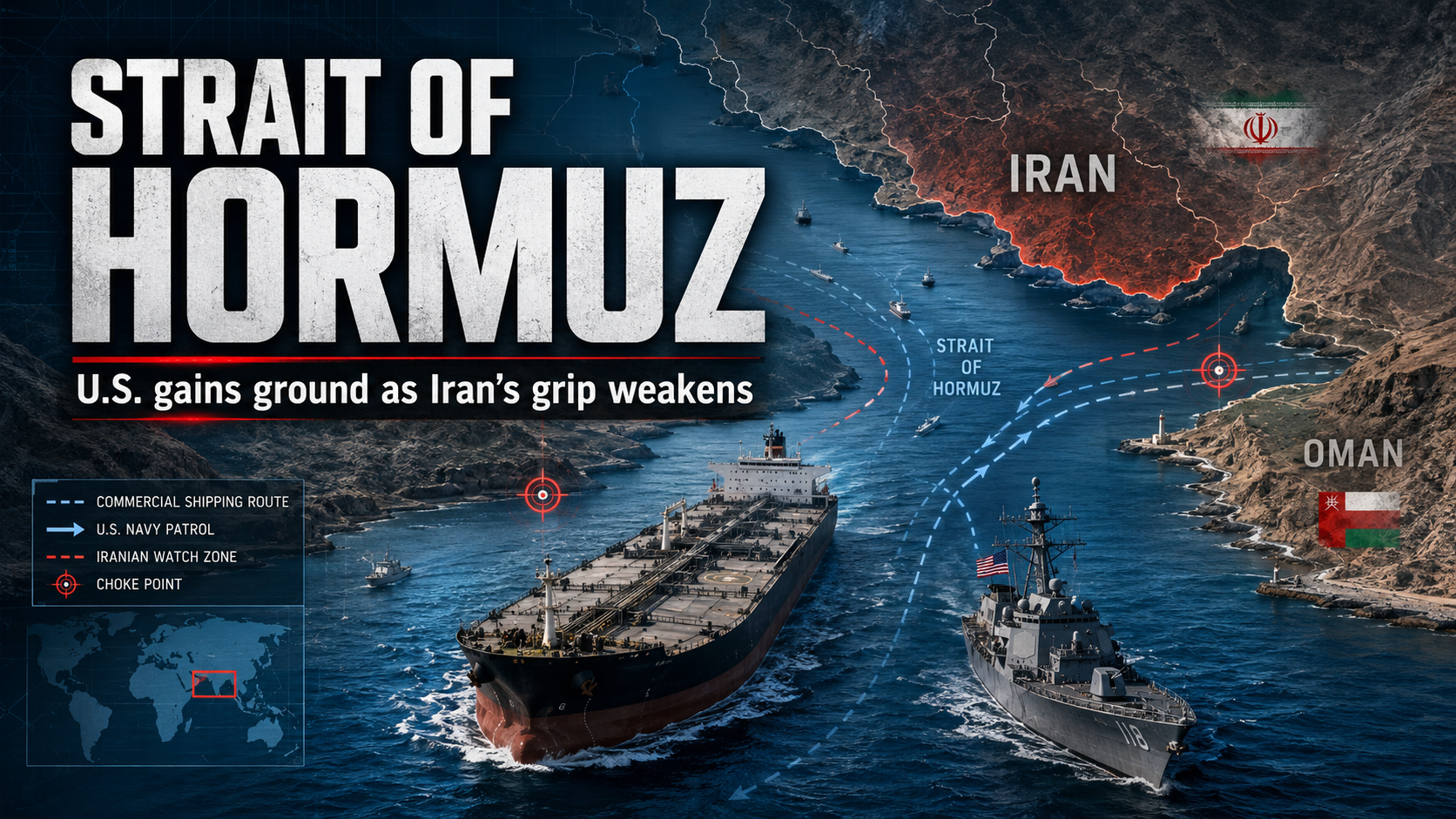
U.S. Gains Ground in Strait of Hormuz as Iran’s Grip Weakens, but Control Remains Contested

WASHINGTON/MUSCAT, Aug. 18, 2026 / The struggle over the Strait of Hormuz has emerged as one of the most consequential fronts of the U.S.-Iran war, with Washington and Tehran making competing claims of control over the narrow waterway that serves as a crucial artery for global energy trade.
Recent shipping patterns suggest that Iran’s ability to dictate how vessels move through the strait has weakened. But the evidence also falls well short of supporting claims that the United States has established complete control.
Ship-tracking data cited by industry analysts indicates that a growing share of vessels willing to risk the crossing have shifted toward routes closer to Oman rather than following channels preferred by Tehran. Kpler data cited in recent reporting showed more than 80% of tracked transits during a two-week period using the Omani side of the strait — a dramatic reversal from roughly a month earlier, when little traffic was recorded there.
The shift is significant because Iran has sought to use control over navigation as economic and strategic leverage. Tehran has threatened or attacked ships operating outside routes it considers acceptable, while Washington has used naval forces, its blockade of Iranian ports and coordination with Gulf allies to challenge Iran’s ability to dominate the waterway. The U.S. Maritime Administration continues to list an active advisory covering Iranian attacks on commercial vessels in the Persian Gulf, Strait of Hormuz and Gulf of Oman.
Iran’s influence appears weaker — but shipping remains severely disrupted
The percentage of vessels using the Omani side can create the impression that commercial shipping has largely returned. The actual numbers tell a more complicated story.
Kpler recorded only five commodity-vessel transits on Saturday, August 15, and none on Sunday, compared with 31 during the previous weekend. Before the war, more than 130 ships a day crossed the strait, according to Reuters. Some vessels operating with their Automatic Identification System, or AIS, switched off may not appear in conventional tracking data, but overall traffic remains far below normal.
That distinction is critical: Iran may be losing some of its ability to determine which route commercial ships use without the United States having restored normal freedom of navigation.
The International Maritime Organization says the Strait of Hormuz’s established Traffic Separation Scheme was originally proposed by Iran and Oman and adopted by the IMO in 1968. The organization has also warned that the traditional scheme should not currently be treated as automatically safe because of reported mines, with navigation instead requiring specially coordinated corridors and routing instructions.
The growing willingness of some operators to use routes closer to Oman therefore represents a challenge to Iran’s deterrence strategy, but not a return to pre-war conditions.
Tankers go “dark” as Gulf exporters find workarounds
Determining precisely how much oil is moving through Hormuz has become increasingly difficult because some tankers disable their AIS transponders while crossing high-risk waters.
Saudi Arabia, the United Arab Emirates and other Gulf producers have increasingly relied on very large crude carriers and ship-to-ship transfers outside the Persian Gulf to reduce exposure to attacks.
The strategy has become particularly visible near Fujairah in the UAE and waters off Oman. Reuters reported Tuesday that ship-to-ship transfers involving Chinese- and Hong Kong-owned vessels in the Gulf of Oman exceeded 600,000 barrels per day in June and July, according to Kpler. Two major Chinese state-controlled shipping companies have meanwhile kept their tankers out of both Hormuz and Bab el-Mandeb since late July, instead collecting cargoes outside the Gulf.
Saudi Aramco has nevertheless begun testing the waters again.
Three very large crude carriers loaded about 2 million barrels each from Saudi terminals inside the Strait of Hormuz between August 12 and 16, according to Kpler and Vortexa data reported by Reuters. Six additional VLCCs could load Saudi crude from inside the strait later this month.
Those movements suggest that oil exporters are gradually developing ways to operate despite Iran’s threats, although the system remains expensive, dangerous and significantly below normal capacity.
Washington says oil flows are much higher than vessel trackers show
The Trump administration argues that conventional ship-tracking services are substantially underestimating Gulf exports because they cannot fully account for dark tankers and alternative export routes.
Energy Secretary Chris Wright said on August 11 that the seven-day average of oil leaving through the Strait of Hormuz had risen to nearly 9 million barrels per day, with another 5 million to 7 million barrels per day leaving the region through pipelines and alternative export infrastructure.
That would place combined regional exports at roughly 14 million to 16 million barrels per day.
But the comparison requires caution. The additional pipeline barrels do not actually transit Hormuz, and independent ship-tracking data has continued to show severe disruption inside the strait itself.
The U.S. Energy Information Administration estimates that crude oil and petroleum liquids moving through Hormuz averaged just 4.9 million barrels per day during the second quarter of 2026, compared with 21.6 million barrels per day in the fourth quarter of 2025, before the conflict began. The EIA expects Hormuz shipments to remain severely constrained through August before recovering gradually.
That makes the administration’s figures and private tracking estimates difficult to compare directly.
Trump claims control; Iran says the strait is still closed
President Donald Trump said Tuesday that the Strait of Hormuz was “open and operating” and that the U.S. naval blockade of Iran remained in force. He also said mines in the waterway had been removed or destroyed.
Iran offered a directly contradictory account.
Iranian negotiator Mohammad Baqer Qalibaf said Tehran would consider the strait closed until Washington fulfills terms Iran says were included in the June interim agreement, including lifting the blockade on Iranian ports, easing oil sanctions, releasing frozen Iranian assets and ending military operations and threats.
The conflicting declarations demonstrate why descriptions of either side having “total control” should be treated cautiously.
Washington has clearly improved its ability to move some Gulf oil despite Iranian pressure. Tehran, however, retains enough military capability to frighten shipping companies, disrupt traffic and impose substantial costs on commercial navigation.
Iran and Oman pursue a separate navigation arrangement
Another potential shift is developing through diplomacy.
Iran says it is close to finalizing an agreement with Oman governing maritime traffic through Hormuz. Iranian Foreign Ministry spokesperson Esmail Baghaei said the two governments had reached an understanding on the map of a proposed transit route.
Details previously discussed would have ships entering through a route closer to Iran and exiting closer to Oman, with no tolls during an interim period. Washington has said it wants an acceptable agreement guaranteeing access to the strait before lifting its blockade on Iranian ports.
The Iran-Oman initiative creates an additional layer of uncertainty because Muscat has traditionally maintained working relations with both Tehran and Washington.
Any agreement that reduces attacks and restores predictable passage could benefit global energy markets. But a framework that gives Tehran formal authority over international shipping would face strong opposition from Washington.
Why Hormuz remains critical to the world economy
Few maritime passages carry comparable economic importance.
Before the current conflict, roughly one-fifth of global oil and liquefied-natural-gas shipments moved through Hormuz. U.S. Energy Information Administration data showed around 20 million barrels of oil per day crossing the strait in 2024, representing about 20% of global petroleum-liquids consumption and more than one-quarter of global seaborne oil trade.
That explains why even relatively small changes in tanker movements can influence crude prices, shipping insurance, freight rates and inflation expectations around the world.
The broader picture on August 18 is therefore more nuanced than the competing declarations coming from Washington and Tehran.
Iran appears to have lost part of its ability to dictate the terms of navigation through Hormuz, particularly as more tankers experiment with routes near Oman and Gulf exporters develop alternative methods to move crude. But the United States has not established uncontested control either.
Commercial traffic remains dramatically below pre-war levels, Iranian attacks continue to influence shipping decisions, and major carriers are still avoiding the strait altogether.
For now, the battle for Hormuz is no longer simply about who physically controls the waterway. It is a contest over deterrence, freedom of navigation, military protection, oil revenues and the power to determine the rules governing one of the world’s most important maritime chokepoints.