U.S. Midterm Elections Underway: American Public Opinion, Global Political Implications, and the Impact on Nepal, 19 Questions, 19 Answers

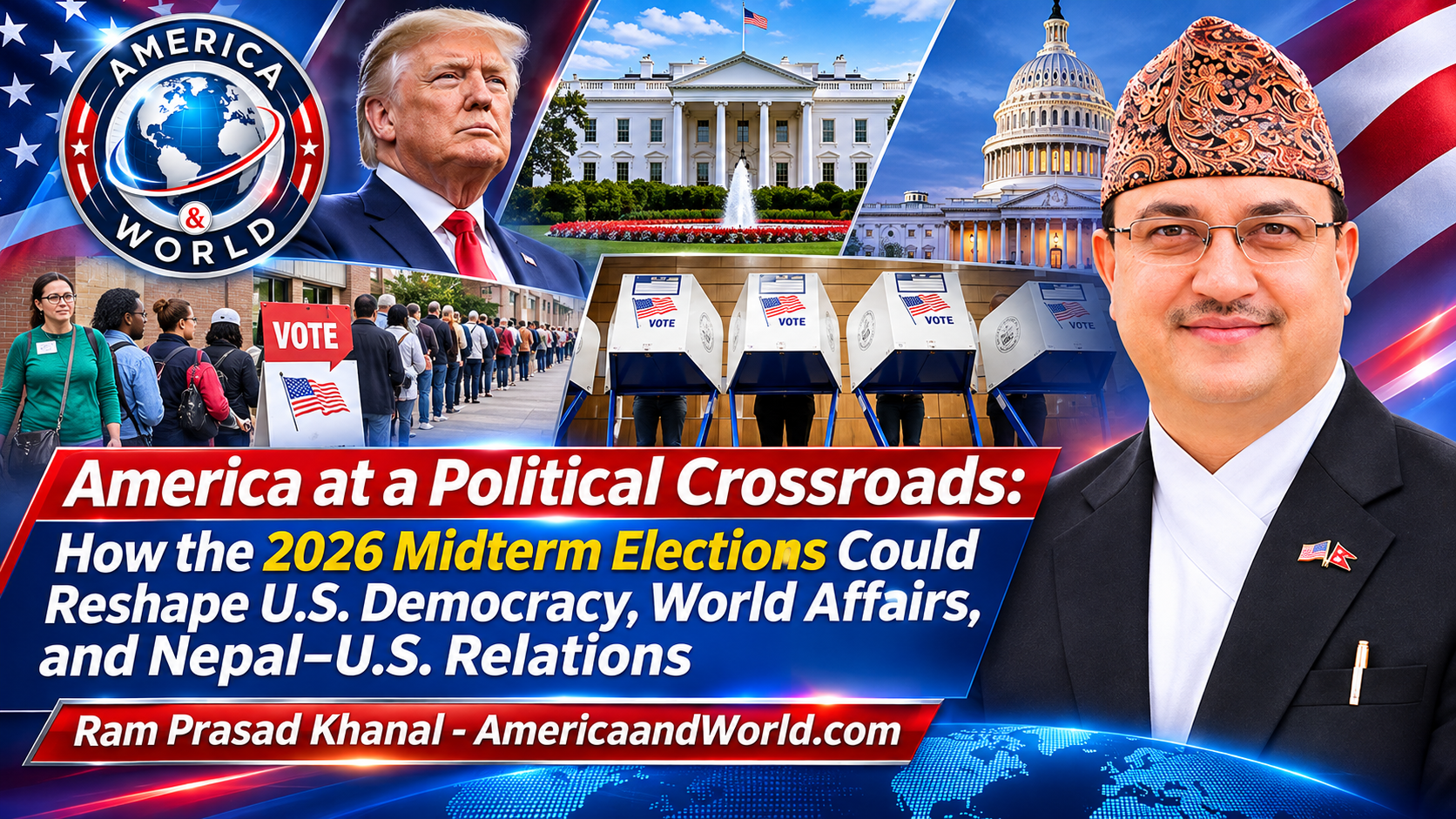
Earlier today, I joined the 7:00 PM prime-time news broadcast of Avenues Khabar Television, one of Nepal’s leading television networks, live from the United States to provide an in-depth analysis of the ongoing American midterm elections.
During the live discussion, we examined the electoral process, voter participation, the political landscape, the balance of power in Congress, President Donald Trump’s policies, and the potential consequences of the election for the United States, international relations, and Nepal.
Following that broadcast, we are presenting an expanded version of the discussion for our readers at NepalMother.com, maintaining the same question-and-answer format while providing additional background, context, and analysis.
America Goes to the Polls in a High-Stakes Election
WASHINGTON, D.C., November 3, 2026 — Americans are voting today in consequential midterm elections that will help determine the political direction of the United States during the remaining two years of President Donald Trump’s second term.
Voters are selecting all 435 members of the U.S. House of Representatives, 35 members of the 100-seat Senate, and governors in 36 states. Numerous state legislative, local government, and other public offices are also being contested.
According to figures cited from the University of Florida’s Election Lab, more than 57 million Americans had already voted early or by mail as of November 2, marking a substantial increase over early voting participation in the 2022 midterm elections.
Beyond the contest between Republicans and Democrats, the election could influence economic policy, immigration enforcement, federal spending, congressional oversight, international trade, America’s relationships with China and other global powers, and the political landscape ahead of the 2028 presidential election.
For Nepal, the outcome also deserves attention because decisions made in Washington can affect foreign assistance, development cooperation, international economic conditions, and broader geopolitical relationships.
We will continue monitoring voting, ballot counting, election results, and their national and international implications.
Ram Prasad Khanal
America Editor – Avenues Khabar Television
Editor-in-Chief – NepalMother.com
Washington, D.C., United States
19 Questions, 19 Answers: An In-Depth Election Analysis
1. Voting is underway across America today. What is the atmosphere like in your area and throughout the country?
Answer: Americans are voting today, Tuesday, November 3, in the 2026 midterm elections.
In Winchester, Virginia, where I am based, and in surrounding communities, polling locations opened at 6:00 AM and are scheduled to close at 7:00 PM. Under Virginia law, eligible voters who are already in line when polls close are still entitled to cast their ballots.
Voting hours differ among the 50 states. Because the United States spans multiple time zones, polling begins and ends at different times across the country.
The atmosphere reflects the significance of this election. It is not simply a routine congressional contest; it is also an opportunity for Americans to influence the relationship between the White House and Congress during the remainder of President Trump’s second term.
Election officials, political parties, candidates, and security agencies are actively coordinating their responsibilities. Early reports indicate that voting is generally proceeding in an orderly manner, although local weather conditions and administrative challenges have affected certain areas.
The broader political atmosphere is characterized by intense competition, strong voter interest, and sharply contrasting views about the country’s future.
2. How strong is voter participation? Are Americans showing greater enthusiasm than in previous midterm elections?
Answer: One of the most notable developments this year has been the level of early voting.
According to the University of Florida’s Election Lab figures cited in our reporting, more than 57 million Americans had voted before Election Day, compared with approximately 46 million early voters in the 2022 midterm elections.
That represents an increase of more than 11 million early votes.
However, it would be premature to conclude that overall turnout will increase by the same proportion. Some voters who previously voted on Election Day may simply have shifted to early or mail-in voting.
Voting is not compulsory in the United States. Participation depends on political engagement, confidence in candidates, personal circumstances, and the voting rules established by individual states.
The early voting figures suggest considerable public interest in the election, but the final turnout percentage and an accurate historical comparison will become clear only after all eligible ballots have been processed.
3. How are American media organizations and political observers interpreting today’s election?
Answer: American news organizations and political analysts are treating this election as a major test of the balance of power in Washington.
A majority in the 435-member House of Representatives ordinarily requires 218 seats. The Senate has 100 members, with Republicans holding 53 seats and the Democratic-aligned side holding 47, including two independents who caucus with Democrats, before this election.
Every House seat and 35 Senate seats are being contested.
Republicans have emphasized their positions on economic policy, border enforcement, energy production, and national security.
Democrats have focused on the rising cost of living, healthcare, civil rights, government accountability, and stronger congressional oversight of the Trump administration.
Media attention extends beyond which party wins the most seats. Equally important is what the results mean for federal legislation, government funding, presidential appointments, congressional investigations, and the ability of either party to advance its policy agenda.
The outcome could fundamentally change the political environment in which President Trump governs over the next two years.
4. Can the midterm elections be considered a public referendum on President Donald Trump’s first two years in office?
Answer: Politically, yes. These elections can be viewed as an important assessment of President Trump’s leadership and policies.
Midterm elections occur halfway through a president’s four-year term. Although the president is not on the ballot, his administration’s performance frequently becomes a central issue.
Voters are evaluating the administration’s economic policies, tariffs, immigration enforcement, federal spending, international relations, and executive decisions.
Historically, the party holding the presidency has often experienced electoral setbacks in midterm elections. Nevertheless, each election is shaped by its particular economic conditions, candidates, local issues, and national political environment.
Trump supporters see the election as an opportunity to strengthen his mandate and sustain his agenda.
His opponents view it as a chance to impose stronger congressional checks on the administration.
Therefore, while this is not a direct presidential election, it can provide a meaningful indication of how Americans assess the direction of the country under Trump’s leadership.
5. What are the most important issues influencing American voters?
Answer: The cost of living appears to be the leading concern for many American voters.
According to a Reuters/Ipsos survey cited in the original report, released on November 3, 48% of registered voters identified living expenses as their most important electoral issue. Another 26% prioritized democratic values, while 13% cited immigration.
For ordinary American families, economic pressures include housing prices, rent, grocery bills, health insurance premiums, prescription medications, education costs, transportation, and energy expenses.
Having a job is not necessarily enough if wages fail to keep pace with household expenses.
Immigration, border security, reproductive rights, healthcare, national security, and overseas conflicts are also important issues.
Ultimately, many voters judge government performance through their personal financial circumstances rather than through national economic statistics alone.
The central question for millions of Americans is whether their lives have become more affordable, secure, and financially stable.
6. How do Americans view the economic policies of the Trump administration?
Answer: Public opinion on President Trump’s economic policies remains deeply divided.
Supporters argue that tax reductions, support for domestic manufacturing, tougher trade negotiations, expanded energy production, and fewer government regulations can strengthen the American economy.
Critics contend that tariffs on imported goods may raise consumer prices, create uncertainty for businesses, and distribute economic benefits unevenly.
An August Reuters/Ipsos survey cited in the report found that 71% of respondents disapproved of Trump’s performance in managing the cost of living, while 22% approved.
For most households, economic performance is not measured solely by stock market gains or gross domestic product.
People are also concerned about take-home pay, job security, mortgage payments, insurance costs, savings, and everyday purchasing power.
The central political debate is therefore not merely whether the economy is growing, but whether ordinary Americans are experiencing meaningful improvements in their financial lives.
7. How have Trump’s immigration and border enforcement policies affected American society?
Answer: Immigration remains one of the most politically sensitive and divisive issues in the United States.
The Trump administration has prioritized stricter border enforcement, legal action against individuals residing in the country without authorization, and expanded deportation efforts.
Supporters argue that strong immigration enforcement is essential to national security, the rule of law, border integrity, and a properly managed immigration system.
Critics raise concerns about due process, family separation, labor shortages, humanitarian consequences, and fear within immigrant communities.
Immigrant workers contribute substantially to agriculture, construction, hospitality, healthcare, restaurants, and other parts of the American economy.
Consequently, immigration policy has economic and social implications beyond border security.
American public opinion is also more complex than a simple division between those who support and oppose immigration.
For example, some voters strongly support legal immigration while favoring stricter measures against unauthorized entry.
The election may reveal how voters balance national security concerns with economic needs, humanitarian considerations, and constitutional protections.
8. How do the priorities of young voters, women, and Americans from immigrant backgrounds differ?
Answer: Electoral priorities differ among age groups, professional backgrounds, and communities because people experience economic and social conditions differently.
For younger Americans, employment opportunities, student debt, affordable housing, education, technological development, and long-term financial security are particularly important.
High housing prices and rental costs have made homeownership increasingly difficult for many younger households.
Women voters are concerned with healthcare, reproductive rights, family finances, childcare, employment opportunities, and personal security.
Americans from immigrant backgrounds may place particular emphasis on employment, economic opportunity, lawful immigration, family reunification, education, and social stability.
However, no demographic group should be treated as politically uniform.
Women, young people, Hispanic Americans, Asian Americans, and other communities contain diverse political opinions, economic interests, and voting preferences.
The outcome will depend on how effectively candidates communicate with these different groups and address their concerns.
9. How significant is President Trump himself as an election issue?
Answer: President Trump has become one of the central figures in this election, despite not being a candidate.
According to the Reuters/Ipsos polling figures cited in the report, 48% of likely voters said they intended to vote in opposition to Trump, compared with 25% who said they would vote to support him.
These findings do not mean that every voter is making a decision based exclusively on the president.
Local candidates, economic conditions, and specific policy issues remain important.
Nevertheless, Trump’s influence within the Republican Party is substantial. Candidates endorsed by him, as well as those promoting his immigration, trade, and economic nationalist policies, have attracted considerable attention.
Democrats, meanwhile, have linked the election to government accountability, constitutional checks and balances, and the need for greater scrutiny of executive power.
The president’s political agenda has therefore become a major factor in electoral competition across the country.
10. Will Republicans retain control of both the House and Senate, or could the balance of power change?
Answer: Control of Congress is the central political question of the 2026 midterm elections.
Before Election Day, Republicans controlled both the House of Representatives and the Senate.
All 435 House seats are being contested, while 35 of the Senate’s 100 seats are on the ballot. The remaining 65 senators continue serving their existing terms.
Republicans are attempting to preserve their congressional majorities and maintain the political support necessary to advance President Trump’s agenda.
Democrats are seeking to gain control of at least one chamber.
The Senate presents a particular challenge for Democrats because Republicans entered the election with 53 seats.
A change in control would require substantial Democratic gains in competitive races.
The House may also be decided by relatively narrow margins, making individual congressional districts particularly important.
However, no definitive conclusion about congressional control can be reached until votes are counted and the results become sufficiently clear.
11. What would happen to Trump’s remaining two years if Democrats win control of the House of Representatives?
Answer: A Democratic majority in the House could create significant legislative and political challenges for President Trump’s administration.
Under the American constitutional system, federal legislation generally requires approval from both the House and Senate, followed by the president’s signature, unless Congress overrides a presidential veto.
If Democrats control the House, the administration may need to negotiate more frequently with opposition lawmakers to pass legislation and approve federal spending.
House committees could also intensify oversight of government agencies, administrative decisions, federal programs, and the use of public funds.
Congressional hearings and investigations could become more prominent.
However, Democratic control of the House would not automatically remove President Trump from office or eliminate his constitutionally established executive powers.
Instead, it would create a divided-government environment in which negotiation, compromise, and political confrontation could become more common.
The president would retain substantial executive authority, but his ability to secure new legislation could become more limited.
12. What if Democrats also gain control of the Senate? How would that affect the federal government?
Answer: A change in Senate control could have particularly important consequences for presidential appointments and the functioning of the federal government.
The U.S. Senate possesses constitutional authority to confirm federal judges, Supreme Court justices, Cabinet members, ambassadors, and numerous senior government officials.
If Democrats gain a Senate majority, President Trump’s nominees could face more difficult confirmation hearings, additional opposition, or rejection.
The Senate also plays a major role in federal legislation, government funding, national security policy, and the approval of international treaties.
If both chambers of Congress were controlled by Democrats, the administration would face stronger legislative opposition and potentially more extensive congressional investigations.
Nevertheless, divided government does not mean the federal government automatically stops functioning.
The U.S. Constitution establishes separate branches of government, each possessing specific powers and responsibilities.
The system of checks and balances is designed to allow government institutions to operate even when political disagreements arise.
The practical consequences would depend on the willingness of the president and congressional leaders to negotiate and cooperate.
13. How could the election affect relations between the United States and China?
Answer: The relationship between the United States and China is among the most consequential factors shaping global politics and the international economy.
The two countries compete in international trade, advanced technology, semiconductor production, artificial intelligence, military capabilities, Taiwan-related security issues, and influence in the South China Sea.
Both Republicans and Democrats have expressed concerns about national security risks and economic dependence on China.
However, the parties may differ in their approaches to tariffs, diplomatic engagement, trade negotiations, and technology restrictions.
A change in congressional control could influence legislation concerning trade, export controls, defense spending, and economic competition with China.
Congress also has significant influence over federal spending and certain aspects of international economic policy.
At the same time, the president retains broad authority over diplomacy and the conduct of foreign relations.
Therefore, a midterm election result would not automatically produce a complete reversal of American policy toward China.
The more important question is how the new congressional balance might influence Washington’s broader strategic approach.
For countries such as Nepal, located between China and India, shifts in American policy toward Asia deserve careful attention.
14. What could the election mean for tensions involving Iran, the Middle East, the war in Ukraine, and U.S. foreign policy?
Answer: International conflicts and security challenges remain significant issues in American foreign policy.
The ongoing tensions involving Iran and the Middle East, as well as the war in Ukraine, have raised difficult questions about military engagement, national security, diplomatic negotiations, and the financial costs of overseas commitments.
The American president possesses considerable executive authority in foreign affairs and military operations.
However, Congress controls important aspects of federal spending, including military assistance, defense appropriations, and funding for international security programs.
Changes in congressional control could therefore influence debates over military assistance to Ukraine, America’s involvement in Middle Eastern conflicts, and policies concerning Iran.
According to the Reuters/Ipsos figures cited in the report, 55% of respondents believed American military action against Iran was not justified by its costs, while 25% considered it justified.
These findings suggest that the financial and human consequences of military involvement are important concerns for many Americans.
However, the result of a congressional election alone cannot determine whether a war begins or ends.
International security developments, diplomatic negotiations, military circumstances, and decisions by the president and other governments remain essential factors.
Congressional oversight and funding decisions could nevertheless influence the direction and sustainability of American foreign policy.
15. Could the congressional election affect U.S.–Nepal relations, American development assistance, and projects such as the MCC?
Answer: The United States has long been an important development partner of Nepal.
Bilateral cooperation includes education, healthcare, development assistance, economic opportunities, democratic institutions, and people-to-people relationships.
The U.S. Congress plays a central role in approving federal budgets and funding for international assistance programs.
Consequently, changes in congressional leadership and spending priorities could affect development programs in Nepal and other countries.
If Washington adopts policies that reduce or restructure foreign assistance, certain projects could face budgetary pressure or implementation challenges.
Regarding the Millennium Challenge Corporation (MCC), the agreement with Nepal operates within its own legal, institutional, and contractual framework.
A change in congressional control would not automatically cancel the MCC agreement.
The future of individual projects depends on approved funding, contractual obligations, implementation progress, and decisions by the responsible authorities.
From my perspective, Nepal should maintain constructive and consistent engagement with both major American political parties, Congress, the administration, and relevant development institutions.
Nepal’s long-term interests are best served by stable diplomatic relationships that extend beyond partisan changes in Washington.
16. Could the election change American strategic priorities toward India, Nepal, and South Asia?
Answer: South Asia occupies an important position in American foreign policy because of its economic, geographical, and strategic significance.
The U.S.–India relationship encompasses defense cooperation, international trade, advanced technology, energy, and security in the Indo-Pacific region.
India’s growing role in the global economy and its strategic position in relation to China have contributed to its importance in American foreign policy.
Nepal’s relationship with the United States has a different emphasis, including development cooperation, education, health, democratic institutions, economic partnerships, and regional stability.
Nepal’s geographical location between India and China also makes developments in the broader region particularly relevant.
However, Nepal’s foreign policy must remain grounded in its own sovereignty, independent decision-making, national interests, and balanced international relations.
A change in congressional control could influence funding priorities, development programs, trade-related policies, and regional legislative initiatives.
Nevertheless, until the results are known and subsequent policy decisions are announced, it would be premature to predict a specific change in Washington’s approach toward either India or Nepal.
The most constructive approach for Nepal is to monitor developments carefully while maintaining balanced, transparent, and mutually beneficial diplomatic relationships.
17. What exactly are Americans deciding today: Trump’s leadership, Republican policies, or the future direction of American democracy?
Answer: In a broader political sense, Americans are making decisions that relate to all three.
Formally, voters are electing members of Congress, governors, state legislators, and other public officials.
But their decisions also reflect judgments about economic management, taxation, immigration, healthcare, national security, and the overall performance of government.
Another fundamental issue is the American constitutional system of checks and balances.
When the presidency and Congress are controlled by the same party, the administration may find it easier to advance its legislative priorities.
When different parties control these institutions, cooperation becomes more necessary, and congressional oversight may become stronger.
The election will therefore indicate the degree to which voters support the current administration’s policies and whether they desire additional institutional constraints on executive power.
American democracy depends on more than elections alone.
It also relies on an independent judiciary, constitutional protections, federalism, freedom of the press, accountability, and public confidence in democratic institutions.
For that reason, the significance of today’s vote extends beyond individual candidates or political parties.
It is also an expression of how Americans want their government to function.
18. How could the midterm election influence the political landscape ahead of the 2028 presidential election?
Answer: The midterm election could play an important role in shaping the strategies of both major parties ahead of the 2028 presidential race.
Election results will help Republicans and Democrats identify where their support has increased or declined.
They will also provide insight into the voting behavior of younger Americans, suburban residents, working-class communities, women, and other important electoral groups.
Both parties may use the results to reconsider their leadership, policy priorities, campaign strategies, and potential presidential candidates.
For Republicans, President Trump’s political influence and the future direction of the party will remain central questions.
Under the 22nd Amendment to the U.S. Constitution, a person cannot be elected president more than twice. President Trump, having already won two presidential elections, cannot be elected to a third term under that provision.
As a result, the question of who might carry forward his political movement and leadership approach will become increasingly important in discussions about 2028.
Democrats will also examine the election to assess their future leadership, ideological direction, electoral coalition, and national campaign message.
Nevertheless, midterm results do not predetermine the outcome of a presidential election two years later.
Economic conditions, international developments, candidate selection, and political events between now and 2028 could significantly change the electoral environment.
19. Finally, as someone living in the United States and closely observing its political environment, what do you believe will be the most important message from this election?
Answer: In my assessment, the most important message of this election will concern the everyday concerns of American citizens, public confidence in government, and political accountability.
The United States may be one of the world’s largest economies and most powerful nations, but ordinary Americans still worry about housing costs, inflation, healthcare, education, employment, taxation, and family security.
Political leaders may debate international conflicts, national strategy, and ideological differences, but voters ultimately evaluate how government policies affect their lives.
The election also demonstrates the importance of constitutional checks and balances.
Through their votes, Americans can change the composition of Congress and influence how political power is distributed within the federal government.
Whether Republicans retain their majorities or Democrats gain control of one or both chambers, all political parties share a responsibility to respect legitimate votes, constitutional procedures, and the integrity of democratic institutions.
In my view, the success of democracy cannot be measured solely by which party wins an election.
True democratic success also depends on preserving public trust, ensuring fair elections, respecting lawful outcomes, and addressing the genuine needs of citizens after political campaigns are over.
Ultimately, the greatest power in a democracy does not belong to the president, Congress, or any political party.
It belongs to the people. Their votes give political leaders both the authority to govern and the responsibility to serve.
Additional Important Election Updates
Supreme Court Rejects Trump Administration’s Emergency Request to Segregate Approximately 20,000 California Ballots
The Trump administration encountered a legal setback ahead of the November 3 midterm elections when the U.S. Supreme Court rejected an emergency request concerning approximately 20,000 ballots in California.
According to the legal developments described in the report, the Department of Justice had raised concerns that some individuals associated with a disputed voter list might not be American citizens.
The administration sought an emergency order requiring the ballots in question to be kept separate from other ballots until citizenship-related concerns could be resolved.
On Monday, November 2, the Supreme Court denied the emergency application without providing a detailed explanation.
Lower federal courts had previously rejected the administration’s requests.
California election officials and voting-rights organizations challenged the reliability of the disputed list, arguing that it could include eligible American citizens as well as individuals who were not registered to vote.
The administration maintained that investigating potential noncitizen voting and enforcing election laws were legitimate government responsibilities.
The Supreme Court’s action blocked the immediate attempt to segregate the ballots. However, the emergency ruling did not constitute a final determination of the citizenship status of every individual named in the disputed records.
The case highlights continuing debates over election administration, federal and state authority, voter eligibility, and the protection of lawful voting rights.
Flooding and Severe Weather Disrupt Voting in Several U.S. States as Election Officials Remain on Alert
Voting across the United States has generally proceeded peacefully, although severe weather and localized operational problems have created challenges in certain areas.
According to the preliminary reports summarized in the original coverage, heavy rainfall and flash flooding have affected parts of Colorado, New Mexico, Arizona, Utah, and Florida.
In southwestern Colorado, flooding reportedly forced election administrators to relocate certain voting or ballot collection locations.
In Utah’s San Juan County, special electronic voting arrangements were introduced for some flood-affected voters.
Arizona election officials also monitored road conditions and access to polling locations.
In Florida, severe weather reportedly required alternative voting arrangements in several communities, including eight precincts in Brevard County.
These disruptions do not mean that voting was suspended across entire states or that every voter in the affected areas was unable to participate.
Election officials have been working to maintain access to the ballot through alternative locations and other arrangements where necessary.
Federal, state, and local authorities have also remained alert to possible voter intimidation, misinformation, security incidents, and disruptions to the election process.
Since voting remains underway, the complete impact of weather-related problems and other incidents will become clearer as election officials release additional information.
When Will Vote Counting Begin, and How Soon Will the Election Results Be Known?
The United States does not have a single nationwide poll-closing time.
Because the country spans several time zones, voting may still be underway in western states when polling locations in eastern states have already closed.
In Virginia, polling locations close at 7:00 PM Eastern Time. Election officials can begin releasing results after the polls close, consistent with applicable state procedures.
Some congressional and statewide races may become clear on election night.
However, closely contested elections may require additional time because of mail-in ballots, provisional ballots, ballot verification, and differences among state election laws.
For example, Virginia permits eligible mail-in ballots postmarked by Election Day to be counted if received by noon on November 6, subject to applicable legal requirements.
Consequently, unofficial election-night projections should not be confused with final certified results.
If control of the House or Senate depends on a handful of closely contested races, determining the final congressional balance of power could take several days or longer.
Why the 2026 U.S. Midterm Elections Matter Beyond America
The significance of these elections extends far beyond America’s domestic political landscape.
Their outcome could affect the remaining two years of President Trump’s administration, the balance of power in Congress, economic policy, immigration enforcement, federal spending, and the direction of major legislative initiatives.
Internationally, changes in congressional control could influence debates involving U.S.–China relations, the Middle East, the war in Ukraine, global trade, military assistance, and foreign development programs.
For Nepal and other developing countries, shifts in American foreign policy and international assistance priorities could carry meaningful economic and diplomatic implications.
Nevertheless, a congressional election result should not be interpreted as an automatic or immediate change in every aspect of American foreign policy.
The president, Congress, the judiciary, and state governments operate within separate constitutional responsibilities.
What makes this election particularly significant is not merely the number of seats won by Republicans or Democrats, but the kind of governing relationship that emerges between the White House and Congress.
That relationship will help shape America’s domestic and international political direction through the next presidential election in 2028.
We will continue providing updates, election results, and analysis as additional information becomes available.
Stay connected with Avenues Khabar Television and NepalMother.com for continuing coverage of the 2026 U.S. midterm elections.