Trump and Xi Open High-Stakes White House Talks as Trade, AI and Security Dominate Agenda

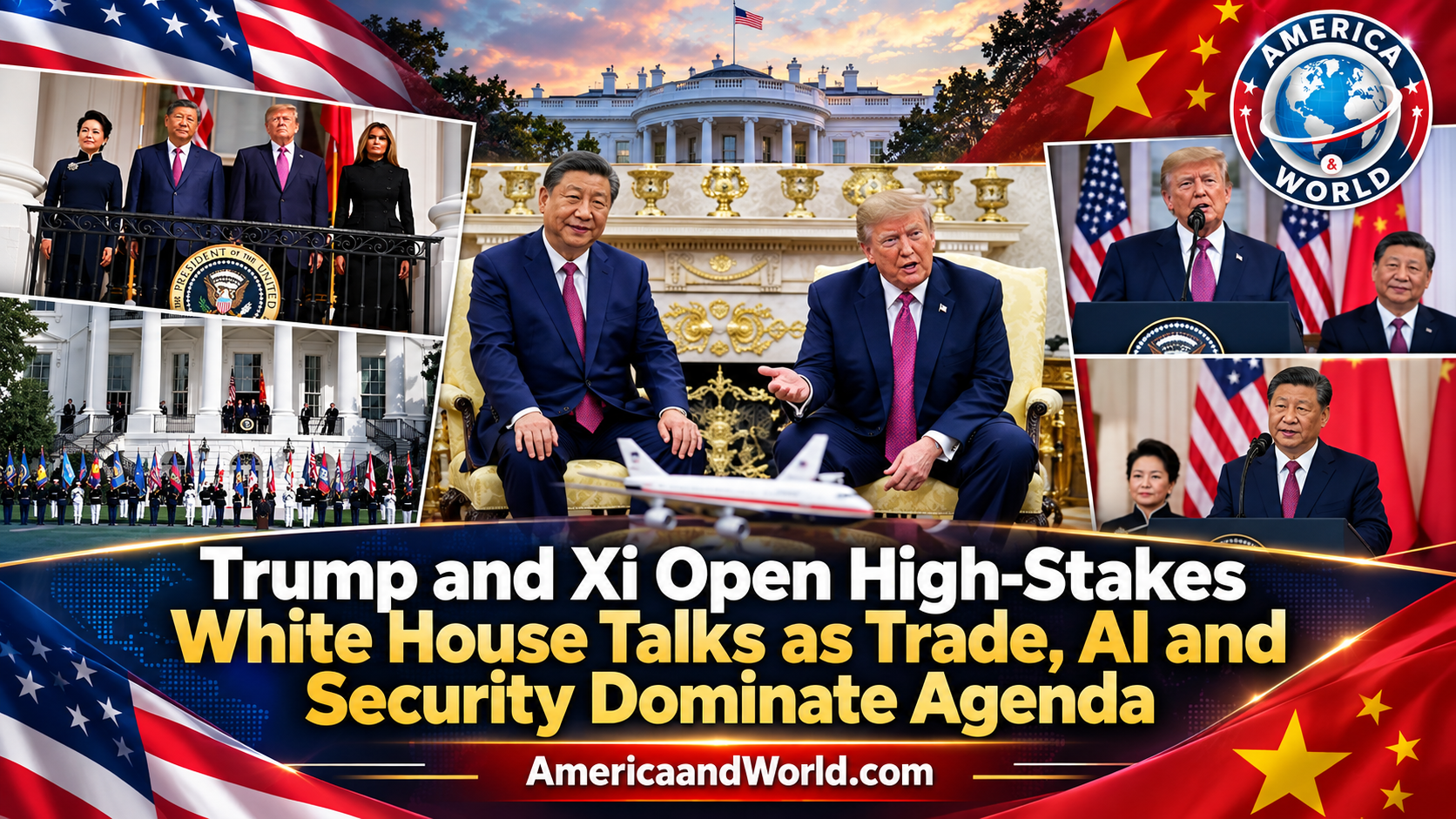
WASHINGTON, Sept. 24, 2026 / U.S. President Donald Trump and Chinese President Xi Jinping opened high-level talks at the White House on Thursday, striking a cooperative public tone while confronting a broad agenda that includes trade, artificial intelligence, technology competition, rare-earth supplies and security tensions.
Welcoming Xi during a formal state visit, Trump said the United States and China had made “tremendous strides on the issues facing our two countries” and said the two governments were working toward a more balanced economic relationship, including expanded market access for American farmers.
Trump said the two leaders would also focus on “security, technology and superintelligence,” using his preferred term for artificial intelligence, and argued that decisions taken by Washington and Beijing could affect global peace and prosperity for decades.
Xi, in his opening remarks, emphasized sustained communication and cooperation between the world’s two largest economies. He said differences between the two countries should be managed through “frank, in-depth and sustained dialogue” and called for greater exchanges across diplomatic, economic, financial, law-enforcement and people-to-people channels.
Xi also urged Washington to treat Chinese companies fairly, while saying China remained open to American investment. According to the Chinese Foreign Ministry, Xi said the United States and China have extensive overlapping interests and argued that many global challenges would be difficult to address without cooperation between Beijing and Washington.
Artificial intelligence has emerged as one of the most closely watched issues surrounding the summit.
Hours before meeting Xi, Trump said AI would be a major subject of discussion but signaled little enthusiasm for creating new bilateral restrictions.
“A big day with President Xi of China. Super Intelligence (SI) will be a big topic of discussion, but I want to leave it exactly where it is,” Trump wrote on social media, adding that he believed China held a similar position and saying that the U.S. Department of Justice was America’s “guardrail.”
Xi, however, publicly placed greater emphasis on management of the technology, saying China and the United States, as major AI powers, have both the capability and responsibility to develop and manage artificial intelligence so that it remains under human control and benefits society.
The contrasting emphasis illustrates one of the central challenges facing the two governments. Both view advanced AI, semiconductors and computing infrastructure as strategically important, while concerns are growing internationally about security risks, military applications and the possibility of advanced systems behaving in unpredictable ways.
Preparatory economic talks between U.S. Treasury Secretary Scott Bessent and Chinese Vice Premier He Lifeng included discussions about AI safety and a possible mechanism for notifying each other about serious AI-related incidents. The talks also covered rare-earth supplies, trade restrictions and efforts to curb chemicals used in fentanyl production.
Trade truce provides breathing room
Economic relations remain at the center of the summit.
Washington and Beijing have spent much of the past two years navigating tariff increases, retaliatory restrictions, semiconductor controls and disputes over Chinese industrial policies. A temporary trade framework has prevented those disputes from escalating further, but many underlying disagreements remain unresolved.
Among the issues under negotiation are tariffs on tens of billions of dollars in goods, Chinese purchases of U.S. agricultural products, American access to the Chinese market, rare-earth exports and possible reductions in China’s tariff on U.S. liquefied natural gas.
Rare earths are particularly important because China plays a dominant role in processing many of the minerals used in automobiles, electronics, defense systems and advanced technology. Previous Chinese restrictions on exports have highlighted Washington’s dependence on those supply chains.
The two governments have also been discussing commitments reached during Trump’s May visit to Beijing. Those included plans for new trade and investment mechanisms and broader efforts to stabilize commercial relations. Some of those commitments have progressed more slowly than originally envisioned.
Taiwan and security remain sensitive
Despite the friendly public atmosphere, major strategic disagreements remain.
Taiwan continues to be one of the most sensitive issues in U.S.-China relations. Beijing regards Taiwan as part of China and strongly opposes U.S. arms sales and official engagement with Taipei. Washington maintains unofficial relations with Taiwan and, under U.S. law, provides the island with means to support its self-defense.
Ahead of the summit, the United States reaffirmed its security commitments to allies Japan and South Korea and emphasized the importance of peace and stability across the Taiwan Strait.
Other potential subjects include Iran, maritime security, fentanyl trafficking and military communication intended to reduce the danger of accidental confrontation.
An unusually elaborate welcome
The diplomatic symbolism surrounding Xi’s visit has been unusually prominent.
Trump personally traveled to Joint Base Andrews on Wednesday to welcome Xi and his wife, Peng Liyuan, when they arrived for the Sept. 23–25 state visit — an uncommon gesture for a sitting U.S. president. The White House confirmed that the visit includes an official arrival ceremony and a state dinner.
The state dinner Thursday evening is expected to bring together senior government officials and some of the biggest names in American technology and business.
Reuters reported that expected guests include Nvidia CEO Jensen Huang, Apple CEO Tim Cook, OpenAI CEO Sam Altman, Tesla and SpaceX chief Elon Musk, Alphabet CEO Sundar Pichai, Amazon founder Jeff Bezos and Dell Technologies CEO Michael Dell.
Their presence underscores how technology — particularly artificial intelligence, advanced chips and computing infrastructure — has become central not only to commercial competition between the United States and China but also to their broader strategic rivalry.
The White House said the state dinner will be held in the East Room and attended by the two official delegations as well as government and business leaders.
Xi’s trip is his first state visit to the United States in more than a decade and follows Trump’s visit to Beijing earlier this year. China’s Foreign Ministry said the Sept. 23–25 visit is intended to expand dialogue, manage differences and identify areas of cooperation between the two countries.
For now, the summit’s significance may depend less on a single sweeping agreement than on whether the two governments can translate the ceremonial warmth into practical arrangements on trade, technology and crisis management.
With the United States and China competing across economics, advanced technology and strategic influence, decisions emerging from Washington could have consequences far beyond the bilateral relationship — affecting global supply chains, financial markets, AI development and security across the Indo-Pacific.