Ukraine Begins Buying Homegrown ‘Equalizer’ Glide Bomb as Kyiv Seeks to Cut Reliance on Foreign Weapons

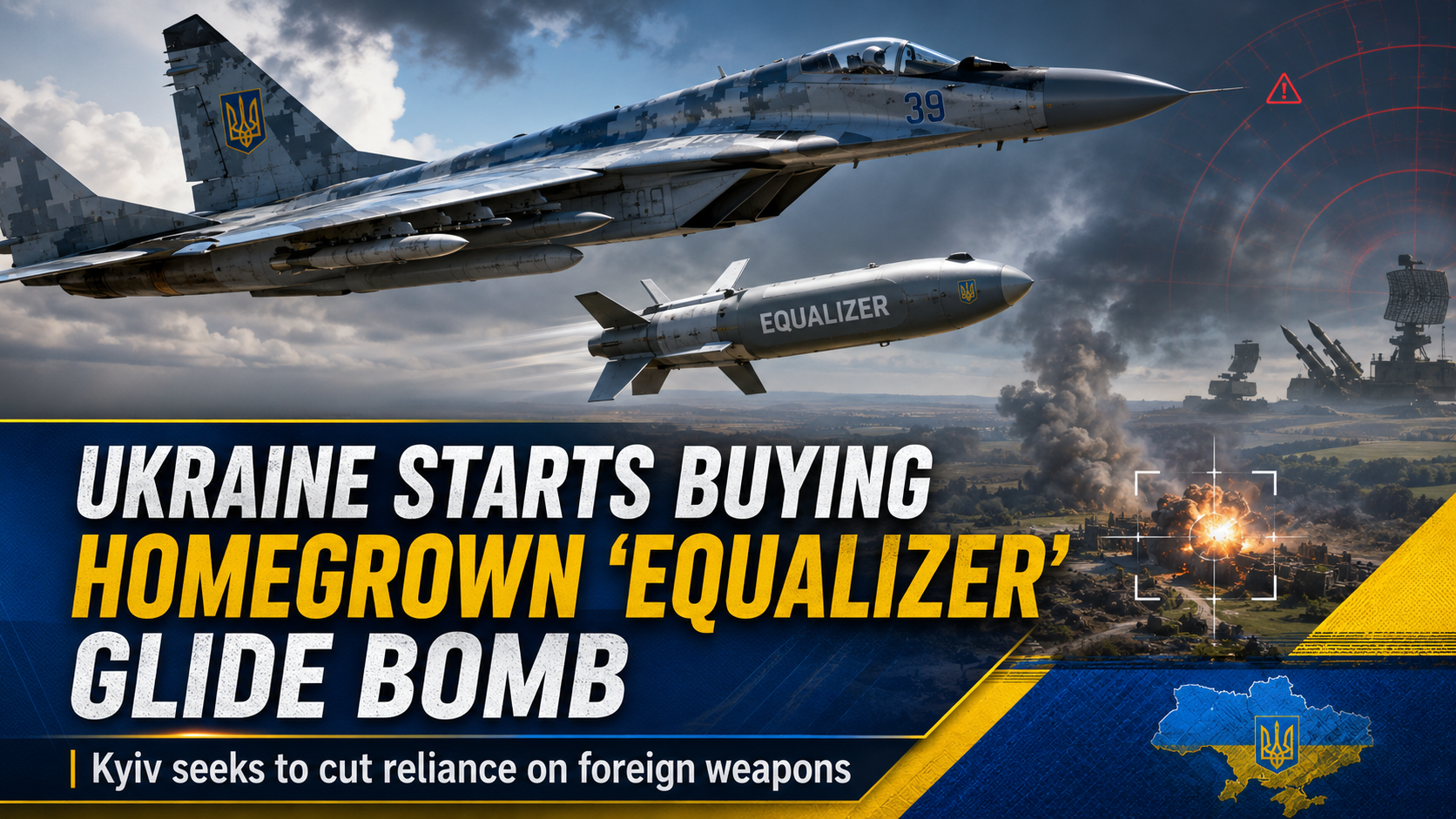
The domestically developed precision weapon carries a 250-kilogram warhead and can strike targets dozens of kilometers away; designed for MiG-29, Su-24 and Su-27 aircraft, with plans to certify it for F-16 and Mirage fighters
KYIV, Ukraine — Ukraine has begun officially procuring its domestically developed “Vyrivniuvach,” or “Equalizer,” guided glide bomb, marking another significant step in Kyiv’s effort to reduce its dependence on U.S. and European precision weapons as its war with Russia continues.
The weapon was developed by Ukrainian defense company DG Industry with support from Brave1, the government-backed defense technology and innovation cluster. Colonel Vladyslav Voloshyn, an official with the Ukrainian Armed Forces’ innovation directorate, told Ukrinform that the bomb had completed the required testing and was now being officially purchased for delivery to the military.
Ukraine’s Defense Ministry had already purchased an initial experimental batch in May after the system passed its trials. According to the ministry, the project took about 17 months to progress from development to a combat-ready system.
What is the Equalizer?
The Equalizer is a precision-guided glide bomb, a class of air-launched weapon that uses aerodynamic surfaces and a guidance system to travel substantially farther than a conventional free-fall bomb.
Instead of requiring an aircraft to fly close to a target, the weapon can be released from a safer distance and glide toward a designated position. Ukraine says the Equalizer can strike fortifications, command posts and other targets dozens of kilometers behind the front line, potentially allowing Ukrainian pilots to remain farther away from some Russian air-defense systems.
The weapon carries a 250-kilogram warhead. Brave1 has not disclosed a precise maximum range, describing it only as capable of reaching targets “dozens of kilometers” away.
Unlike some longer-range guided bombs, the Equalizer does not have its own engine. Its range therefore depends heavily on the aircraft’s altitude, speed and release profile, as well as the bomb’s aerodynamic design.
A Brave1 representative told The War Zone that the lack of propulsion presented a major engineering challenge because navigation and control must rely on the bomb’s inertia and aerodynamics.
Designed for Soviet-era jets – and potentially F-16s and Mirages
The Equalizer was designed for aircraft already operated by the Ukrainian Air Force, including the MiG-29, Su-24 and Su-27.
Developers also say the weapon can be adapted for Ukraine’s Western-supplied F-16s and Mirage fighters, although additional certification is required before regular operational use on those aircraft.
Ukraine has previously relied heavily on Western-supplied precision weapons for comparable missions, including the American JDAM-ER, the GBU-39 Small Diameter Bomb, and France’s AASM Hammer.
Those weapons have given Ukrainian aircraft the ability to attack Russian positions without flying directly over heavily defended front-line areas. But their availability ultimately depends on foreign inventories, political decisions and the willingness of allies to continue supplying them.
That vulnerability has pushed Kyiv to expand its domestic arms industry and develop weapons that can be manufactured and employed without waiting for approval or deliveries from foreign governments.
Ukrainian design, but not entirely free of foreign components
The Equalizer represents a major achievement for Ukraine’s defense industry, although it is not entirely independent of international supply chains.
According to Brave1, everything from the wings to the flight-control software was developed in Ukraine, while certain chips and microcircuits are imported.
Around 90 percent of the component base comes from Ukrainian, European and American sources, and developers say the supply chain was deliberately structured to avoid critical dependence on any single foreign supplier.
DG Industry has also said the Equalizer could cost roughly one-third as much as a U.S.-made JDAM-ER, although exact procurement prices have not been publicly disclosed. If produced at scale, that could allow Ukraine to use locally made glide bombs against tactical and operational targets while conserving more expensive or limited Western weapons for missions where they are most needed.
The Equalizer is also part of a wider Ukrainian effort to create a domestic family of air-launched precision weapons. Brave1 says at least eight manufacturers are working on glide-bomb technology, while Ukrainian military officials have said roughly a dozen prospective precision-air-weapon projects are under development.
Russia’s massive glide-bomb campaign drives urgency
Ukraine’s push to manufacture its own glide bombs comes as Russia continues to use guided aerial bombs on a huge scale.
Russian forces have converted large stocks of Soviet-era FAB-series bombs by fitting them with wing and guidance kits, often referred to as UMPK modules. The relatively inexpensive conversions allow Russian aircraft to release powerful explosives from farther behind the front line rather than flying directly into the densest Ukrainian air-defense zones.
Ukraine’s Defense Ministry said Russian forces used more than 8,000 guided aerial bombs in July 2026 alone, underscoring the enormous scale of the threat facing Ukrainian troops and front-line communities.
The growing use of such weapons has become one of Russia’s most consequential advantages along parts of the battlefield because even heavily fortified positions can be devastated by repeated strikes carrying hundreds of kilograms of explosives.
Ukraine’s Equalizer will not immediately erase that numerical imbalance, but domestic mass production could provide Kyiv with a comparatively inexpensive means of conducting similar stand-off attacks.
Deadly Kyiv attack highlights air-defense shortages
The announcement comes amid renewed concern about Ukraine’s ability to defend its cities against Russia’s expanding missile and drone campaign.
A massive Russian attack on Kyiv and the surrounding region on August 20 killed 17 people and wounded more than 40, according to Ukrainian authorities. Residential buildings, a school, a kindergarten and a children’s hospital were among the structures damaged. Russia said its strikes targeted military-related facilities.
Ukraine’s Air Force said Russia launched dozens of cruise, ballistic and hypersonic missiles along with 168 drones during the assault. Ukrainian defenses intercepted nearly 90 percent of the drones and most cruise missiles, but Kyiv continues to face particular difficulty countering ballistic weapons.
President Volodymyr Zelenskyy has repeatedly called for additional Patriot interceptor missiles, arguing that shortages are leaving Ukrainian cities increasingly vulnerable. Reuters reported that Patriot remains Ukraine’s principal system capable of intercepting the ballistic missiles being used in such attacks.
The real test will be mass production
For Ukraine, completing development of the Equalizer is only the first step.
Its battlefield significance will ultimately depend on production volume, accuracy, reliability, resistance to Russian electronic warfare and how consistently the Ukrainian Air Force can deploy it.
Kyiv has not disclosed how many Equalizers are being manufactured, how large the latest procurement is, or when the weapon will become available to combat units in substantial numbers.
Nevertheless, the move reflects a broader transformation of Ukraine’s defense strategy.
More than four years into the full-scale war, Kyiv increasingly wants weapons whose production schedules, supply chains and operational use are controlled inside Ukraine rather than determined by foreign stockpiles or shifting political decisions abroad.
If the Equalizer proves effective and can be manufactured in large numbers, it could become an important part of that strategy — giving Ukraine a homegrown precision weapon capable of striking Russian forces from greater distances while conserving scarce Western-supplied munitions for higher-priority targets.