Nepal’s Endless Search for a Savior : From the 1990 Revolution to Gen Z, Why Power Changed but the Political Culture Did Not ?


- By Ram Prasad Khanal
Nepal is once again standing at an uncomfortable political crossroads. The question is no longer simply whether K.P. Sharma Oli was right or wrong, whether Sher Bahadur Deuba failed, whether Pushpa Kamal Dahal “Prachanda” betrayed the revolution he once led, whether Baburam Bhattarai’s intellectual promise translated into governance, whether Rabi Lamichhane truly represented an alternative, or whether Balendra “Balen” Shah can transform the extraordinary public mandate now in his hands into lasting change. The larger and much more difficult question is this: Nepal has repeatedly changed governments, prime ministers, constitutions, political systems and political heroes since the restoration of multiparty democracy in 1990. Why, then, has the culture of exercising power changed so little?
The scale of Nepal’s political instability is extraordinary. Reuters reported in March 2026 that Nepal had seen 32 governments since the restoration of multiparty democracy in 1990, with none completing a full five-year term. Even after the monarchy was abolished in 2008 and a federal democratic republic established, political instability remained deeply embedded in the system.
That record alone should force Nepal to look beyond the convenient explanation that every crisis was caused by one bad prime minister, one bad political party or one defective provision of the Constitution. Different systems have been tried. Different electoral mandates have been given. Majority governments, minority governments, coalitions, communist alliances, Congress-led governments, Maoist-led governments, royal intervention, technocratic arrangements, an interim government led by a former chief justice, and now a new-generation government backed by an overwhelming parliamentary majority have all been tested.
Yet the fundamental public demand has barely changed: honest government, equal justice, jobs, dignity, public services that work, and a country in which children do not have to leave simply to build a future.
The People’s Movement of 1990 ended three decades of the partyless Panchayat system and restored multiparty democracy under a constitutional monarchy. For millions of Nepalis, it was a moment of enormous hope. Freedom of expression expanded. Political parties could openly organize. Competitive elections returned. The press acquired space it had not enjoyed under the Panchayat system. The expectation was that an accountable government elected by citizens would gradually replace arbitrary rule, corruption and patronage with democratic institutions.
The first parliamentary election of the restored democratic era, held in May 1991, gave the Nepali Congress a clear majority—110 of the 205 seats in the House of Representatives. The UML emerged as the principal opposition. Nepal therefore had something that later generations would repeatedly demand: a government that did not depend on fragile coalition mathematics.
Yet even that majority could not guarantee stability. Internal conflict within the Nepali Congress weakened Girija Prasad Koirala’s government, and Nepal went to an early election in 1994. That election produced a hung parliament, the UML became the largest party, and Man Mohan Adhikari headed a minority government. The period that followed helped normalize the politics of coalition bargaining, shifting parliamentary alliances, ministerial distribution and the struggle to assemble enough lawmakers to survive confidence votes.
The important lesson is often overlooked. Nepal’s instability did not begin with the present mixed electoral system. Nor can it be explained solely by proportional representation or federalism, because the same disease was clearly visible under the 1990 Constitution.
The 1999 general election again gave the Nepali Congress a majority—111 of 205 seats. Yet even that Parliament saw Krishna Prasad Bhattarai, Girija Prasad Koirala and Sher Bahadur Deuba succeed one another as prime minister. Nepal had therefore been given two opportunities to demonstrate the advantages of single-party majority rule, in 1991 and again in 1999, and neither produced a government that completed the entire parliamentary term under one stable leadership.
That history matters today because it demonstrates that Nepal’s problem has never been parliamentary arithmetic alone. It has also been the internal character of its political parties: highly personalized leadership, factional rivalry, limited internal democracy, patronage networks and a political culture in which controlling the government often became more urgent than governing the country.
During the 1990s, allegations of political horse-trading became part of popular political vocabulary. The infamous phrase “Pajero culture” came to symbolize a broader public perception that legislators and political elites were becoming disconnected from the sacrifices and expectations of the democratic movement. Governments were formed with strange ideological combinations. Parties that had spent decades defining one another as political enemies discovered that ideological differences could suddenly become negotiable when ministries and parliamentary majorities were at stake.
This did not mean democracy itself had failed. Democracy gave citizens freedoms and political rights that should never be trivialized. But the behaviour of democratic actors steadily weakened public confidence in the democratic order they had fought to establish.
While parliamentary instability was deepening, another crisis was developing outside Kathmandu. On February 13, 1996, the Communist Party of Nepal (Maoist) launched an armed insurgency. What began in relatively remote districts developed into a nationwide conflict. The Office of the UN High Commissioner for Human Rights later documented widespread violations and abuses by both Maoist forces and state security forces. Its major conflict report estimated that at least 13,000 people had been killed by the time the Comprehensive Peace Agreement formally ended the war in November 2006, while more than 1,300 people recorded as disappeared remained missing at the time of that report.
Later estimates have sometimes placed the overall death toll higher, but the exact number should not obscure the deeper reality: families on every side were devastated. Civilians were killed. People were abducted. Security personnel were attacked. Villages were militarized. Suspected Maoist sympathizers were detained, tortured or disappeared by state forces. Maoists were accused of killings, extortion, forced recruitment, intimidation and attacks on civilians and public infrastructure. The war transformed the countryside and left wounds that remain inadequately addressed two decades after the peace agreement.
It is also intellectually dishonest to discuss the Maoist insurgency only as terrorism or only as revolution. It emerged from real social and economic grievances—rural exclusion, caste discrimination, poverty, landlessness, unequal political access and the profound distance between Kathmandu’s governing elite and large sections of the countryside. But legitimate grievances do not erase responsibility for violence, and state authority does not excuse grave abuses committed by security forces. Nepal still owes truth, justice and reparations to victims on all sides.
The Comprehensive Peace Agreement signed on November 21, 2006 explicitly envisaged mechanisms to address serious human rights violations and the legacy of the conflict. Yet transitional justice remains unfinished. Human Rights Watch has repeatedly documented the long delay in providing accountability, truth and reparations to victims.
That unfinished business is important because impunity does not remain confined to the past. When a state demonstrates for decades that politically sensitive abuses can be postponed, negotiated or forgotten, it creates habits that affect the present.
The Maoist war was not Nepal’s only trauma during this period. On June 1, 2001, almost the entire immediate family of King Birendra was killed in the Narayanhiti Royal Palace massacre. The tragedy shattered one of the country’s most powerful national institutions and transformed public psychology. Gyanendra Shah subsequently became king.
As the Maoist insurgency intensified and parliamentary politics deteriorated, relations between the palace and political parties worsened. Parliament had been dissolved in 2002 on the recommendation of Prime Minister Sher Bahadur Deuba. King Gyanendra subsequently dismissed Deuba and moved increasingly into active politics. On February 1, 2005, the king assumed direct executive power, arguing that the political establishment had failed to control the insurgency and provide effective government.
For people who were already frustrated with the parties, royal intervention initially appeared to some as a possible path to order. But direct royal rule did not defeat the Maoists, eliminate corruption, create an economic miracle or restore durable stability. Instead, restrictions on political and civil freedoms and growing opposition to royal rule pushed the mainstream political parties and Maoists toward an alliance against the monarchy.
After weeks of mass protests in April 2006, King Gyanendra restored the House of Representatives on April 24. His proclamation explicitly recognized that state authority and sovereignty rested with the people and reinstated the House that had been dissolved in 2002.
The political transformation that followed was dramatic. The Seven-Party Alliance and Maoists negotiated a peace process. The Comprehensive Peace Agreement ended the armed conflict. Maoists entered mainstream competitive politics. Elections were held for a Constituent Assembly in 2008. Former rebels who had spent a decade fighting the state became the largest force in the Assembly.
Then came one of the most consequential moments in modern Nepali history. On May 28, 2008, the Constituent Assembly voted overwhelmingly to abolish the monarchy and establish Nepal as a republic, ending the Shah dynasty’s centuries-old rule.
Again, the public expectation was enormous. Nepal had gone through war, royal authoritarianism and a mass democratic uprising. A new Nepal was promised. The Maoists had entered government. The monarchy was gone. A Constituent Assembly was supposed to restructure the state and write a progressive Constitution.
But once again, institutional delivery failed to match political drama.
Prachanda became prime minister but resigned after a confrontation surrounding the army chief. Madhav Kumar Nepal followed. Then Jhala Nath Khanal. Then Baburam Bhattarai. The first Constituent Assembly repeatedly extended its tenure but failed to reach agreement on the new Constitution, particularly over federal restructuring and related questions. On May 27, 2012, the parties acknowledged that they would miss the final constitutional deadline and the Constituent Assembly expired without delivering the document for which it had been elected.
For citizens, it was another bitter lesson. Nepal had fought a civil war partly over the demand for a Constituent Assembly, elected one, spent four years debating the future of the state—and still failed to produce a Constitution.
Political parties then resorted to another unusual compromise: sitting Chief Justice Khil Raj Regmi headed an election government. Nepal eventually held a second Constituent Assembly election in 2013. This time the Nepali Congress emerged as the largest party, the UML became another major force and the Maoists fell to third place.
The catastrophic April 2015 earthquake, which killed thousands and devastated communities and infrastructure, added pressure on political leaders to conclude the long constitutional process. On September 20, 2015, Nepal promulgated a new Constitution establishing a secular federal democratic republic with a complex system of inclusion, fundamental rights, provincial government, local government and proportional representation.
That Constitution remains one of the major achievements of Nepal’s democratic transition. Women and historically marginalized communities obtained broader constitutional representation. Local government was constitutionally entrenched. Fundamental rights expanded. Federalism sought to take state authority closer to citizens. Periodic elections have continued. Peaceful changes of government have generally replaced armed struggles for state power.
These achievements should not be erased simply because the country remains dissatisfied with its leaders.
At the same time, the Constitution did not settle every political grievance. Madhesi and other groups strongly objected to provisions concerning representation, provincial boundaries and citizenship. Protests in the Tarai intensified and a prolonged disruption at major India-Nepal border points created severe shortages of fuel and essential supplies. Madhesi parties eventually lifted the four-month blockade in February 2016.
The crisis profoundly influenced Nepal’s domestic politics. India became the focus of intense public anger. K.P. Sharma Oli emerged as a powerful voice of nationalism. Nepal’s political conversation increasingly blended governance with geopolitics: who was close to India, who was close to China, who was protecting sovereignty and who was allegedly serving foreign interests.
The 2017 elections then created perhaps the greatest opportunity for political stability since 1990. The UML-Maoist alliance won an overwhelming mandate, and the two parties subsequently merged to create the Nepal Communist Party. K.P. Sharma Oli led a government backed by a near two-thirds parliamentary majority.
Nepalis had heard for decades that unstable coalitions prevented governments from performing. Now that excuse appeared to have disappeared.
But the government’s greatest threat eventually came from within the ruling party itself. Conflict between Oli, Prachanda, Madhav Kumar Nepal and competing factions deepened. Oli dissolved the House of Representatives in December 2020. The Supreme Court reinstated Parliament. The House was dissolved again in May 2021. In July, the Supreme Court again restored it and ordered Sher Bahadur Deuba’s appointment as prime minister.
Here again Nepal encountered a recurring pattern: a powerful electoral mandate was not destroyed primarily by a hostile opposition, but by internal struggles for leadership and control.
This is one of the most important conclusions from the entire period since 1990. Nepal has tried both fragmented parliaments and large majorities. Both have produced instability. Therefore, changing electoral formulas alone cannot solve the problem. Political parties themselves must become institutions rather than personal empires or coalitions of factions.
The post-2022 period made public cynicism still deeper. Prachanda became prime minister after the 2022 election with UML support, later shifted toward the Nepali Congress, then again changed alignment. In less than two years he repeatedly sought votes of confidence as coalition partners changed. He eventually lost power in 2024 after the UML withdrew support and the Nepali Congress and UML, previously bitter opponents, formed another governing arrangement.
In a functioning parliamentary democracy, coalitions are legitimate. Parties are allowed to change alliances. Compromise is not inherently corrupt. But when parties repeatedly campaign against one another as existential threats and then join governments together without convincing policy explanations, citizens naturally begin to doubt whether ideology has any meaning beyond election speeches.
That perception—that everyone will join everyone else for power—became devastating for Nepal’s traditional parties.
Corruption further accelerated the erosion of trust. It is important to distinguish allegations from proven cases, because political debate in Nepal often treats an accusation as equivalent to a conviction. Yet several major scandals have resulted in substantial judicial findings.
In the Lalita Niwas land case, Nepal’s Special Court in 2024 convicted more than 100 people, including former senior bureaucrats, over the illegal conversion of government land in Baluwatar into private property, while acquitting political leaders connected to Cabinet-level decisions. The verdict reignited controversy over whether the undefined category of “policy decisions” allows senior political figures to escape accountability for decisions for which civil servants are punished.
In the Nepal Airlines wide-body procurement case, the Special Court convicted four senior Nepali officials in December 2024. The Commission for the Investigation of Abuse of Authority had alleged that the purchase of two Airbus A330 aircraft caused a loss of approximately Rs1.47 billion to the state.
The fake Bhutanese refugee scandal struck even more deeply at public confidence because it involved a scheme to pass Nepali citizens off as Bhutanese refugees in exchange for money and promises of resettlement in the United States. In July 2026, Kathmandu District Court convicted former deputy prime minister Top Bahadur Rayamajhi, former home minister Bal Krishna Khand and others. Rayamajhi was sentenced to four years and Khand to two, with the court describing the scheme as one that damaged Nepal’s international reputation and constituted offences against the state.
These cases also demonstrate something that is sometimes lost in public anger: Nepal’s institutions are not completely dead. Investigations occur. Journalists expose wrongdoing. Courts convict powerful people. Anti-corruption bodies file cases. Civil society continues to challenge the state.
The deeper problem is inconsistent accountability.
Citizens see cases delayed for years. They see accusations of selective prosecution. They see bureaucrats punished while questions surrounding political decision-makers remain unresolved. They see appointments to supposedly independent institutions negotiated among parties. They see corruption become a weapon to destroy rivals rather than a principle applied equally to friends and enemies.
Transparency International currently gives Nepal a Corruption Perceptions Index score of 34 out of 100, ranking it 109th among 182 countries. Its most recent Global Corruption Barometer data for Nepal found that 84 percent of respondents considered government corruption a major problem.
Rule of law concerns extend beyond corruption. The World Justice Project’s 2025 assessment said Nepal was among the countries experiencing deterioration in freedom of expression, freedom of assembly and civic participation, while indicators concerning judicial independence and constraints on executive power also weakened.
Yet the claim often heard in political conversations that “Nepal has only gone backward since 1990” is also historically inaccurate.
Nepal has made substantial social progress. UNDP data show that Nepal’s Human Development Index rose dramatically over the post-1990 period. Between 1990 and 2022, the country’s HDI value increased by more than 50 percent, while life expectancy, schooling and per-capita income improved significantly.
The World Bank likewise notes dramatic poverty reduction. Using its current poverty benchmark, extreme poverty fell from 21.5 percent in 2011 to about 3 percent in 2023. But the same World Bank assessment highlights Nepal’s continuing structural weaknesses: moderate and uneven growth, constrained private-sector development and migration as a dominant livelihood strategy.
That distinction matters. Nepal has not literally become poorer, less educated or less connected than it was in 1990. Millions have electricity, roads, telecommunications, education and health services that earlier generations could not access. Women and marginalized communities possess forms of constitutional representation that were largely unimaginable under earlier political systems.
But much of household progress has depended heavily on migration and remittances rather than a transformation of Nepal’s productive economy.
That is why citizens can simultaneously be materially better off than their parents and politically more frustrated.
A concrete house in a village may have been financed by work in Qatar. A child may obtain a university degree only to search for employment in Australia, Japan, South Korea, Europe, the Gulf or the United States. A family may escape poverty while the village loses its working-age population. Consumption rises, but domestic production does not rise at the same pace.
The result is a paradox: Nepal’s people have progressed faster than the Nepali state.
The World Bank projected Nepal’s economic growth to slow to about 2.3 percent in FY2026 from 4.6 percent in FY2025, citing the lingering effects of the September 2025 political unrest, Middle East conflict and slower agricultural growth. It has emphasized that stronger private-sector development and structural reforms are essential for durable growth and job creation.
This economic frustration created fertile ground for new political forces. By the early 2020s, many citizens were no longer asking which of the old parties should govern. They were asking whether politics itself could be conducted differently.
The victories of independent candidates such as Balen Shah in Kathmandu and Harka Sampang in Dharan reflected that mood. The extraordinary rise of Rabi Lamichhane and the Rastriya Swatantra Party carried it into national politics.
The message from voters was simple: we have watched the old establishment long enough; now let someone else try.
But the rise of new political actors also produced another necessary lesson. “New” does not automatically mean democratic, clean, competent or institutionally mature. New parties must be subjected to exactly the same scrutiny as old parties. If supporters excuse wrongdoing simply because their favourite leader is new, then new politics quickly becomes old politics wearing different clothes.
Disillusionment with republican parties also revived support for the monarchy. On March 28, 2025, a large pro-monarchy demonstration in Kathmandu turned violent, leaving two people dead, including a journalist. Protesters demanded restoration of the monarchy and a Hindu state.
It would be foolish for republicans to dismiss every royalist as backward or anti-democratic. The revival of monarchist sentiment is partly a judgment on the performance of the republican political class. When governments are unstable, corruption appears protected and citizens believe the state serves party networks rather than the public, nostalgia becomes politically powerful.
But it would be equally mistaken to imagine that restoration of the monarchy would automatically solve Nepal’s structural problems.
Nepal has already experienced direct royal rule in the modern era. It did not defeat the Maoist insurgency, eliminate corruption, create mass employment or establish enduring political stability. It ended in a mass movement demanding the restoration of democratic authority.
Even if the monarchy were restored tomorrow, Nepal would still confront the same bureaucracy, courts, police, schools, hospitals, contractors, land system, labour market, geography, corruption risks and economic constraints.
A king cannot manufacture millions of good jobs by proclamation.
Nor can a republic do so simply by calling itself democratic.
If Nepal is to debate restoration of the monarchy, the debate should therefore be serious rather than sentimental. What kind of monarchy? Ceremonial or executive? What would happen to federalism? Who would control government? How would an unelected hereditary head of state be held accountable? What constitutional mechanism would resolve conflict between the monarch and elected representatives?
Likewise, republicans cannot protect the republic forever by shouting that democracy is in danger. The most effective defence of republicanism is competent government. If citizens receive justice, employment, decent public education, accessible health care and honest administration, nostalgia for authoritarian alternatives naturally loses strength.
Then came September 2025.
The government of Prime Minister K.P. Sharma Oli imposed a sweeping ban on social-media platforms. Young people, overwhelmingly identifying with a loose “Gen Z” movement, took to the streets. But censorship was only the trigger. The deeper anger involved corruption, nepotism, unemployment, inequality and the widening distance between political elites and a generation that had grown up connected to the outside world.
On September 8, security forces used lethal force against demonstrators. Human Rights Watch documented at least 19 deaths and more than 300 injuries that day and later concluded that security forces had used disproportionate force.
Violence then spiralled dramatically. Government buildings and private properties were burned. Politicians, journalists and others were attacked. Human Rights Watch found that some people involved in the second day’s arson and violence appeared not to be connected to the original Gen Z protest movement. Ultimately at least 76 people were killed during the two days of violence, according to subsequent human-rights reporting.
Oli resigned.
Former Chief Justice Sushila Karki became interim prime minister, the first woman to head Nepal’s government, with a mandate to oversee fresh elections. She publicly acknowledged that failures involving corruption, unemployment and governance had contributed to the upheaval.
The uprising was therefore much more than a protest against social-media regulation.
It was a generational revolt against political entitlement.
Before the 2026 election, public distrust was already visible. A Kathmandu Post survey reported that 39.6 percent of respondents said no political party was trustworthy; when those answering “don’t know” or declining to choose were included, a majority could not identify a party they trusted. The political vacuum was enormous.
Then voters made an extraordinary decision.
In the March 5, 2026 election, the Rastriya Swatantra Party won a commanding parliamentary majority. The official Election Commission result gave the RSP 57 proportional-representation seats; combined with its direct victories, the party secured 182 of the 275 seats in the House of Representatives.
Balen Shah was sworn in as prime minister on March 27.
This was not an ordinary transfer of power. It was the most dramatic electoral rejection of Nepal’s post-1990 political establishment in a generation.
For decades, the Nepali Congress, UML and Maoist leadership had argued that fragmented Parliaments prevented reform. The 2026 election removed that excuse. The RSP government possesses the kind of parliamentary strength that previous governments repeatedly claimed they needed.
That is why expectations are so high—and why the political consequences of failure could be unusually severe.
The Shah government has recorded early achievements. A Kathmandu Post assessment at the 100-day mark noted progress in areas including digital governance and service delivery. It also reported that 38 of the government’s 100 initial commitments had been implemented, meaning approximately two-thirds remained incomplete or largely on paper.
This is where the distinction between political campaigning and governing becomes unavoidable.
Balen succeeded as an anti-establishment figure partly because he projected decisiveness, independence and impatience with traditional political procedure. Those qualities can be powerful in a municipal executive environment. But a federal parliamentary democracy is deliberately more complicated. A prime minister must work through Parliament, Cabinet, ministries, constitutional bodies, provinces, courts, opposition parties and laws.
Democratic procedure can appear frustratingly slow because it is designed to prevent one individual from becoming the state.
Within the government’s first 100 days, even RSP lawmakers began publicly criticizing ministers and questioning whether the government was fulfilling its promise of good governance. Some complained that MPs were not being sufficiently respected in decision-making.
There have also been positive reports about faster government services, alongside criticism that speed and populist decision-making sometimes came at the expense of procedure. The political question is therefore not whether the new government has done anything useful. It clearly has. The question is whether it can convert administrative urgency into durable institutional reform.
More serious concerns have arisen around judicial independence. In July 2026, Amnesty International, Human Rights Watch and the International Commission of Jurists jointly warned that government actions and political pressure risked undermining the independence of Nepal’s judiciary. They specifically criticized changes to the Constitutional Council framework through an ordinance and warned against political interference in judicial appointments or removals.
Such warnings should not automatically be treated as proof that the government is authoritarian. Governments are entitled to reform institutions, including institutions that have accumulated legitimate criticism.
But the method matters.
The most important test for a reformist government is not whether it can remove officials associated with the old order. It is whether it can create rules that would remain fair even when those rules are later used against the reformers themselves.
A truly democratic anti-corruption government should build an anti-corruption agency capable of investigating the prime minister.
A genuinely independent judiciary should be capable of ruling against the government without fearing political retaliation.
A truly professional civil service should continue functioning effectively after a different party wins the next election.
That is the difference between reform and political replacement.
Recent events have also exposed tensions between the party organization and the prime minister. In September, RSP chair Rabi Lamichhane was reportedly not informed until shortly before the swearing-in that Prime Minister Shah had decided to replace the industry minister. Sources cited by OnlineKhabar described the episode as exposing growing differences over the balance of power between the party chair and prime minister.
This should not be exaggerated. The RSP has not split. Nepal does not currently have reliable nationwide evidence showing that the electorate that gave Balen and the RSP a landslide has turned decisively against them.
But the warning signs deserve attention because Nepal has seen this movie before.
Large mandates repeatedly become internal power struggles.
If the RSP allows competition between the prime minister, party chairman, ministers and factions to reproduce the habits of the Congress, UML and Maoist parties, the greatest promise of 2026 could quickly become its greatest disappointment.
The stakes are higher than the fate of one government.
If the RSP were eventually to fracture, or if the Balen government collapsed without delivering meaningful reform, millions of citizens could conclude not merely that another party had failed but that there is no democratic alternative left.
That would be dangerous.
Democracy can survive people being angry at the government. What threatens democracy more deeply is the belief that changing governments makes no difference.
That belief creates space for authoritarianism, political extremism and violent movements.
Nepal’s political discussion also gives enormous attention to “foreign interference.” Some of that concern is understandable. Nepal is located between India and China, two of the world’s largest powers. India has unmatched cultural, economic, geographic and security ties with Nepal. China views Nepal through the lenses of Tibet, border security, infrastructure and wider regional strategy. The United States has development, democratic, geopolitical and security interests. European countries, Japan, South Korea, Gulf states and multilateral institutions also have legitimate interests.
Major powers pursue their own interests. That is normal international politics.
The more important question is whether Nepal has clearly defined its own.
Weak states invite greater external influence not simply because foreign powers are manipulative, but because domestic institutions are fragmented and political leaders themselves often internationalize internal disputes.
One faction accuses another of serving India.
Another is accused of serving China.
Another is called an American project.
Domestic political actors then seek external legitimacy while simultaneously blaming foreigners for interfering in Nepal.
This cycle weakens national autonomy far more than any embassy could do by itself.
The Shah government has publicly emphasized balanced economic engagement with both India and China. Reuters reported in June that Foreign Minister Shishir Khanal’s early diplomacy sought Chinese investment and technology while maintaining engagement with India, with employment and economic development presented as core priorities.
Nepal also possesses international strengths that should not be overlooked. It has a long diplomatic tradition, a strategic Himalayan location and an exceptional record in United Nations peacekeeping. Recent UN data have placed Nepal among the world’s largest contributors of uniformed personnel to UN peace operations.
Therefore it is an exaggeration to say that Nepal has become internationally irrelevant.
But it is fair to say that decades of political instability have reduced Nepal’s ability to translate geography and goodwill into economic and diplomatic influence.
The current BRICS debate illustrates this distinction.
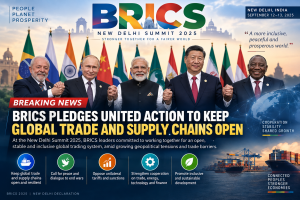
The 18th BRICS Summit is being held in New Delhi on September 12–13, 2026, with an expanded grouping that includes Brazil, Russia, India, China, South Africa, Egypt, Ethiopia, Iran, the United Arab Emirates and Indonesia. The bloc now represents more than 40 percent of the world’s population and roughly a quarter of global GDP.
Nepal is neither a BRICS member nor one of its formal partner countries.
Some Nepali commentators have therefore interpreted Nepal’s absence as evidence of diplomatic decline. The reality is more complicated. An analysis published during the summit noted that India did not generally invite South Asian heads of government in the manner some in Kathmandu had expected. In 2016, when then-prime minister Prachanda attended the Goa BRICS summit, he participated in a specially organized BRICS-BIMSTEC outreach meeting. India did not reproduce that same broad regional format for Nepal this year.
So saying “BRICS met next door and nobody even asked Nepal” may be politically satisfying, but it is analytically incomplete.
A better question is why Nepal has not yet developed an economic and diplomatic strategy that makes its participation in such forums more consequential.
Should Nepal seek BRICS partnership?
Would membership eventually serve Nepal’s economic interests?
How should Nepal engage with the New Development Bank?
How can it benefit from India-China economic competition without becoming trapped inside India-China strategic rivalry?
Those are more productive questions than measuring foreign policy entirely through invitations and photographs.
The broader point remains: international influence is ultimately connected to domestic strength. A country with stable institutions, credible economic policy, high-value exports, infrastructure, energy capacity and predictable government carries more diplomatic weight than a country whose prime ministers and alliances change constantly.
Nepal must therefore stop imagining foreign policy as a substitute for domestic reform.
Neither India nor China nor the United States can fix Nepal’s courts, municipalities, procurement system, public universities or political parties.
They can invest.
They can pressure.
They can support.
They can obstruct.
But Nepalis themselves determine whether the state is strong enough to manage those relationships.
The catastrophic floods of August 2026 have further exposed the importance of state capacity. More than a thousand people have been killed and thousands remain missing across Nepal and Tibet following the extraordinary Himalayan disaster, while roads, bridges, hydropower infrastructure and entire communities have suffered enormous destruction.
No government could prevent every consequence of a disaster of such magnitude. But reconstruction, transparency in aid, search and rescue, public communication, disaster preparedness, infrastructure standards and accountability will all become tests of whether the new state works better than the old one.
The political question now facing Nepal is therefore bigger than whether Balen is popular.
What happens if the Balen government eventually falls?
What happens if the RSP divides?
Do citizens return to the Nepali Congress, UML and Maoist parties?
Do monarchists grow stronger?
Does another new party emerge?
Does a new street movement overthrow another government?
Does Nepal again rewrite its Constitution?
This sense that “there is no alternative left” is understandable, but it is also based on a mistaken assumption.
Nepal’s alternative was never supposed to be a single person.
A democratic state should not collapse because one leader disappoints citizens.
If the RSP fractures, the Constitution still exists.
If a prime minister loses his majority, parliamentary procedures exist.
If voters reject the current ruling party, another election exists.
The purpose of a constitutional system is precisely to ensure that the country survives its leaders.
The old parties are also not permanently dead.
The Nepali Congress, UML and Maoist movement still possess organizational networks, histories, experienced cadres and millions of citizens who have supported them at different times. Democracy does not require their disappearance.
It requires their reform.
The Nepali Congress cannot live indefinitely on the moral capital of B.P. Koirala and the democratic struggles of previous generations. It must demonstrate internal democracy, leadership renewal, financial transparency, principled candidate selection and credible economic ideas.
The UML cannot rely forever on Madan Bhandari, Man Mohan Adhikari, nationalist rhetoric or organizational discipline while avoiding questions about excessive centralization of leadership and tolerance of internal dissent.
The Maoists cannot simply repeat that they brought republicanism, federalism and inclusion. Their historic role is undeniable, but they also need to answer why the movement that promised radical transformation became so deeply integrated into the same patronage-based politics it once denounced—and why conflict victims are still waiting for justice.
The RSP must move beyond saying, “We are new.”
It must prove, “We are institutionally different.”
That means internal democracy, transparent financing, clear separation between party and state, accountability for ministers, tolerance of dissent and rules that do not change according to who controls the leadership.
Balen Shah faces a particularly difficult personal transition.
He built his political brand as an outsider who could act quickly.
But the strongest democratic leader is not the one who personally makes every good decision.
It is the one who builds institutions capable of making good decisions after he is gone.
Royalists face a similar obligation. If restoration of the monarchy is to be presented as a serious political alternative, its advocates should explain the constitutional architecture they are proposing instead of relying only on nostalgia.
Would the king reign but not govern?
Could an elected Parliament remove a government without royal approval?
Would federalism survive?
Would Nepal remain secular?
How would royal powers be limited?
Who would be accountable if palace and Parliament came into conflict?
Political alternatives must be judged by their institutions, not merely their symbols.
Journalists, intellectuals and civil society must undergo the same self-examination.
Nepal’s political culture is not created exclusively by politicians.
Media outlets sometimes become aligned with parties or business interests. Intellectuals apply different standards to leaders they like and leaders they dislike. Civil-society figures sometimes move between advocacy and political patronage. Citizens themselves often condemn nepotism nationally while seeking personal connections for their own administrative problems.
A culture of patronage survives partly because society continues to reward access.
Nepal therefore needs something much more difficult than another revolution: a change in the incentives under which political and administrative power operates.
A minister should know that interfering in a police investigation carries a political cost.
A bureaucrat should know that refusing an illegal order will not destroy a career.
A businessman should know that contracts cannot be secured simply by financing politicians.
A judge should know that a politically inconvenient decision will not result in retaliation.
A journalist should be able to investigate any government without being branded an enemy of the nation.
A citizen should be able to obtain an ordinary government service without knowing a politician.
That is what functioning democracy looks like in daily life.
Nepal also needs long-term national priorities that survive governments.
Energy policy should not restart every time a coalition changes.
Education reform cannot be rewritten by each new minister.
Infrastructure projects should not become monuments to individual politicians.
Foreign policy should not swing according to whether a leader is considered closer to Delhi, Beijing or Washington.
Tourism, hydropower, information technology, agricultural processing, manufacturing, climate resilience and public infrastructure should become areas of long-term national consensus.
The country must also fundamentally rethink migration.
There is nothing inherently wrong with Nepalis working overseas. Labour mobility can create skills, capital and international networks.
The failure lies in migration becoming the principal economic strategy of the state.
Young people should leave because they choose global opportunities, not because remaining in Nepal means surrendering ambition.
The next stage of Nepal’s development therefore cannot be financed mainly through exporting workers and importing consumer goods.
Remittance must increasingly become capital.
Hydropower must become industry.
Tourism must move beyond low-value volume.
Agriculture must connect to processing and markets.
The digital economy must create globally competitive Nepali companies.
Education must produce capability rather than certificates.
Federalism must be judged not by how many offices exist but by whether citizens receive better services.
And corruption control must shift from periodic political spectacle to routine institutional enforcement.
Nepal’s geographic position can also become an advantage if its leaders stop treating it only as a vulnerability.
India represents a vast market, transit network and cultural-economic space.
China represents capital, technology, tourism and another enormous market.
The United States, Europe, Japan and South Korea represent investment, technology, higher education and development partnerships.
The Gulf states possess capital and employ large numbers of Nepalis.
Nepal does not have to choose one civilization against another.
It has to become capable enough to negotiate with all of them.
The most striking feature of Nepal since 1990 may ultimately be this: Nepali society has modernized faster than Nepali political institutions.
Citizens today possess smartphones and instantaneous access to information.
They compare Kathmandu with Seoul, Doha, Sydney, New York and Dubai.
Millions have lived abroad and experienced different administrative systems.
Young Nepalis scrutinize politicians’ homes, assets, children and lifestyles.
They follow Cabinet decisions in real time.
They organize politically through networks that parties cannot fully control.
They no longer automatically respect a leader because he once went to prison, led an underground movement, fought a war or participated in a revolution.
This is one reason the political old guard was swept aside so dramatically in 2026.
But the same generation that destroyed an old political consensus can become impatient with the new one.
That is why the next few years matter so much.
If the Balen government succeeds, success should not be measured only by how many corrupt figures are arrested, how many officials are dismissed, how many government offices are digitized or how popular the prime minister remains online.
Its greatest achievement would be leaving behind institutions stronger than Balen Shah himself.
If the government fails, however, Nepal should resist concluding that democracy itself has failed.
Oli’s failure would not prove democracy was impossible.
Prachanda’s failure would not prove republicanism was impossible.
King Gyanendra’s failed direct rule did not prove Nepal itself was impossible.
Balen’s possible failure would not prove that a new generation cannot govern.
People fail.
Parties fail.
Governments fail.
A durable constitutional state survives those failures and allows citizens to try again peacefully.
Since 1990, Nepalis have repeatedly changed the answer while asking essentially the same question.
In 1990, they demanded democracy.
During the Maoist period, millions demanded structural social change.
In 2006, citizens rejected direct royal rule.
In 2008, Nepal embraced republicanism.
In 2015, it adopted federalism and a new Constitution.
In 2017, voters gave the communist alliance a huge mandate for stability.
In 2022, they created space for independent and new political forces.
In 2025, a furious Gen Z movement rebelled against corruption, censorship and political arrogance.
In 2026, voters gave the RSP and Balen Shah extraordinary power.
The personalities changed.
The slogans changed.
The constitutional arrangements changed.
The central aspiration did not.
Nepalis still want justice.
They want dignity.
They want opportunity.
They want government without bribery.
They want leaders who obey the laws they impose on everyone else.
They want their children to be able to imagine a prosperous life in Nepal.
The tragedy of Nepal’s post-1990 politics is not that nothing changed.
A great deal changed.
The deeper tragedy is that so many political transformations failed to transform the everyday relationship between citizen and state.
Nepal has probably had enough political messiahs.
It does not need another leader presented as the last hope of the nation.
It needs institutions strong enough that the nation does not require a saviour.
It needs laws that apply equally to a former prime minister, a current minister, a police officer, a businessman and an ordinary citizen.
It needs political parties that can survive the retirement of their chairmen.
It needs courts independent enough to rule against the government.
It needs anti-corruption institutions independent enough to investigate their own political patrons.
It needs a bureaucracy professional enough to tell ministers “no” when ministers act illegally.
It needs an economy capable of producing opportunity instead of merely exporting frustration.
It needs a foreign policy based neither on anti-India nationalism, fear of China nor dependence on Western approval, but on a precise understanding of Nepal’s national interest.
And it needs citizens and media willing to judge their preferred leaders by exactly the same standards they apply to their opponents.
If Balen Shah succeeds, Nepal should celebrate.
If he fails, Nepal must continue.
If the RSP remains united, it has an extraordinary opportunity.
If it divides, the country must not divide with it.
If the old parties return, they should return transformed—not simply waiting for public disappointment to restore the privileges they lost.
And if the monarchy again becomes a serious national question, the discussion should be decided through democratic legitimacy, constitutional reasoning and evidence, not romantic memories of the past or anger at the present.
Nepal’s defining choice is therefore not ultimately Oli or Balen, Deuba or Rabi, Prachanda or the King.
It is a choice between personality and institution.
Between patronage and merit.
Between impunity and justice.
Between political theatre and measurable results.
Between an economy sustained by migration and an economy that produces opportunity at home.
Between a state captured by competing elites and a republic genuinely belonging to its citizens.
Since 1990, Nepal has experienced enough governments to know that changing the prime minister is not the same thing as changing the country.
It has experienced enough political movements to know that a successful revolution does not guarantee successful administration.
It has written enough promises to know that constitutional language is meaningless without implementation.
It has produced enough political heroes to know that no individual remains a hero forever.
It has lost enough lives to political conflict to know that violence is an unbearably expensive way to change governments.
And it has watched enough young people depart through Tribhuvan International Airport to understand that nationalism without economic opportunity eventually becomes an empty speech.
Nepal does not need another miracle.
It needs a state that works.
It does not need another political god.
It needs institutions that do not depend on gods.
It does not need another cycle of hope, worship, disappointment and revolt.
It needs accountability strong enough to break that cycle.
After 1990, Nepal changed its political system.
After 2006, it changed the source of sovereign authority.
After 2008, it changed the institution at the top of the state.
After 2015, it changed the constitutional architecture.
After 2025, a new generation changed the political establishment.
After the 2026 election, voters changed the ruling class.
Now comes the most difficult transformation of all:
changing the culture of power itself.
Until that happens, Nepal may continue changing rulers without truly changing governance.
If that transformation does happen, however, Nepal may finally discover that the alternative it has spent decades searching for was never another king, another revolution, another party or another charismatic leader.
The real alternative was always a lawful, accountable, productive and institutionally strong state.
-
Writer is the President of Federation of international Journalist, America ( FIJA) Washinton DC and also Editor in Chief of America and World.