

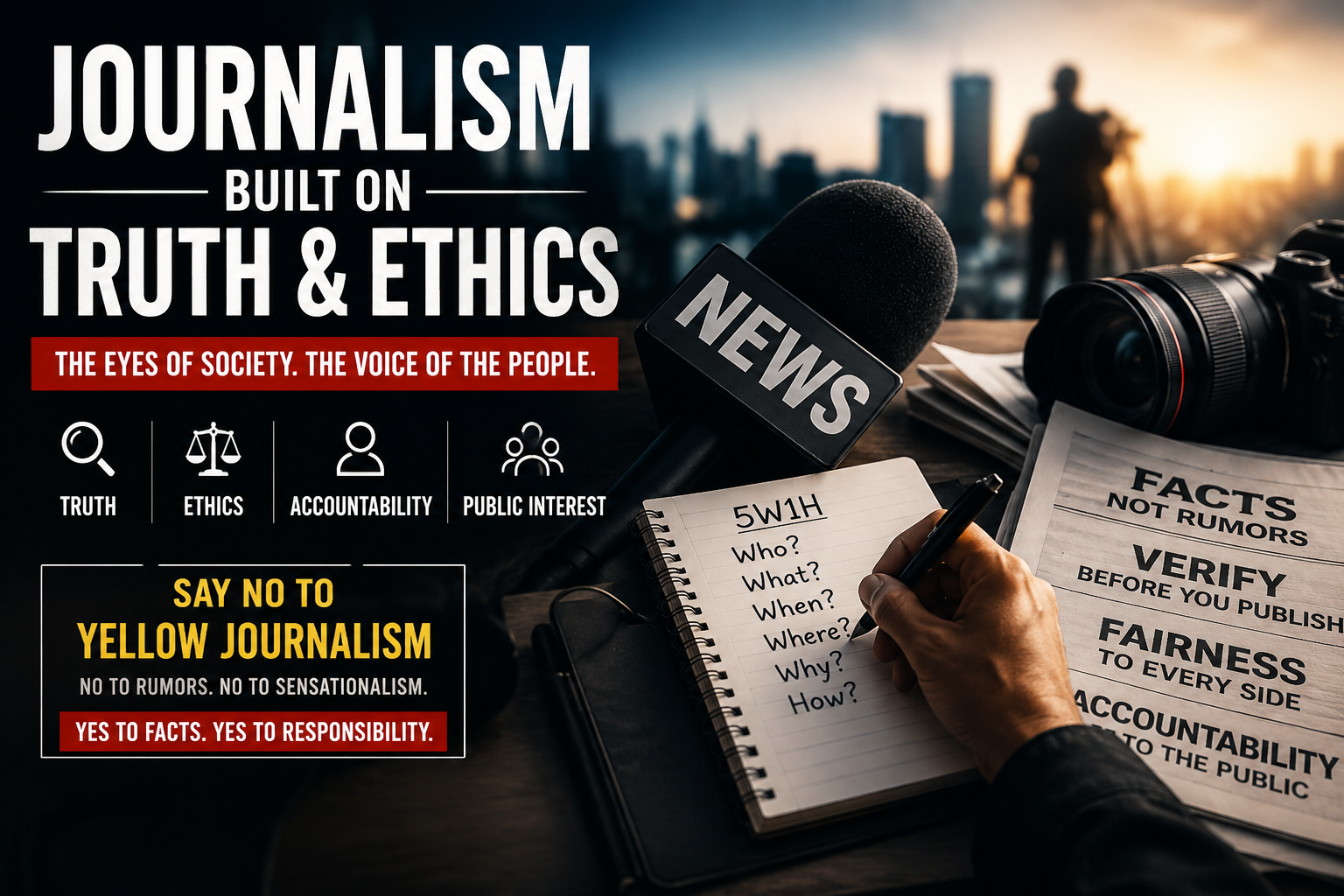
Journalism is more than a profession. It is a public trust.
A responsible journalist becomes the eyes and ears of society, observing what citizens cannot always see for themselves, asking questions that powerful institutions may prefer not to answer, and bringing verified information into the public square. When journalism works properly, it informs citizens, holds power accountable, gives voice to communities, exposes wrongdoing and helps society understand itself.
But that enormous influence carries an equally enormous responsibility. A journalist has the power to protect a reputation or destroy it, to clarify public understanding or confuse it, to calm unnecessary fear or inflame it. That is why journalism without honesty, ethics and discipline can become more dangerous than useful.
Today, when information moves around the world within seconds, the need for ethical journalism is greater—not smaller.
Truth Must Come Before Speed
The first obligation of journalism must always be to the truth.
Being first is desirable. Being right is essential.
The Society of Professional Journalists’ Code of Ethics organizes ethical journalism around four fundamental principles: seeking truth and reporting it, minimizing harm, acting independently, and being accountable and transparent. It emphasizes accuracy, fairness, verification and correcting mistakes when they occur.
Reuters follows similarly demanding standards, including treating accuracy as fundamental, seeking fair comment, correcting errors transparently, striving for balance and freedom from bias, disclosing conflicts of interest and avoiding unattributed opinion in news reporting.
These are not merely rules for large international organizations. They represent principles that every serious journalist and news organization should consider fundamental.
A journalist should therefore never publish an allegation simply because somebody said it. A social-media post is not automatically evidence. A viral video may be edited, old, mislabeled or removed from its original context. A politically convenient claim does not become a fact because thousands of people repeat it.
Verification must come before publication.
The Discipline of 5W1H
At the foundation of good reporting remains one of journalism’s simplest and most useful disciplines:
Who? What? When? Where? Why? How?
These six questions—commonly known as 5W1H—force reporters to move beyond rumor, assumption and incomplete narratives.
Who was involved?
What actually happened?
When did it happen?
Where did it happen?
Why did it happen—or what explanation is supported by available evidence?
How did it happen?
Not every story will immediately provide complete answers to all six questions. Breaking news develops. Some facts remain unknown. Authorities may investigate for days, months or years.
Ethical journalism does not fill those gaps with imagination.
If something is unknown, say it is unknown. If information has not been independently confirmed, say so. If two credible parties dispute a fact, report the disagreement fairly and continue seeking evidence.
There is no shame in saying, “This has not yet been independently verified.”
There is great danger in presenting uncertainty as certainty.
Journalism Is Not a Weapon for Personal Revenge
Journalists must maintain professional boundaries, values, discipline and independence.
Newsrooms should never become instruments of personal revenge, political retaliation, business competition or character assassination. Journalism should not be used to threaten opponents, protect friends, promote hidden financial interests or deliberately damage people with selective information.
Independence is central to public trust. The Associated Press says its standards and practices are designed to protect reporting from bias and inaccuracies, while its conflict-of-interest principles seek to preserve the ability to report fairly and accurately without improper influence.
Journalists, like every human being, have opinions. But professional journalism requires the discipline to prevent those opinions from determining which facts are included, which are ignored, whom we defend and whom we attack.
News is not activism disguised as reporting.
Commentary has an important place in journalism, but news and opinion should be clearly distinguished.
The Danger of Yellow Journalism
One of the greatest threats to journalism today comes from practices that may attract attention but destroy credibility: sensational headlines, exaggerated claims, unverified allegations, manipulated images, misleading thumbnails, selective quotations, anonymous accusations without adequate verification and stories designed primarily to generate outrage or clicks.
This is the modern face of what has long been described as yellow journalism.
A headline may bring a reader to a website once. Trust brings that reader back.
No number of clicks can compensate for the long-term damage caused when a publication becomes known for exaggeration or misinformation.
The digital age has intensified this problem. UNESCO’s journalism and disinformation resources emphasize the importance of verification, fact-checking, media literacy and professional journalism in confronting misinformation and disinformation, which can undermine public trust and democratic values.
Responsible media must resist the temptation to become part of that information disorder.
Hear Every Side but Follow the Evidence
Fairness does not mean pretending that every claim is equally true.
When serious accusations are made against a person, institution, government, company or organization, journalists should make a genuine effort to obtain their response. Reuters, for example, explicitly includes seeking fair comment among its journalistic standards.
But balance should never become an excuse for false equivalence.
If overwhelming verified evidence establishes one reality while another side offers an unsupported allegation, journalism should accurately describe that difference.
Our responsibility is not to manufacture equality between truth and falsehood.
Our responsibility is to follow the evidence wherever it leads.
Journalism Must Represent the Whole Society
Media should not exist only for presidents, prime ministers, billionaires, celebrities or political parties.
Society is larger than the powerful.
A responsible newsroom should pay attention to workers, farmers, entrepreneurs, teachers, students, immigrants, minorities, women, children, senior citizens, people with disabilities, professionals, ordinary families and communities whose stories rarely dominate headlines.
Journalism must look upward toward power, but it must also look outward across society.
The suffering of an unknown citizen may deserve as much journalistic attention as the statement of a famous politician.
A free press should become a bridge between citizens and institutions—not an exclusive club for the influential.
Freedom of the Press Requires Responsibility
Press freedom is indispensable. Journalists must be able to investigate governments, political leaders, corporations, institutions and powerful individuals without intimidation or censorship.
But freedom does not mean freedom from responsibility.
Journalists must respect applicable law, human dignity, privacy, fairness and professional ethics. The SPJ Code specifically connects ethical reporting with minimizing unnecessary harm and being accountable and transparent about journalistic decisions.
When journalists make mistakes—and every newsroom eventually will—the correct response is not to hide them.
Correct them.
Explain significant errors transparently.
Learn from them.
Accountability does not weaken journalism. It strengthens credibility.
Technology Changes; Journalism’s Principles Should Not
Artificial intelligence, smartphones, social networks, livestreaming and digital publishing have transformed how news is gathered and distributed.
But technology cannot replace journalistic judgment.
A machine can help transcribe an interview. It can search documents or assist with translation and data analysis. But responsibility for accuracy, context, fairness and publication remains with journalists and editors.
The platform may change.
The deadline may become faster.
The newsroom may become digital.
But the essential principles remain remarkably constant: accuracy, verification, independence, fairness, transparency and accountability.
Journalism Must Earn Trust Every Day
Trust cannot be demanded simply because someone carries a press card or owns a news website.
Trust must be earned—story by story, headline by headline, correction by correction.
Before publishing, every journalist should ask:
Is it true?
Have I verified it?
Is the source credible?
Have I provided necessary context?
Have I sought the other side where appropriate?
Am I separating fact from opinion?
Could this headline mislead readers?
Am I publishing this because it serves the public—or merely because it attracts attention?
Can I defend this report ethically and professionally after publication?
If we cannot answer those questions confidently, we should continue reporting before pressing “Publish.”
Journalism at its best is not the loudest voice in society. It is the most dependable one.
In an age overflowing with information, people do not merely need more content. They need credible information.
They need journalists who understand journalism’s ethics, values, principles, discipline and limits. They need media organizations courageous enough to investigate the powerful but humble enough to correct themselves. They need reporters who reject prejudice, propaganda, misinformation and sensationalism.
Journalism must never become a marketplace where truth is sacrificed for clicks, money, political loyalty or personal interest.
Facts before rumors.
Evidence before accusation.
Verification before publication.
Fairness before prejudice.
Public interest before personal interest.
Truth before traffic.
That is the journalism society deserves.
And that is the journalism every responsible media organization should strive to practice.