Iran Rejects Trump’s New ‘Economic Warfare’ as U.S. Threatens Nations Keeping Tehran Afloat
China rejects sanctions and urges diplomacy; UAE freezes trade and financial dealings with Iran after missile allegations; Hormuz shipping remains severely restricted as Brent crude climbs above $94


WASHINGTON/TEHRAN / August 20, 2026 / Iran has dismissed U.S. President Donald Trump’s newly announced campaign of “economic warfare and isolation” as another failed attempt to force Tehran into submission, setting the stage for a potentially far-reaching confrontation over Iranian oil exports, international banking and the countries that continue doing business with the Islamic Republic.
Trump announced the escalation Wednesday on social media, describing it as an unprecedented economic operation against Iran and warning that countries providing Tehran with financial, commercial or logistical support could themselves face major U.S. economic consequences.
“ANY country” allowing its financial institutions, businesses, airports or government entities to provide Iran with an economic lifeline could be targeted, Trump said. However, the White House and Treasury Department had not, as of Thursday morning, released a detailed package explaining exactly what new sanctions, tariffs or financial restrictions would be imposed.
The announcement marks a new phase in Washington’s effort to pressure Tehran as the U.S.-Iran war approaches the six-month mark. The conflict began on February 28 with U.S. and Israeli strikes on Iran and has since disrupted energy markets, shipping routes and security across the Gulf. Two ceasefire arrangements announced in April and June failed to produce a lasting settlement.
Tehran: Pressure Will Bring ‘More Failures’
Iranian Foreign Minister Abbas Araghchi quickly rejected Trump’s threat, calling Washington’s approach a continuation of policies that have failed to force Iran to surrender despite decades of U.S. sanctions.
Araghchi argued that Trump’s announcement was intended partly to divert American attention from domestic economic challenges, including record federal debt and rising borrowing costs. He said continued economic pressure would deepen resentment toward the United States among Iranians rather than compel Tehran to accept Washington’s terms.
Araghchi also accused Washington of using what he called “economic terrorism,” warning that aggressive sanctions against third countries could affect the global economy and the sovereignty of governments that choose to maintain relations with Iran.
Iranian officials have continued to say they are willing to negotiate but will not equate negotiations with surrender. Tehran also insists its nuclear program is intended for peaceful purposes, while Trump has maintained that Iran must never be allowed to obtain a nuclear weapon.
Washington Already Has a Large Sanctions System in Place
Trump’s latest announcement does not begin from scratch. The United States has already built one of the world’s most extensive sanctions systems against Iran.
The Treasury Department has been conducting a campaign known as “Economic Fury,” targeting Iran’s oil exports, shadow fleet, financial networks, currency exchanges and businesses accused of helping Tehran bypass existing restrictions.
In April, the Treasury sanctioned Chinese independent refinery Hengli Petrochemical (Dalian) Refinery Co. along with roughly 40 shipping companies and vessels tied to Iran’s petroleum trade. Treasury said that since February 2025, the Office of Foreign Assets Control had sanctioned more than 1,000 Iran-related individuals, vessels and aircraft under the broader maximum-pressure campaign.
Treasury has also targeted Iranian foreign-exchange houses and overseas front companies accused of moving billions of dollars in foreign currency and converting proceeds from oil sales into funds usable by Iranian institutions.
That means the most important question is not simply whether Washington announces additional sanctions, but whether it is prepared to impose tougher secondary measures on foreign banks, refiners, shipping companies and governments that continue facilitating Iranian commerce.
Potential options identified by sanctions specialists include additional action against Chinese independent refiners, foreign banks processing Iranian transactions, shipping companies, aviation networks and currency exchanges. More sweeping action against major Chinese financial institutions, however, could provoke retaliation from Beijing and expand the confrontation far beyond Iran.
China Becomes the Critical Test
China is likely to be the most important test of Trump’s new strategy.
According to 2025 shipping data from Kpler, China purchased more than 80 percent of Iran’s shipped oil, making Beijing by far Tehran’s most important petroleum customer. Much of that crude has been processed by independent Chinese refineries that have continued purchasing discounted Iranian supplies despite American sanctions.
Beijing on Thursday publicly rejected the logic behind Trump’s campaign.
Chinese Foreign Ministry spokesperson Lin Jian said that “sanctions and pressure tactics are not the solution” and called on the parties to pursue a political and diplomatic approach.
China has long opposed unilateral U.S. sanctions that do not have United Nations authorization and has objected particularly to secondary sanctions designed to punish foreign entities for transactions Washington prohibits.
If the Trump administration aggressively targets larger Chinese banks, refiners or other major companies, the Iran dispute could therefore develop into another major source of U.S.-China economic tension. Beijing has economic leverage of its own, including its dominant position in several critical-mineral supply chains important to American manufacturing and technology industries.
UAE Cuts Economic Ties — but Move Came Before Trump’s Announcement
Meanwhile, the United Arab Emirates has suspended commercial activities, trade exchanges and financial transactions with Iran until further notice, adding another serious economic challenge for Tehran.
The timing is significant: the UAE announced the suspension before Trump’s Wednesday economic-warfare declaration, meaning the Emirati move should not be described as a direct response to the new U.S. campaign.
Abu Dhabi said the decision followed a renewed regional escalation after its Defense Ministry detected two ballistic missiles allegedly launched from Iran. Emirati authorities said the missiles fell into Gulf waters. Iran denied responsibility and described the allegation as baseless.
The UAE has historically been particularly important to Iran because of its role as a regional financial, commercial and re-export hub. Restricting access to Emirati trade and finance could therefore prove economically significant even before Washington announces its next sanctions package.
The move also illustrates how the continuing military confrontation is increasingly reshaping economic relationships across the Gulf.
Strait of Hormuz Remains Far From Normal
At the center of the global economic consequences remains the Strait of Hormuz, the narrow waterway connecting the Persian Gulf with the Gulf of Oman and international shipping lanes.
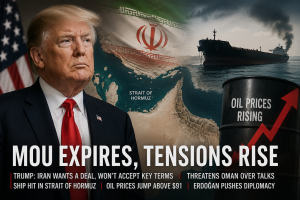
Trump has insisted that the strait is open. Iran says it remains effectively closed to normal shipping under the conditions it has demanded.
Actual vessel traffic indicates that neither description fully captures the situation.
Kpler ship-tracking data showed only nine commodity vessels passed through Hormuz on Wednesday, the same number as Tuesday. The tracking company cautioned that some ships may travel with their transponders switched off, meaning they would not appear in standard counts.
Nevertheless, current traffic is dramatically below prewar levels.
Before the conflict began on February 28, shipments equivalent to roughly one-fifth of global oil consumption moved through the Strait of Hormuz, making it one of the most important energy chokepoints in the world.
Any prolonged disruption affects far more than crude oil prices. It can raise tanker rates, maritime insurance costs, gasoline and diesel prices and the cost of transporting goods across international supply chains.
Egypt, Qatar and Oman Continue to Push Diplomacy
While Washington and Tehran exchange increasingly sharp threats, several Middle Eastern governments continue to argue that a sustainable solution to Hormuz can only come through negotiations.
Egypt has repeatedly called for de-escalation, diplomatic engagement and protection of freedom of navigation through both the Strait of Hormuz and the Red Sea. Egyptian Foreign Minister Badr Abdelatty has been involved in discussions with Iranian, Omani and other regional officials aimed at preventing further escalation.
Qatar has similarly urged the United States and Iran to return to dialogue and implement agreements guaranteeing freedom of navigation. Prime Minister and Foreign Minister Sheikh Mohammed bin Abdulrahman Al Thani has emphasized that regional security depends on diplomacy and a broader agreement capable of producing lasting peace.
Oman, which has traditionally acted as a diplomatic intermediary between Iran and Western governments, has been discussing a new framework with Tehran for managing shipping through Hormuz.
Iran has said negotiations with Oman over new shipping lanes are in their final stages. Omani Foreign Minister Badr Albusaidi said Thursday that lasting security in the Strait of Hormuz requires lasting regional peace and rejected further military escalation as a sustainable solution.
Contradictory Signals Over U.S.-Iran Talks
It remains unclear whether meaningful negotiations between Washington and Tehran are currently taking place.
Trump said Tuesday that no talks were underway. Yet a day earlier, his adviser and special envoy Jared Kushner suggested that communications remained active and described them as unusually robust.
The contradictory statements highlight the uncertainty surrounding diplomatic efforts following the collapse of previous ceasefire arrangements.
Iranian officials have said they remain prepared for diplomacy, but they want relief from sanctions and restrictions and reject Washington’s demand for what they see as capitulation.
Washington, meanwhile, is seeking far-reaching restrictions on Iran’s nuclear capabilities and wants greater control over Tehran’s ability to use military force in the region.
Oil Surges to Three-Week High
Markets are already reacting to the renewed uncertainty.
Brent crude futures for October rose 2.7 percent to $94.06 a barrel Thursday morning, while September U.S. West Texas Intermediate crude climbed to $87.67 a barrel. Both benchmarks reached their highest levels since July 24 and were heading for a fifth consecutive session of gains.
The increase reflects fears that the political stalemate and continuing instability in Hormuz could restrict Middle Eastern supplies for longer than previously expected.
The war has also disrupted supplies of refined fuels and contributed to falling distillate inventories, potentially extending its impact beyond crude markets to diesel, heating oil, transportation and consumer prices.
What Happens Next?
Trump’s new economic threat could become one of the most consequential phases of the conflict if Washington moves beyond sanctions on Iranian institutions and begins systematically penalizing major foreign companies and financial institutions that continue dealing with Tehran.
The critical questions now are whether the United States can significantly reduce Iran’s remaining oil exports, whether China is willing to absorb the economic risk of resisting American pressure, whether the UAE’s suspension of trade further constricts Tehran’s financial access, and whether diplomacy can restore predictable commercial shipping through the Strait of Hormuz.
Iran has endured decades of sanctions and has developed extensive networks for moving oil, money and goods outside conventional Western financial channels. Washington, however, now appears prepared to target not only those networks but also foreign institutions that help keep them operating.
That could increase economic pressure on Tehran—but it also carries risks for U.S.-China relations, Gulf stability, global energy prices and international trade.
For now, neither military pressure nor diplomacy has produced a lasting settlement. And with Hormuz traffic still far below normal and oil prices rising again, the consequences of the U.S.-Iran confrontation are increasingly being felt well beyond the battlefield.