U.S. and Canada Close In on Trade Deal as Trump Pauses 50% Tariffs
Trump says agreement will benefit American farmers and manufacturers; Carney says Canada is seeking the best possible terms for key industries as auto tariffs remain a major sticking point

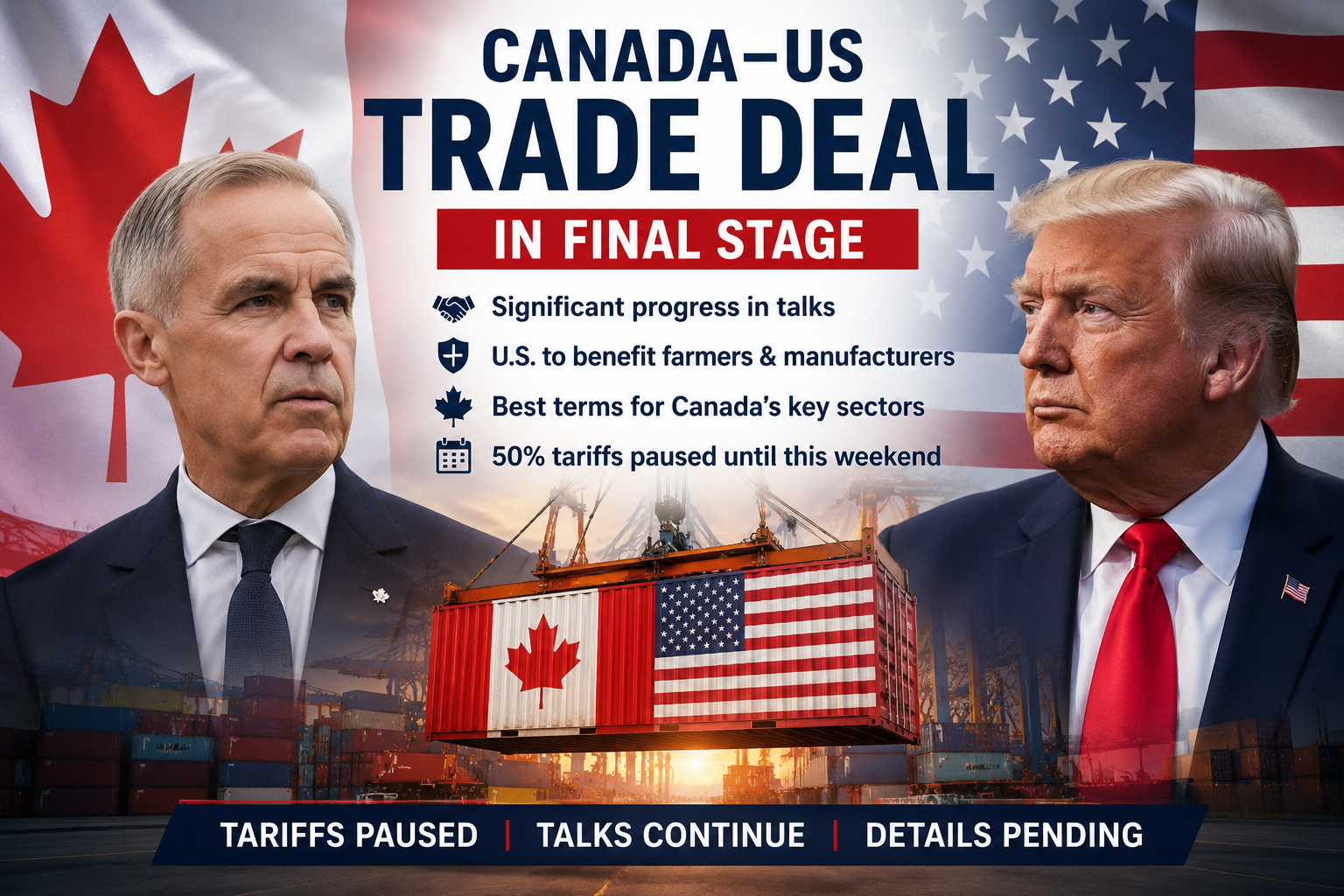
WASHINGTON/OTTAWA / The United States and Canada are moving closer to a major trade agreement after days of intensive negotiations, with President Donald Trump and Canadian Prime Minister Mark Carney both pointing to significant progress while acknowledging that important details still have to be finalized.
The negotiations gained urgency after Trump temporarily suspended a new 50% tariff on roughly $20 billion worth of Canadian imports that had been scheduled to take effect Wednesday. The three-day pause pushes the deadline to 12:01 a.m. Eastern Time on Saturday, August 22, unless the two governments complete an agreement beforehand.
Trump said the two countries have essentially reached a deal, subject to final documentation. Carney has used more cautious language, saying that substantial progress has been achieved but that important work remains.
Canadian Minister responsible for U.S. trade Dominic LeBlanc and chief negotiator Janice Charette met U.S. Trade Representative Jamieson Greer again Wednesday as both governments worked through the remaining disagreements.
Trump said Wednesday that the agreement would provide major benefits to U.S. farmers, saying Canada had agreed to remove some barriers affecting American agricultural exports. The president also indicated that Washington would reduce some existing tariffs affecting Canadian products, although he did not provide a complete list of sectors or tariff rates.
U.S. officials have said the emerging agreement would provide broader access to the Canadian market for American goods and include commitments involving economic security and digital trade. Washington has specifically raised concerns about Canadian policies affecting dairy products, alcoholic beverages and automobiles.
Carney, meanwhile, has portrayed the negotiations as an effort to protect Canada’s most important industries while bringing greater stability to the deeply integrated cross-border economy.
Canada has been seeking relief from U.S. tariffs affecting steel, aluminum, automobiles and softwood lumber, while Washington has pressed Ottawa over agricultural market access, provincial restrictions on American alcohol and Canadian retaliatory measures. The Canadian government had already identified relief from existing sectoral tariffs and the threatened new U.S. tariffs as central negotiating objectives.
Auto tariffs remain one of the toughest issues
One of the most difficult unresolved questions involves automobiles.
The United States currently imposes a 25% tariff on imported Canadian vehicles and parts. Canada is reportedly seeking to reduce that rate to around 10%, while the U.S. side has proposed 15%, according to industry sources familiar with the negotiations.
Another dispute concerns how much of a Canadian-built vehicle should qualify for tariff deductions. Washington has pushed for deductions based mainly on U.S.-made content, while Canada wants components produced anywhere in North America — including Canada and Mexico — to count.
The issue is especially important because automobile manufacturing across the United States, Canada and Mexico relies on highly integrated supply chains, with parts often crossing borders several times before a finished vehicle reaches consumers.
Some auto questions could ultimately be left for the broader negotiations over the future of the United States-Mexico-Canada Agreement (USMCA/CUSMA) rather than resolved in this week’s deal.
Dairy remains politically sensitive
Agriculture — particularly Canada’s dairy system — has also emerged as a sensitive area.
The United States has long sought greater access for American dairy producers, arguing that Canada’s tariff-rate quotas and supply-management policies restrict opportunities for U.S. farmers.
Canada, however, has faced strong domestic political pressure not to dismantle its supply-management system, which regulates production and imports of dairy, poultry and eggs.
Washington says Canada has committed to addressing what the United States regards as discriminatory treatment involving cheese and other products, but Ottawa has not publicly confirmed the full extent of any agricultural concessions contained in the proposed agreement.
That distinction is significant because reducing individual trade barriers would not necessarily amount to eliminating Canada’s broader supply-management system.
Alcohol dispute also on negotiating table
American negotiators have also pushed Canada to reverse restrictions on U.S. wine and spirits imposed by several provinces during the wider trade confrontation.
The Distilled Spirits Council of the United States welcomed the tariff pause and urged both governments to restore American spirits to Canadian retail shelves and return the sector to tariff-free trade.
Enormous economic stakes
Few international trading relationships are as economically significant as that between the United States and Canada.
U.S. government figures show that bilateral trade in goods alone totaled approximately $719.5 billion in 2025, including $336.5 billion in U.S. exports to Canada and $383 billion in Canadian goods shipped to the United States.
The U.S. Trade Representative describes the two economies as deeply connected through energy, automobiles, manufacturing, agriculture and cross-border supply chains. The broader USMCA region supports nearly $2 trillion in annual U.S. trade in goods and services.
That integration means a prolonged tariff battle could affect not only exporters but also manufacturers that depend on components moving repeatedly across the border.
Canadians wary of further concessions
Carney also faces political pressure at home not to surrender too much in order to secure an agreement.
A Leger survey conducted August 15–17 among 1,622 Canadian adults found that 56% wanted the federal government to take a hard line and make no further concessions, while 31% favored greater flexibility if necessary to reach an agreement. Only 26% supported reducing Canada’s supply-management protections.
Business groups, however, have been urging both governments to avoid further escalation, warning that uncertainty and additional tariffs could hurt investment, employment and North American competitiveness.
Canadian Chamber of Commerce CEO Candace Laing said the current uncertainty is undesirable and stressed that resolving the dispute quickly is important.
Broader USMCA questions still ahead
Even if Washington and Ottawa complete the immediate agreement, the larger debate over North American trade is far from finished.
The Trump administration declined in July to renew the USMCA in its current form, triggering annual reviews as Washington seeks changes to trade rules, manufacturing requirements and regional supply chains. The agreement remains in force, but the decision created a longer-term period of uncertainty over its future.
For now, the immediate objective is preventing Saturday’s threatened 50% tariffs from taking effect.
Both Trump and Carney are presenting the negotiations as progress, but the precise balance of concessions — particularly on automobiles, agriculture, alcohol and existing U.S. sectoral tariffs — will determine whether the emerging agreement represents a durable reset in U.S.-Canada trade relations or simply a temporary truce in a much larger trade dispute.