Ukraine’s Political Tensions Deepen as Ousted Defence Minister Fedorov Calls for Wartime Elections

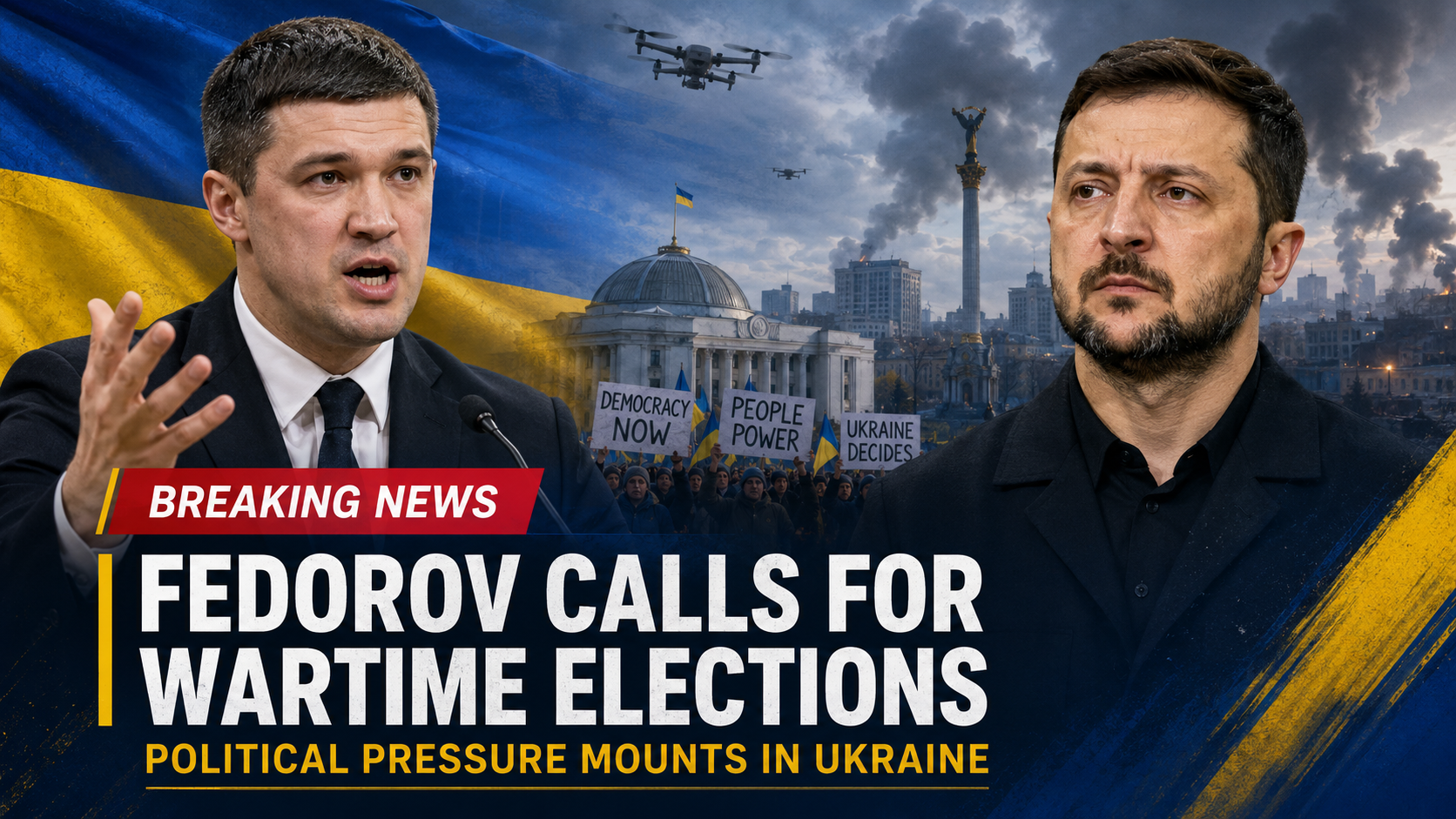
KYIV, Ukraine / Ukraine has been thrust into one of its most serious domestic political disputes since Russia launched its full-scale invasion in February 2022, after former Defence Minister Mykhailo Fedorov publicly called for a mechanism to hold national elections despite the country remaining under martial law.
Fedorov, 35, made the appeal in a video address released Tuesday, arguing that Ukraine’s democratic system should not remain indefinitely suspended because of Russia’s war. He said the country needed to develop a “legal, safe and realistic mechanism” for restoring a full democratic process even if the conflict continues for an extended period. Reuters described the intervention as the first such demand from a major Ukrainian political figure since the full-scale invasion began.
The comments represent a significant political break between Fedorov and President Volodymyr Zelenskyy, whose administration dismissed him as defence minister in July after only about six months in the post.
Fedorov stopped short of announcing a presidential campaign or directly attacking Zelenskyy by name. However, his remarks about political accountability, corruption and appointments based on loyalty rather than performance have intensified speculation about his political ambitions and Ukraine’s post-war leadership.
Elections remain legally blocked under martial law
Ukraine has remained under martial law since Russia’s invasion, and current Ukrainian legislation explicitly prohibits presidential and parliamentary elections while martial law is in force. Ukraine’s parliament has been studying how elections could eventually be organized after or around the end of the war, including how soldiers, refugees, internally displaced citizens and residents of frontline or formerly occupied territories could participate safely.
A Verkhovna Rada working group said as recently as May 5, 2026, that its members had reached a consensus that elections could not be conducted under the existing martial-law framework.
That legal reality makes Fedorov’s proposal highly controversial. Any credible election would also have to address security risks from Russian missile and drone attacks, voting by hundreds of thousands of military personnel, millions of Ukrainians living abroad, displaced voters and citizens living in Russian-occupied territory.
Supporters of postponing elections argue that conducting a nationwide campaign and vote under those conditions could divide the country and create opportunities for Russian interference. Fedorov, however, argues that Ukraine should begin designing a democratic solution rather than allowing Moscow’s aggression to determine indefinitely when Ukrainians can vote.
Fedorov’s dismissal triggered political backlash
Fedorov had been one of Ukraine’s most prominent younger political figures and was closely associated with the modernization of the country’s wartime technology.
Before heading the Defence Ministry, he served as minister of digital transformation and became a leading figure in Ukraine’s technology-driven response to Russia. His initiatives included support for the volunteer IT Army of Ukraine, the Army of Drones program and systems designed to reward military units for successful strikes against Russian targets.
As defence minister, Fedorov pushed for expanded drone production, faster procurement, military digitalization and reforms aimed at breaking down what his supporters viewed as outdated command structures.
His dismissal in July produced demonstrations and exposed tensions within Ukraine’s military and political establishment. Reporting at the time linked his departure partly to disagreements with then Commander-in-Chief Oleksandr Syrskyi over military reform and battlefield strategy. Zelenskyy later removed Syrskyi as well and replaced him with General Mykhailo Drapatyi.
Fedorov was subsequently offered other senior government roles but resisted returning unless he could resume control of the Defence Ministry.
The government has now moved in another direction. On Wednesday, Ukraine’s parliament backed Yevhenii Khmara as defence minister, strengthening Zelenskyy’s effort to stabilize the military leadership following weeks of political turmoil.
Corruption investigation adds pressure on Zelenskyy administration
The election dispute comes at the same time that Ukraine’s independent anti-corruption institutions are pursuing a major investigation involving political figures and officials connected to the presidential administration.
The National Anti-Corruption Bureau of Ukraine and the Specialized Anti-Corruption Prosecutor’s Office are investigating an alleged money-laundering scheme involving roughly $3.4 million in bail funds, according to the Associated Press. Current and former lawmakers and a presidential-office official are among those connected to the investigation.
Zelenskyy’s office announced Wednesday that deputy presidential-office head Iryna Mudra had been dismissed as Ukrainian media reported searches linked to the investigation. Authorities have not publicly established criminal guilt against Mudra, and investigations remain ongoing.
The case is politically sensitive because strengthening anti-corruption institutions, judicial independence and the rule of law remains central to Ukraine’s ambitions for eventual European Union membership.
Fedorov used his video address to argue that corruption has direct consequences on the battlefield because money lost through corruption means fewer weapons, drones and other resources for Ukrainian forces. He described Ukraine as facing a broader crisis of governance and warned against a political culture in which loyalty could outweigh professional competence.
Debate divides even Zelenskyy critics
Fedorov’s proposal has received a mixed response, including from Ukrainians who previously supported his return to the Defence Ministry.
Some opposition politicians argue that Ukraine eventually needs a renewed democratic mandate and that prolonged wartime rule cannot become permanent.
Others — including critics of Zelenskyy — maintain that elections while cities remain under bombardment and soldiers are fighting on the front would be unsafe and potentially destabilizing.
The issue has also become intertwined with Russian claims questioning Zelenskyy’s legitimacy after the expiration of the five-year period that began with his 2019 election. Ukrainian authorities reject Moscow’s narrative, emphasizing that the country’s constitutional and martial-law framework provides continuity of state authority until a lawful election can be held.
For Kyiv, the debate is therefore not simply about Zelenskyy or Fedorov. It raises the larger question of how a democratic state can preserve competitive politics without undermining national security during an existential war.
Political turmoil unfolds as Russian attacks continue
Ukraine’s internal political debate is taking place while Russian attacks continue to kill civilians.
On Wednesday, a Russian drone struck a passenger minibus in the southern frontline city of Kherson, killing four people, according to Ukrainian authorities. Reuters reported that other Russian drone attacks in the region raised Wednesday’s death toll further.
The attack underscored the enormous challenge facing anyone advocating elections while much of Ukraine remains exposed to missiles, drones and active combat.
Recent United Nations monitoring has also documented a sharp increase in Ukrainian civilian casualties. Reuters reported that 437 civilians were killed and 2,610 injured in July 2026, the highest monthly casualty level recorded since May 2022, according to UN figures.
Against that backdrop, Fedorov’s intervention has opened a political debate that Ukraine had largely postponed throughout the war: when — and under what conditions — should Ukrainians return to the ballot box?
For now, Ukrainian law provides a clear answer: elections cannot take place while martial law remains in force. But Fedorov’s challenge suggests that the political question of Ukraine’s democratic future is becoming increasingly difficult to postpone as the war enters another year.