Trump–Xi Washington Summit Ends With Warm Words but Few Public Breakthroughs

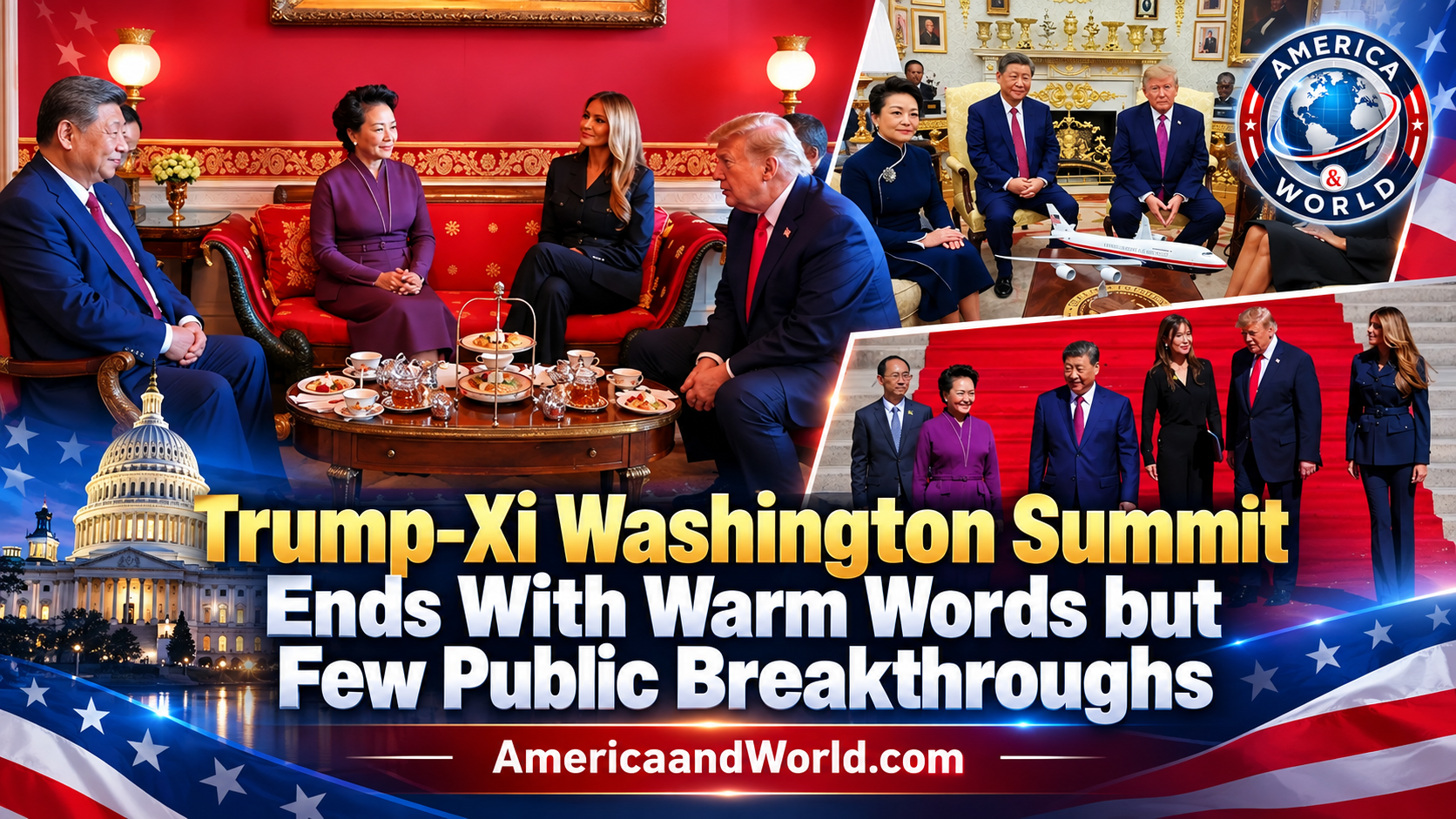
WASHINGTON, Sept. 25, 2026 — Chinese President Xi Jinping concluded his three-day state visit to the United States on Friday, ending a closely watched Washington summit with President Donald Trump that emphasized continued dialogue, economic cooperation and strategic stability while leaving many of the most difficult disputes between the world’s two largest economies unresolved.
Trump and First Lady Melania Trump hosted Xi and his wife, Peng Liyuan, for tea in the White House Red Room on Friday morning before the two presidential couples traveled to the National Archives, where they viewed historical documents connected with U.S.-China relations. The National Archives visit had been scheduled as the ceremonial conclusion to Xi’s Sept. 23–25 state visit.
Speaking before Xi’s departure, Trump described the visit as highly productive and said the two sides had made substantial progress. He offered few specifics, however, beyond suggesting that American farmers would benefit from developments reached during the talks.
“I think our farmers are going to be very happy,” Trump said, while indicating that additional details would emerge later. Reuters characterized the three-day summit as one that showcased high-level personal diplomacy while producing few publicly announced breakthroughs in the broader economic relationship.
Xi, meanwhile, praised the hospitality extended during the visit and said his discussions with Trump had added “new substance” to the relationship. According to China’s Foreign Ministry, Xi said the two governments should pursue a relationship in which cooperation remains central, competition is managed and disagreements do not lead to confrontation.
The visit marked Xi’s first state visit to Washington in more than a decade and followed Trump’s trip to China in May. China’s Foreign Ministry described the reciprocal presidential visits within several months as an unusual moment in the history of U.S.-China relations.
Trade and American Agriculture Remain Central
Trade remained one of the dominant issues throughout the meetings.
The United States and China continue to negotiate over tariffs, agricultural purchases, investment and Beijing’s dominant position in the processing and supply of rare-earth minerals, which are essential to electronics, electric vehicles, advanced manufacturing and defense systems.
The two countries recently extended their existing trade truce until January, giving negotiators additional time to address unresolved commercial disputes.
Agriculture appears to have been one of the areas where Trump expects movement. China is a critical export market for U.S. agricultural commodities, particularly soybeans and other farm products, making Chinese purchasing commitments economically and politically significant for American farming states.
But publicly available statements Friday did not provide detailed figures for new Chinese agricultural purchases or specify the timetable for implementation.
AI Emerges as a Strategic Issue
Artificial intelligence was another major subject of the summit.
Ahead of Thursday’s negotiations, Trump said advanced artificial intelligence — which he has sometimes referred to as “superintelligence” — would be a major topic in his discussions with Xi.
The issue is increasingly tied to the broader technological rivalry between Washington and Beijing. The United States maintains restrictions on China’s access to some advanced semiconductors and chipmaking technology, while U.S. officials continue to raise concerns about intellectual property, technology transfer and national security.
China, meanwhile, has criticized U.S. technology restrictions as attempts to constrain its development.
Despite the competition, both governments have increasingly acknowledged the need for discussions surrounding the development and security implications of advanced AI systems. AP reported before the summit that both governments were seeking a more stable framework for competition even as tensions over AI, trade and strategic technology remained significant.
Taiwan Remains One of the Most Sensitive Disputes
Taiwan remained another major point of disagreement.
Beijing considers Taiwan part of China and strongly opposes American arms sales and official contacts with Taipei. Washington maintains unofficial relations with Taiwan and, under U.S. law, supports Taiwan’s ability to maintain sufficient self-defense capabilities.
Ahead of Xi’s Washington visit, Reuters reported that Beijing was expected to press the Trump administration over U.S. arms sales to Taiwan.
Neither government announced a major change in Taiwan policy following the summit.
Iran and Middle East Tensions Enter the Talks
The expanding conflict involving Iran also formed part of the discussions.
Washington has been pressing Beijing over its economic relationship with Tehran while China has called for diplomatic solutions to the regional conflict.
The issue reflects the broader international dimension of U.S.-China relations: the two countries compete strategically while also facing pressure to communicate on conflicts and crises where their interests overlap or collide.
Recent reporting indicated that Trump raised concerns directly with Xi about China’s support for Iran, while U.S. officials said further details surrounding those discussions would be released separately.
State Dinner Brings Together Political and Technology Leaders
The diplomatic visit also included an elaborate White House state dinner Thursday evening, hosted by President Trump and First Lady Melania Trump.
Senior technology executives were among the invited guests, reflecting the importance of technology and AI in U.S.-China economic relations. Attendees included executives from companies such as Nvidia, Apple, Tesla, Microsoft, Amazon, Google and OpenAI, among others.
China’s Foreign Ministry said Xi used his dinner remarks to emphasize the importance of maintaining dialogue and expanding areas of cooperation.
Symbolism Stronger Than the Publicly Announced Agreements
The summit demonstrated that both governments remain willing to maintain direct presidential-level engagement despite deep disagreements.
But as Xi departed Washington on Friday, major disputes remained over tariffs, advanced semiconductor technology, rare-earth supply chains, intellectual property, Taiwan and geopolitical competition.
No comprehensive trade settlement or major strategic agreement was publicly announced by the end of the visit. Reporting from Washington described the closing events as cordial but noted that substantial unfinished business remains between the two governments.
Xi and Trump are nevertheless expected to remain in frequent contact.
The two leaders are expected to have further opportunities for meetings later this year, including around major international gatherings, extending a diplomatic process aimed at managing competition between Washington and Beijing without allowing disputes to spiral into a broader confrontation.
For now, the Washington summit appears to have reinforced communication and temporarily stabilized the relationship — while postponing many of the hardest decisions for future negotiations.