25 Years After 9/11: America Remembers, Trump Leads Pentagon Tribute as Four Former Presidents Unite at Ground Zero

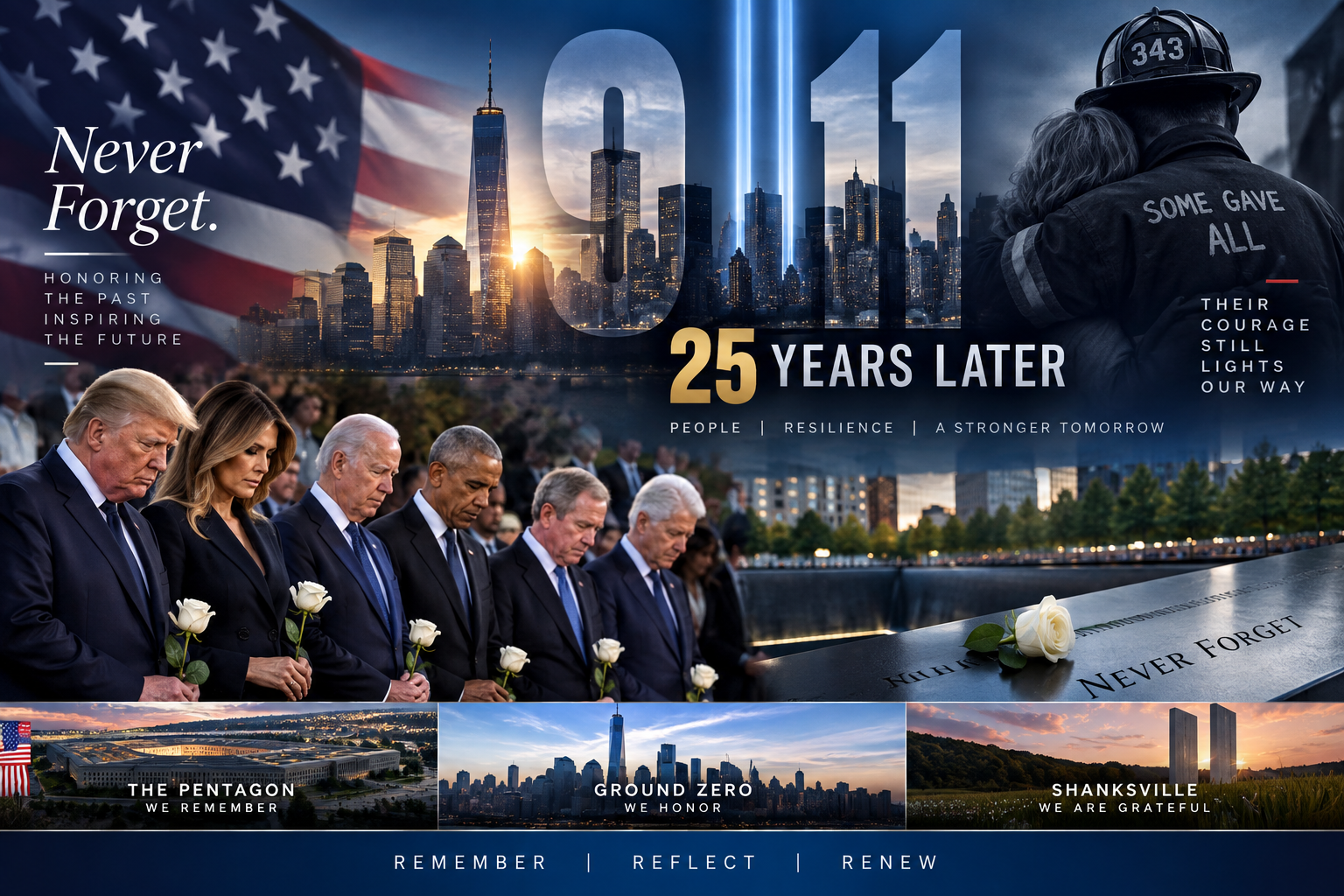
NEW YORK — Twenty-five years after hijacked passenger jets struck the World Trade Center, the Pentagon and a field in Pennsylvania, the United States marked the anniversary of the September 11, 2001 terrorist attacks on Friday with solemn ceremonies, emotional family tributes and renewed debate over the intelligence failures, wars, health consequences and national-security policies that followed one of the darkest days in American history.
President Donald Trump, accompanied by First Lady Melania Trump, attended the remembrance ceremony at the Pentagon in Arlington, Virginia, while Vice President JD Vance joined all four living former U.S. presidents — Bill Clinton, George W. Bush, Barack Obama and Joe Biden — at Ground Zero in Lower Manhattan. Separate ceremonies were held at the Flight 93 National Memorial near Shanksville, Pennsylvania, where passengers and crew fought back against their hijackers before the aircraft crashed.
The coordinated al-Qaeda attacks killed 2,977 people from 90 countries: 2,753 in New York, 184 at the Pentagon and aboard American Airlines Flight 77, and 40 passengers and crew members aboard United Airlines Flight 93. The FBI says all 19 hijackers were trained by al-Qaeda.
At Ground Zero, the focus remained where organizers have traditionally kept it — on victims and their families rather than political speeches.
Relatives spent roughly four hours reading 2,983 names. That number is sometimes confused with the official 9/11 death toll of 2,977 because the annual New York ceremony also honors the six people killed in the February 26, 1993 World Trade Center bombing. The same 2,983 names are engraved around the memorial pools.
The ceremony paused at the moments that permanently entered American history: 8:46 a.m., when American Airlines Flight 11 struck the North Tower; 9:03 a.m., when United Airlines Flight 175 hit the South Tower; 9:37 a.m., when Flight 77 struck the Pentagon; 9:59 a.m., when the South Tower collapsed; 10:03 a.m., when Flight 93 crashed in Pennsylvania; and 10:28 a.m., when the North Tower fell.
But this year there was an important addition.
For the first time, organizers observed a seventh moment of silence, after the reading of the names, to honor first responders, recovery workers, survivors and others who have died from illnesses and injuries associated with exposure to toxic dust and debris after the attacks. The National September 11 Memorial & Museum says the new observance will become a permanent part of future anniversary ceremonies.
The addition underscored a painful reality: the human toll of September 11 did not end in 2001.
New York officials say more than 600 FDNY members have died from 9/11-related health complications since the attacks, in addition to the 343 firefighters killed that morning. More than 469 NYPD members have died from illnesses linked to their service following the attacks, compared with 23 NYPD officers killed on September 11 itself. More than 10,000 FDNY members are currently certified as having a 9/11-related physical health condition.
The federal World Trade Center Health Program now serves nearly 150,000 responders and survivors across the United States, providing monitoring and treatment for illnesses linked to exposure at the World Trade Center, Pentagon and Shanksville sites.
At the Pentagon, Trump and the first lady listened as the names of the 184 victims killed at the Pentagon and aboard Flight 77 were read, with a bell sounding in remembrance.
Trump renewed the central promise that has defined American commemorations since 2001.
“We will never, ever forget,” he said.
Trump told the gathering that the attacks demonstrated both the vulnerability and resilience of the United States, praising service members, first responders and Americans who responded to the national emergency. He also connected the lessons of September 11 to his administration’s present-day national-security policies and the ongoing U.S. confrontation with Iran, arguing that America must prevent hostile regimes and terrorist organizations from threatening the country.
That contemporary reference requires an important historical distinction: Iran was not responsible for the September 11 attacks. The attacks were organized by Osama bin Laden’s al-Qaeda network and carried out by 19 al-Qaeda-trained hijackers. Trump’s remarks invoked Iran in the context of his current foreign and national-security policy, rather than attributing the 2001 attacks to Tehran.
Perhaps one of the most striking moments at the Pentagon came not from a current official, but from Condoleezza Rice, who was President George W. Bush’s national security adviser on September 11, 2001.
Rice made an unusually personal acknowledgment of the failure of the American national-security system to recognize the danger in time.
“We did what we knew to do, but by definition it was not enough,” she said, adding that she continues to carry “deep personal remorse” over the suffering endured by the victims and their families.
Her comments took on added significance because the CIA used the 25th anniversary to undertake one of the most consequential 9/11-related intelligence disclosures in years.
CIA Director John Ratcliffe announced the declassification of 71 President’s Daily Brief products connected to al-Qaeda, Osama bin Laden and the threat environment surrounding September 11. According to the agency, it is the largest single release of declassified CIA President’s Daily Brief material related to the attacks.
The collection includes more than 100 pages of intelligence analysis being made public for the first time and traces how CIA analysts attempted to understand al-Qaeda’s plans amid incomplete and often fragmentary intelligence.
Among the records are reports carrying warnings about possible attacks inside the United States, the prospect of aircraft hijackings and possible American targets. The collection adds new context to the long-running debate over why numerous warning signals before September 11 never produced a sufficiently specific picture of the operation to stop it.
The best-known pre-attack intelligence document remains the August 6, 2001 President’s Daily Brief, “Bin Ladin Determined to Strike in US,” which later became central to investigations into whether the U.S. government could have done more to prevent the attacks.
Yet the 25th anniversary has produced another major disclosure — this time involving the health consequences of Ground Zero.
New York City Mayor Zohran Mamdani’s administration opened a new public portal containing approximately 170,000 pages of city records concerning air quality, health risks and government decisions following the destruction of the World Trade Center.
City Hall said the records include previously difficult-to-obtain materials concerning what officials knew about environmental hazards after the attacks. The administration said additional documents will be reviewed and released during the coming year.
The release is especially significant for firefighters, police officers, construction workers, volunteers, residents, students and employees who spent time around Lower Manhattan after the attacks and were exposed to dust containing a complex mixture of toxic contaminants.
Mayor Mamdani also attended the Ground Zero commemoration, alongside former New York leaders and national political figures.
Meanwhile, President Trump had formally proclaimed September 11, 2026, as Patriot Day, ordering U.S. flags on federal buildings and facilities to be flown at half-staff in memory of the 2,977 people killed.
In his proclamation, Trump said an entire generation of Americans has now grown up without firsthand memory of September 11 and argued that the promise to “Never Forget” must be passed from generation to generation.
The generational question has become increasingly central to the anniversary. The 9/11 Memorial & Museum notes that roughly a third of the country is now too young to remember the attacks personally, increasing the importance of education as eyewitnesses, survivors and first responders grow older. Its educational programs have reached more than 20 million students.
The anniversary also revived unresolved questions surrounding accountability.
At Ground Zero, Terry Strada, whose husband Tom Strada was killed in the North Tower, again pressed U.S. leaders over allegations concerning possible Saudi assistance to some of the hijackers. Families of 9/11 victims have pursued litigation and demanded greater disclosure for years.
Fifteen of the 19 hijackers were Saudi nationals, but Saudi Arabia has consistently denied that its government was involved in the attacks. The allegations concerning assistance by Saudi-linked individuals therefore remain a matter of litigation and investigation rather than an established finding that the Saudi government directed the plot.
At Shanksville, Pennsylvania, Americans again remembered the extraordinary resistance aboard United Airlines Flight 93. After passengers and crew learned through phone calls that other hijacked aircraft had been used as weapons, they fought back. The plane crashed before reaching Washington, killing all 40 passengers and crew members but preventing the hijackers from reaching their intended target.
A quarter-century later, the consequences of that September morning remain embedded in American life.
The attacks led the United States into Afghanistan, launched a global campaign against al-Qaeda and other terrorist networks, transformed airport and border security, reshaped the FBI and intelligence community, and contributed to the creation of an enormous homeland-security structure. They also ushered in two decades of wars, surveillance controversies, political disputes over civil liberties and continuing debate about when American military power should be used overseas.
The FBI itself describes September 11 as an event that fundamentally transformed the bureau, shifting its overriding national-security mission toward preventing terrorist attacks before they could occur.
That legacy explains why the 25th anniversary was more than a memorial to a single morning.
It was a remembrance of 2,977 lives lost, a recognition of thousands more who became sick or died afterward, a reunion of presidents who pursued sharply different policies in response to terrorism, a release of intelligence documents showing the warnings officials struggled to interpret, and another reminder that some of the political, legal and health consequences of September 11 remain unresolved.
Twenty-five years later, “Never Forget” therefore carries a broader meaning.
It means remembering the men and women who went to work or boarded airplanes that morning and never returned. It means remembering firefighters, police officers and ordinary civilians who ran toward danger. But it also means examining what American institutions knew before the attacks, what they learned afterward, how the country responded, which decisions succeeded, which failed, and what price was paid in the decades that followed.
For millions of younger Americans, September 11 is no longer a memory. It is history.
The challenge facing the United States now is ensuring that history is neither forgotten nor simplified.