
Ukraine’s Rare Humanitarian Ceasefire Ends as Russian Strikes Intensify, Leaving Thousands Without Power

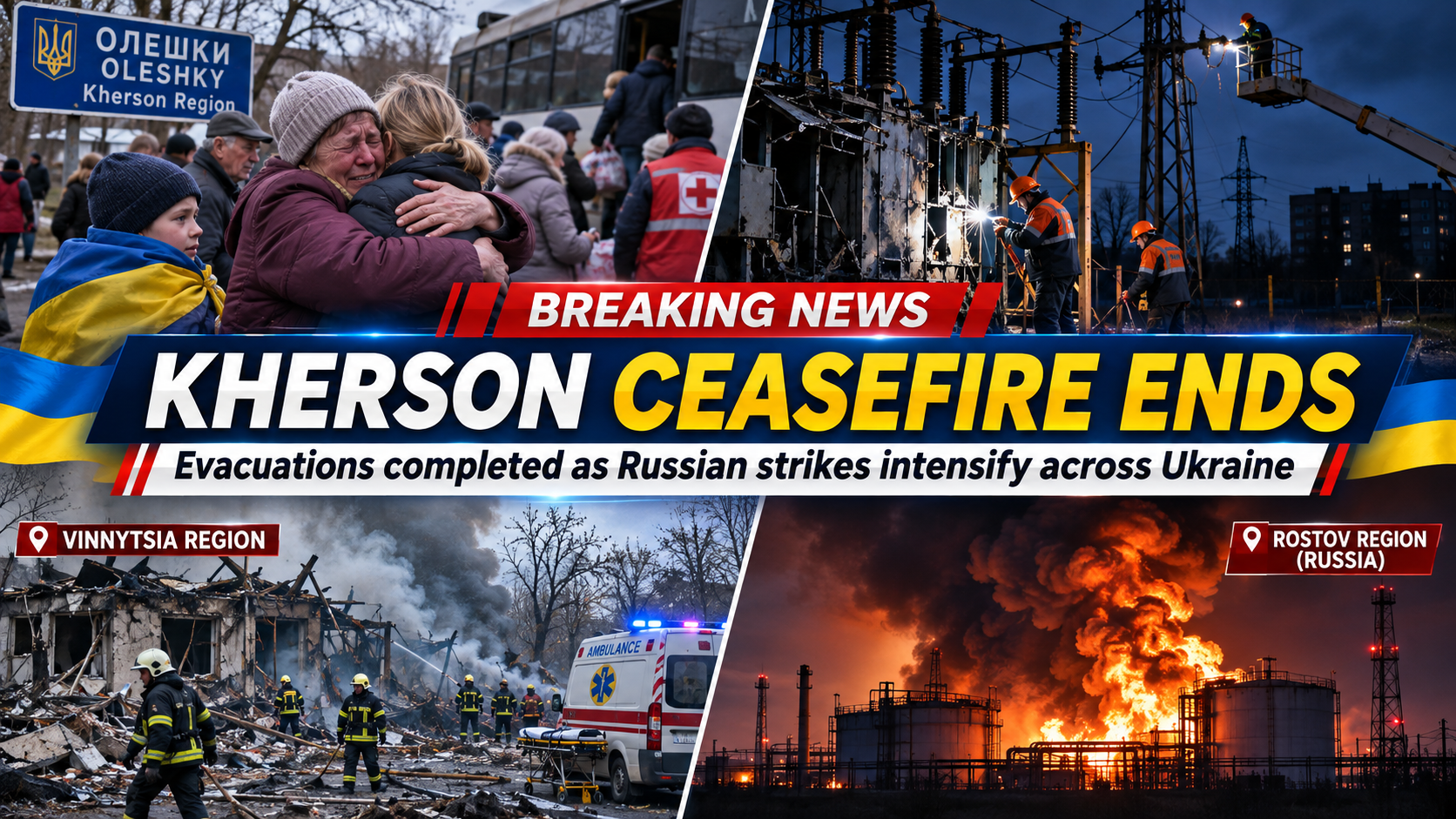
KYIV, Ukraine, November 1, 2026 — A rare humanitarian ceasefire between Russia and Ukraine in the southern Kherson region expired Sunday evening, ending a temporary pause in fighting that allowed hundreds of civilians to escape the Russian-occupied city of Oleshky. The breakthrough offered a brief moment of hope in a war that continues to devastate communities and critical infrastructure.
The ceasefire, which began Tuesday and was facilitated through diplomatic efforts involving U.S. First Lady Melania Trump and Pope Leo XIV, was among the most significant localized humanitarian agreements since Russia launched its full-scale invasion in February 2022.
The agreement initially covered Oleshky before expanding to surrounding areas of Kherson. It enabled humanitarian assistance and the evacuation of residents trapped for years by Russian occupation, mined roads, drone attacks and severe shortages of food, drinking water, electricity and medicine.
Some evacuees endured a lengthy journey through Russian-controlled territory, southern Russia and Belarus before finally reaching Ukrainian-held territory. Emotional reunions followed, bringing together families separated for years. Ukrainian officials reported that evacuees ranged in age from a one-year-old child to a 94-year-old resident.
Despite the humanitarian breakthrough, fighting continued elsewhere across Ukraine.
Russian missile and drone attacks targeted energy facilities in several Ukrainian regions over the weekend, leaving hundreds of thousands of households without electricity. Emergency repair teams restored some services Sunday, but more than 60,000 customers in the Dnipropetrovsk region remained without power by early evening.
The capital, Kyiv, also experienced widespread electricity interruptions and disruptions to water supplies as Russian forces continued targeting critical infrastructure ahead of winter.
In the central Vinnytsia region, a Russian drone strike near a vocational school dormitory killed civilians, including a 13-year-old girl, and injured several others, among them children, according to Ukrainian emergency officials.
Meanwhile, Ukraine intensified its own long-range operations inside Russia. President Volodymyr Zelensky confirmed that Ukrainian forces struck the Kamensky chemical plant in Russia’s Rostov region, a major producer of solid rocket propellant used in Russian missile systems. Ukrainian military officials reported fires and damage to four production facilities, although the full extent of the destruction could not be independently verified.
Zelensky warned that Russian attacks had reached exceptionally high levels and accused Moscow of exploiting Ukraine’s shortage of ballistic missile interceptors. He renewed urgent appeals to the United States and European allies for additional Patriot air-defense missiles.
The expiration of the Kherson ceasefire raises fresh concerns for civilians who remain in Russian-occupied Oleshky, where an estimated 1,700 to 2,000 residents were believed to be living before the evacuation operation.
While the limited agreement demonstrated that humanitarian cooperation remains possible even between bitter adversaries, it has not produced a broader cessation of hostilities.
With winter approaching, Ukraine faces an increasingly dangerous combination of relentless aerial attacks, mounting damage to its energy network and an urgent need for stronger air defenses. The brief Kherson ceasefire has provided a humanitarian opening, but the prospects for a lasting peace remain deeply uncertain.