Google Makes History: AI Runs in Space and Sends Its First Poem Back to Earth
Project Suncatcher achieves a major breakthrough, opening the door to solar-powered AI data centers in orbit

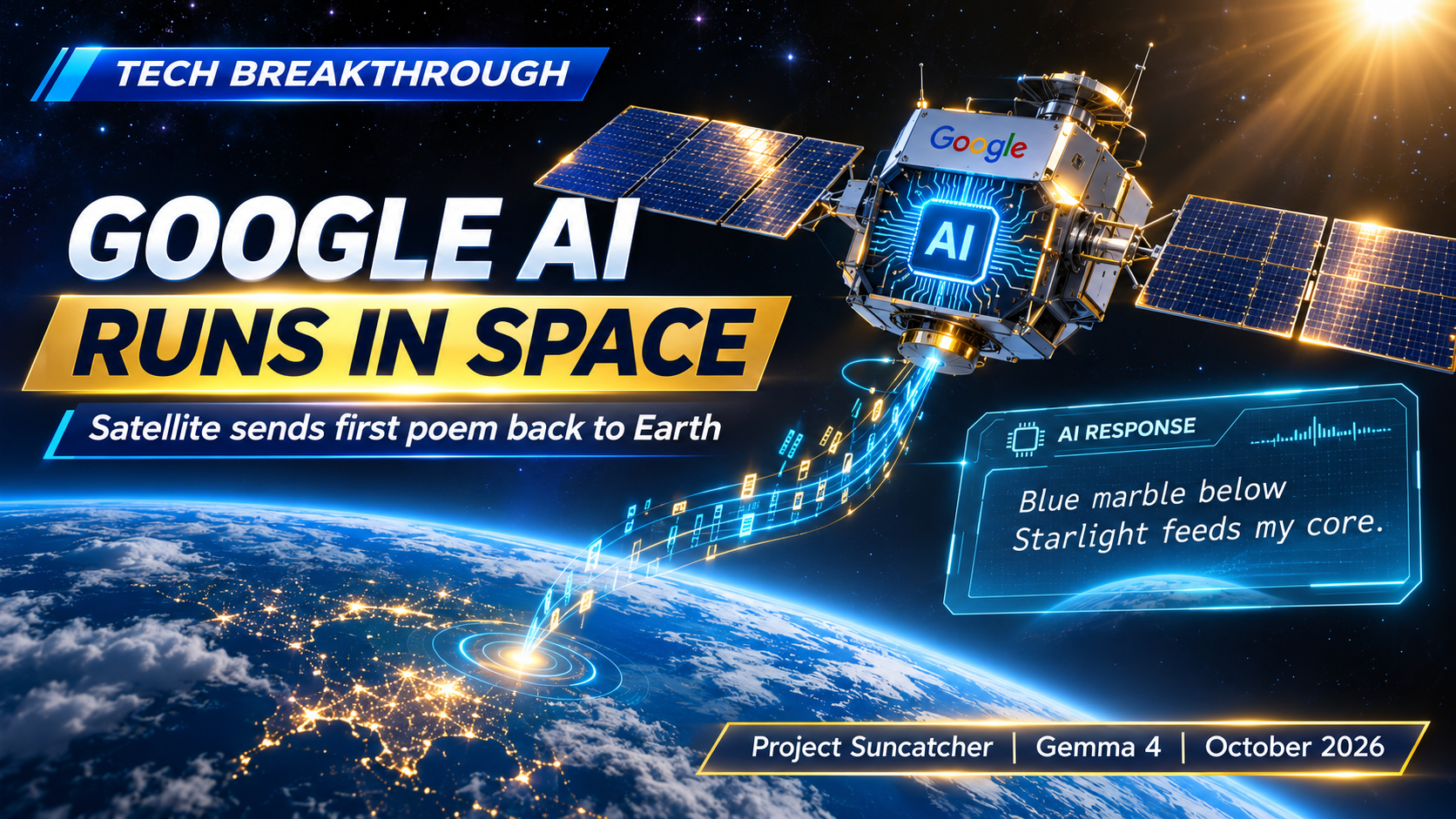
WASHINGTON, D.C., November 1, 2026 — Google has achieved a significant technological milestone by successfully operating an artificial intelligence model aboard a satellite in Earth’s orbit and transmitting its first AI-generated response back to the ground.
The achievement marks an important step toward a future in which powerful AI computing systems could operate beyond Earth, potentially transforming the global infrastructure supporting artificial intelligence.
Google announced the breakthrough on October 30 as part of Project Suncatcher, an ambitious research initiative exploring the feasibility of establishing solar-powered AI computing facilities in space.
The experimental satellite, developed in partnership with Planet Labs, was launched on October 1 aboard a SpaceX Falcon 9 rocket. It carries four advanced Tensor Processing Units (TPUs), Google’s specialized processors designed to handle demanding AI workloads. Due to current power and thermal limitations, only one processor can operate at a time.
A Poem Written in Space
In its first successful demonstration, Google engineers transmitted a request to the satellite’s onboard Gemma 4 AI model, asking it to compose a short Japanese-style haiku about space.
As the satellite passed over Svalbard, Norway, the system successfully generated and transmitted the three-line poem back to Earth.
The poem described Earth as a blue marble beneath the spacecraft, with streams of data flowing silently and starlight powering its core.
Google described the test as its first successful AI response from a data-center-class TPU operating in orbit.
Engineers subsequently conducted additional experiments, including generating more poetry and requesting technical information about the satellite’s onboard systems.
Could AI Data Centers Move Into Space?
The larger vision behind Project Suncatcher is far more ambitious than generating poetry.
With artificial intelligence driving enormous demand for electricity, computing capacity and cooling infrastructure, technology companies are exploring alternative ways to power their expanding data centers.
Google believes that orbital computing systems could eventually take advantage of abundant solar energy, potentially reducing some of the energy and land requirements associated with Earth-based facilities.
However, substantial engineering and economic challenges remain, including radiation exposure, extreme temperature variations, heat dissipation, high-speed communications and the cost of launching and maintaining hardware in orbit.
Google Targets Another Major Milestone in 2027
The company’s next experiments will examine how reliably its AI processors perform under prolonged exposure to space radiation and temperature fluctuations.
Google plans to launch two interconnected satellites in 2027 to investigate whether computing workloads can be coordinated across multiple spacecraft.
Successful tests could lay the groundwork for much larger orbital computing networks, although commercially viable AI data centers in space remain a long-term possibility rather than an immediate reality.
The significance of Google’s achievement extends beyond a single satellite or a short poem. It demonstrates that advanced AI hardware can perform useful computations in orbit, bringing the possibility of space-based computing infrastructure one step closer to reality.
For an industry increasingly constrained by electricity demands and infrastructure costs, the breakthrough offers a glimpse of a future in which some of the world’s most powerful computing systems may operate hundreds of miles above Earth.
Based on Google’s official announcements of October 1 and October 30, 2026, and additional technology reporting