Israel Election Deadlock: Netanyahu Loses Parliamentary Majority as Arab Parties Surge, Foreign Interference Allegations Spark Political Crisis

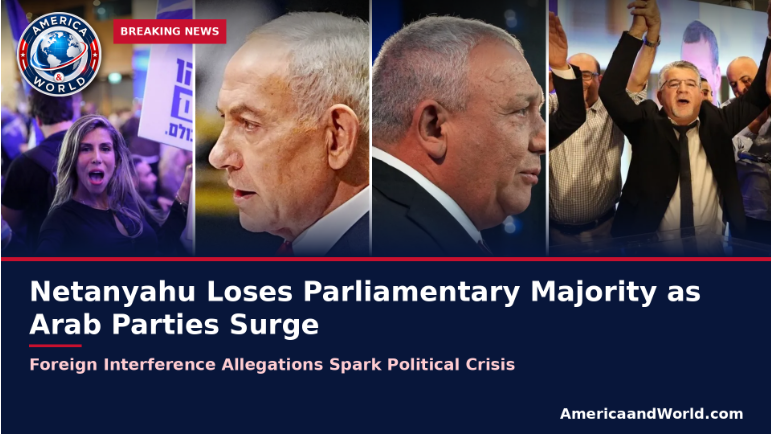
JERUSALEM, October 29, 2026: Israel is facing a period of political uncertainty following Tuesday’s parliamentary election, which left Prime Minister Benjamin Netanyahu without a governing majority and opposition leader Gadi Eisenkot unable to secure enough seats to form a government independently. The historic electoral gains of Arab-led political parties have placed them at the center of coalition negotiations, triggering allegations of foreign interference, accusations of political intimidation and growing disputes over the legitimacy of the election results.
According to the final vote count, Netanyahu’s right-wing and religious coalition secured 53 seats in the 120-member Knesset, eight short of the 61 required for a parliamentary majority. Eisenkot’s opposition bloc won 48 seats, while the Arab-led Joint List and Ra’am parties captured a combined 19 seats, their strongest parliamentary showing to date.
The result represents a significant setback for Netanyahu, whose outgoing parliamentary coalition held 68 seats, but it does not automatically remove him from office. He remains prime minister while political leaders negotiate the formation of the next government.
The composition of the new parliament leaves no straightforward path to power for either major political bloc. Netanyahu must find additional parliamentary support, while Eisenkot would need an agreement involving Arab-led lawmakers or another realignment of political alliances.
The election has also elevated the political influence of Arab citizens of Israel, who account for roughly one-fifth of the country’s population. Their increased turnout contributed to the record gains made by the Joint List and Ra’am.
The political controversy intensified on Thursday when Netanyahu’s Likud party accused Arab-led political groups of benefiting from alleged illegal electoral activities, including voter bribery and foreign financial support.
The accusations followed a request from Supreme Court Justice Noam Sohlberg, chairman of Israel’s Central Elections Committee, for the Shin Bet domestic security agency to examine suspicions of foreign interference.
Likud described the alleged activities as a major political scandal and demanded an immediate investigation. Some coalition figures went further, calling for Arab politicians to be questioned over possible foreign funding.
However, the allegations remain unproven, and Israeli election authorities have challenged claims of widespread electoral wrongdoing.
Acting Central Elections Committee Director General Dean Livne stated that the election had been conducted lawfully and that officials had found no basis for allegations of systematic violations of electoral integrity.
The Shin Bet also emphasized that its investigation is limited in scope and should not be interpreted as an accusation against Arab voters generally.
The investigation has also created diplomatic tensions involving Qatar and Turkey, both of which have been mentioned in allegations concerning possible efforts to influence voter turnout in Arab communities.
Qatar’s Foreign Ministry categorically rejected claims that Doha had financed political activity or attempted to influence the Israeli election.
Foreign Ministry spokesperson Majed Al Ansari described the accusations as politically motivated and accused certain Israeli politicians of using Qatar as a scapegoat for domestic political difficulties.
Turkey separately denied any involvement. Its Center for Countering Disinformation called the accusations unfounded and characterized them as part of a campaign to manipulate public opinion.
No publicly established evidence has demonstrated that either government financed illegal election activities or altered the outcome of the vote.
Gadi Eisenkot, the former Israeli military chief who leads the Yashar party, strongly criticized Netanyahu’s response to the election.
Eisenkot said any genuine evidence of foreign interference should be investigated thoroughly, but warned against using unproven allegations to challenge the legitimacy of the results or delay the installation of the newly elected Knesset.
He accused Netanyahu of conducting a coordinated political campaign intended to discredit the election outcome.
Arab political leaders issued similar objections. Joint List representatives rejected allegations that their electoral gains resulted from illegal funding or manipulation, arguing that the increased vote reflected genuine political mobilization among Arab citizens.
Ra’am leader Mansour Abbas also denied involvement in wrongdoing and expressed willingness to cooperate with investigators.
Israeli President Isaac Herzog intervened in the dispute on Thursday, emphasizing both the need to investigate credible allegations and the importance of respecting citizens who participated legally in the election.
Herzog warned against blaming an entire community for alleged misconduct by individuals. He also appealed to political leaders to approach the upcoming coalition consultations with national interests in mind.
The president is expected to receive the certified election results on November 4 before beginning consultations with parliamentary factions over the formation of a new government.
One of the election’s most significant developments is the rise of Arab-led political parties as potential power brokers.
The Joint List and Ra’am together hold 19 seats. Their parliamentary support could be decisive in determining whether Netanyahu remains prime minister or whether Eisenkot can assemble an alternative government.
A national unity arrangement between Netanyahu and Eisenkot could establish a majority government, although their political differences present substantial obstacles.
Netanyahu could also seek support from lawmakers outside his existing coalition, while Eisenkot could attempt to form a government with Ra’am’s participation and support from the Joint List.
Such an arrangement would require political compromises because several parties in Eisenkot’s bloc have previously opposed cooperation with Arab-led factions.
A survey conducted by Hebrew University’s Accord Center on election night found that 61 percent of surveyed voters supporting four major opposition parties favored an Eisenkot-led government including Ra’am. The poll indicates support for that arrangement among those voters, although it does not establish whether party leaders will ultimately reach an agreement.
Israel now faces a period of potentially difficult coalition negotiations.
Although the vote count has been completed, the formal process of certifying results and appointing a candidate to form the next government is still ahead.
Netanyahu’s coalition has lost its previous parliamentary majority, but the election has not produced an outright victory for Eisenkot. Arab-led lawmakers now hold a potentially decisive position, while disagreements over political cooperation and allegations of foreign involvement complicate negotiations.
An important late-Thursday development came from Israeli television reporting that unnamed Shin Bet sources considered the foreign-interference investigation too limited to affect the election outcome. According to that report, the certified results remain scheduled for presentation to President Herzog on November 4. The investigation itself remains ongoing.
For Netanyahu, the immediate question is whether he can retain power through new political alliances. For Eisenkot, it is whether a fragmented opposition can reach an agreement that produces a workable parliamentary majority.
For Israel’s Arab citizens, the election has brought unprecedented parliamentary representation and increased influence over coalition negotiations.
The outcome will determine not only who leads Israel’s next government but also the composition of a parliament that will confront major domestic, security and regional diplomatic challenges.
As of October 29, 2026, no new governing coalition has been formed, and neither major political bloc has secured the 61 seats required for a parliamentary majority.