Nepal is a country where the politics of lies and misinformation has flourished and those who call themselves “communists” often seem to thrive on it and revel in it.


- By Ram Prasad Khanal
Nepal’s political crisis is not only a crisis of governance, ideology or leadership. It is increasingly a crisis of truth.
For years, a parallel political culture has been taking root alongside the formal contests over policy, development, democracy and public accountability. It is a politics built on accusation, insinuation, conspiracy, half-truth and manufactured outrage.
When a government falls, it is called a conspiracy. When a leader loses influence, it is blamed on a conspiracy. When protesters take to the streets, unseen forces are said to be behind them. When an election result disappoints one side, foreign interference is invoked. Political failures that deserve sober examination are often transformed into dramatic stories about secret deals, foreign agents, traitors and shadowy powers.
Nepal is, of course, a geopolitically sensitive country. It would be foolish to pretend that foreign governments have no interests here, or that external influence never exists. But there is a difference between recognizing geopolitical realities and blaming every setback on invisible hands.
Too often, conspiracy becomes a substitute for evidence.
Nepal’s communist movements have historically relied on a vocabulary filled with terms such as imperialism, expansionism, reactionism and comprador capitalism. That legacy helps explain why conspiracy-heavy political narratives have long found an audience. But today, the problem is no longer confined to the left.
Communists, Congress supporters, royalists, emerging parties, independent political groups and online activists increasingly operate in the same information environment—one in which emotion often travels faster than evidence, and accusation faster than verification.
That is the more troubling reality.
The modern political lie is also becoming more sophisticated.
It is no longer always a complete fabrication. Often, it is a fragment of truth placed in a false context.
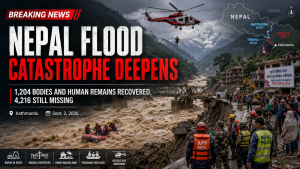
A genuine photograph is given a misleading caption. An old video is presented as new. A sentence is cut from a longer speech and stripped of context. A real event is reframed to suggest something that never happened.
The most effective falsehood, in other words, is often not a lie from beginning to end.
It is a half-truth.
And half-truths can be far more dangerous because they come wrapped in something recognizable and real.
Social media has accelerated this transformation.
Political propaganda once had a visible source: a party office, a newspaper, a rally or an official statement. Today, it may emerge from an anonymous Facebook page, a pseudonymous account, a viral video channel or an influencer whose funding, affiliation and motives remain unclear.
The machinery of political persuasion has become decentralized, faster and harder to trace.
That is why misinformation should not be treated as the exclusive weapon of any one party or ideology. Across Nepal’s political spectrum, leaders and public figures have been targets of false, exaggerated or misleading claims.
The pattern points to something deeper than partisan conflict.
It points to a damaged information culture.
Why does falsehood often outperform truth?
Because truth is complicated.
A lie is simple.
Truth says: The facts are still being investigated.
A lie says: This is exactly what happened.
Truth requires patience, documents and context.
A lie requires a confident voice, a dramatic headline and perhaps a fifteen-second video.
In the economy of social media, certainty is often rewarded more than accuracy.
Human psychology makes the problem worse.
People tend to accept information that confirms what they already believe. An allegation against a disliked politician is easily accepted: “Of course, that sounds like him.” Evidence against a favored leader, however, is quickly dismissed: “This must be a conspiracy.”
At that point, evidence stops being the standard of truth.
Identity replaces it.
Politics becomes divided into “our truth” and “their truth.”
But truth does not belong to a party.
Nor does it carry a political flag.
Few narratives are as politically marketable in Nepal as the claim of a foreign conspiracy.
At various times, India is blamed. At other moments, China, the United States or a foreign embassy is drawn into the story. Some of these suspicions may occasionally raise legitimate questions. But suspicion is not evidence, and geopolitics should not become an excuse for intellectual laziness.
A democracy cannot function properly when every inconvenient fact is dismissed as a plot and every political failure is blamed on outsiders.
The media must also examine its own role.
The race for clicks, shares, advertising and attention has created incentives for speed and sensation. Stories are labeled “breaking” before their importance is clear. Social-media claims are amplified before being verified. Rumor is sometimes repackaged as journalism simply because it is already trending.
When journalism imitates the logic of social media, the public loses one of its most important defenses against manipulation.
Artificial intelligence will make this challenge even more dangerous.
Fake photographs, cloned voices and manipulated videos are becoming easier to produce and harder to detect. A public figure’s voice can be imitated. Authentic video can be paired with fabricated audio. Entire scenes can be generated with extraordinary realism.
The next generation of political propaganda may not be distributed through leaflets, speeches or party offices.
It may arrive directly on a mobile phone.
Yet censorship is not the answer.
Efforts to combat misinformation can themselves become tools of repression if governments use them to silence criticism, restrict free expression or intimidate independent journalists.
The better defense is a stronger democratic information culture: rigorous journalism, independent fact-checking, transparent political communication, digital literacy and citizens willing to question what they see before they share it.
The most powerful question in politics is often the simplest one:
Where is the evidence?
When a dramatic video goes viral, ask: Where is the full recording? When was it made? Where did it come from? Who first published it? Has any credible, independent source verified it?
These questions may seem elementary.
But democracy depends on them.
A lie supporting a leader we admire remains a lie.
A fact benefiting a leader we oppose remains a fact.
That is one of the hardest disciplines of democratic citizenship: rejecting falsehoods from our own side and accepting truth even when it is politically inconvenient.
Nepal does not merely need new leaders, new parties or new slogans.
It needs a political culture capable of facing facts.
If lies, rumors and conspiracy theories continue to serve as political weapons, one party may win an election, one leader may capture power, and one faction may dominate social media.
But the long-term loser will be the country itself.
Truth may be uncomfortable. It may be complicated. It may even be politically inconvenient. But no nation can build a secure future on rumor, manufactured outrage and conspiracy. Nepal’s future will be stronger only when facts matter more than noise, evidence matters more than loyalty, and accountability matters more than propaganda.
-
Writer Khanal is the President of Federation of International Journalist, America ( FIJA )